
Diabetic Eye Exams in Las Vegas: How Often You Need One

TLDR: If you live with diabetes, plan on a diabetic eye exam once a year, starting the year you are diagnosed with type 2. Early diabetic retinopathy usually has no symptoms, so your yearly exam is how you catch it while it is still small.
Answer: Book your diabetic eye exam in Las Vegas once a year. National guidelines call for your first exam at the time of a type 2 diagnosis and five years after the onset of type 1. Any retinopathy means yearly visits or more. Your exam checks your retina, documents it with imaging and sends the findings to your diabetes doctor.
Diabetes often shows up in your eyes first. It damages the tiny blood vessels inside your retina long before you notice blur. That is why I treat your yearly visit as preventive care, not a glasses check. As an optometrist in Downtown Summerlin, I make diabetic eye exams the core of the medical eye care I give you.
This guide gives you the schedule the guidelines set, what happens in the chair, how coverage works and when a finding needs a specialist. I reviewed 27 primary sources across five research lenses for this guide, and every clinical guideline I read agreed on one point: once retinopathy shows up, your retina needs a dilated exam at least once a year. Read on and you will know exactly when to book your next visit.
How Often Do You Need a Diabetic Eye Exam?

The American Diabetes Association sets the schedule most doctors follow. Its 2026 Standards of Care call for your first dilated, comprehensive exam at the time of a type 2 diagnosis. With type 1, your first exam comes five years after onset. After that, your findings set the pace, and the ADA names an ophthalmologist or an optometrist to do the work.
| Your situation | Guideline timing |
|---|---|
| Newly diagnosed type 2 diabetes | First dilated, comprehensive exam at diagnosis |
| Adult with type 1 diabetes | First dilated exam 5 years after onset, then yearly |
| No retinopathy on one or more yearly exams, glucose at goal | Every 1 to 2 years, only if your eye doctor agrees |
| Any level of diabetic retinopathy | At least once a year, often more |
| Type 1 or type 2 diabetes and planning a pregnancy | Before pregnancy and in the first trimester, then as your doctor directs |
| Gestational diabetes only | No routine eye exam during pregnancy per the ADA |
Read the third row carefully. The one-to-two-year option applies only after normal yearly exams and with your glucose in the goal range. The American Academy of Ophthalmology, the American Optometric Association and the National Eye Institute all keep you on a yearly schedule, and Medicare covers one exam a year. My advice is simple: plan on once a year unless your history earns you a longer gap.
Children with type 1 diabetes have their own schedule. The ADA recommends a first dilated exam once your child has had type 1 diabetes for three to five years, provided your child is 11 or older or puberty has started. Put that date on your family calendar the day you hear the diagnosis.
Why Diabetic Retinopathy Hides Without Symptoms

Diabetic retinopathy starts quietly. High blood sugar weakens the small vessels in your retina until they leak or close off. The National Eye Institute states the early stages usually have no symptoms. You read the eye chart perfectly and still carry damage in the back of your eye.
What Diabetic Macular Edema Means for You
Diabetic macular edema, or DME, happens when those vessels leak fluid into the macula, the part of your retina you use for sharp central vision. About 1 in 15 people with diabetes develop DME over time, per the National Eye Institute. It blurs your reading, faces and road signs. Your exam looks for it every single time.
How Common Is It in Nevada?
About 346,000 Nevada adults, or 12.2 percent, live with diagnosed diabetes, according to the American Diabetes Association’s Nevada report. Across the country, a CDC-led study in JAMA Ophthalmology estimated 9.6 million people lived with diabetic retinopathy in 2021, about 26 percent of everyone with diabetes. The same study estimated about 1 in 5 for Nevada. Your own risk is personal, so your yearly exam matters more than any state average.
Many Nevadans with diabetes skip the visit. A CDC report found only 48.8 percent of Nevada Medicare beneficiaries with diabetes had an eye exam in 2017, one of seven states under half. Put your next exam on your calendar today.
What Happens at Your Diabetic Eye Exam in Las Vegas
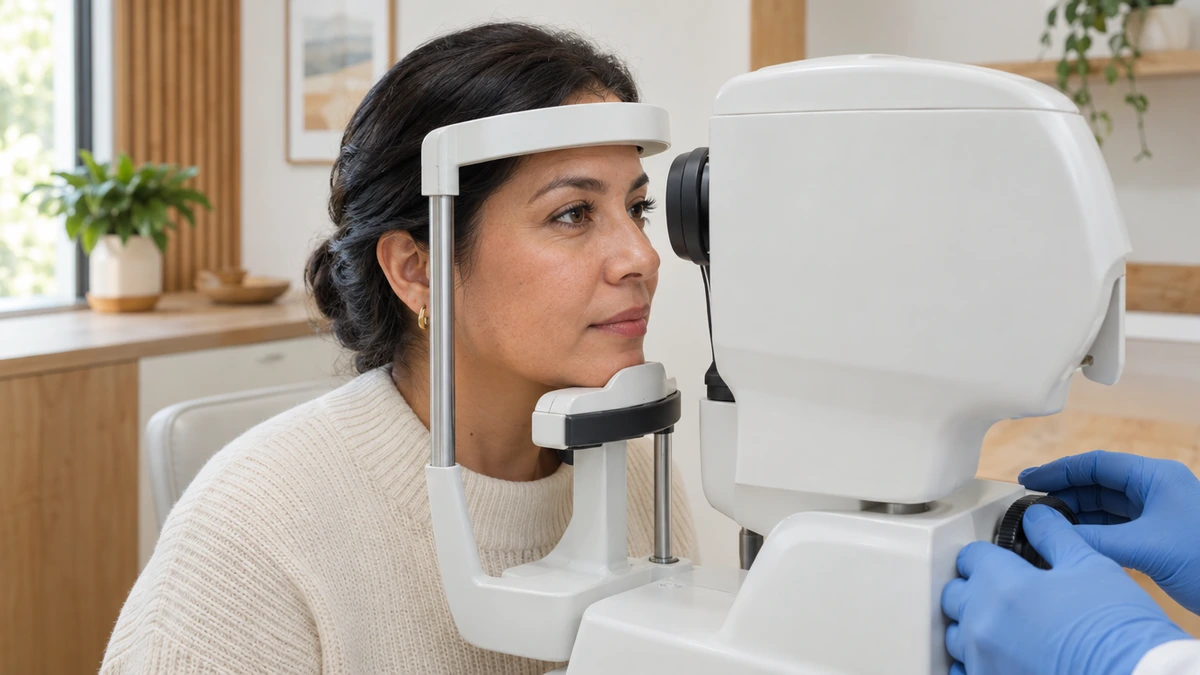
Your visit starts with your history. Bring your latest A1C, your medication list and the name of your primary care doctor or endocrinologist. Tell me if you recently started or changed a diabetes medicine that lowers your blood sugar fast, because the American Academy of Ophthalmology notes rapid, tight control sometimes brings early worsening of retinopathy. Your history shapes everything I look for.
Next comes measurement. Visionix digital diagnostics capture your refraction, your eye pressure and your retinal imaging in minutes. That image is a detailed photograph of your retina, optic nerve and blood vessels. I compare it with your earlier images year over year, which is how small changes get caught while they are still small.
Then I examine your retina closely. You get a dilated exam when I see a medical reason for one, and I explain that choice at your visit. Bring sunglasses in case your pupils are dilated, since bright Las Vegas light feels harsh while they recover.
Your findings then travel to the right people. The ADA and the AOA both say your eye results belong with the doctor who manages your diabetes, even when your retina looks healthy. Tell my team who that doctor is, and we share your results with your primary care physician or endocrinologist.
Dilated Exam or Retinal Imaging: What the Guidelines Say

You will hear about camera checks at primary care offices and AI screening tools. They have a place. The ADA calls photography programs an appropriate screening strategy, but only when they include a path to a full comprehensive eye exam, and it states retinal photographs are not a substitute for dilated comprehensive eye exams. Screening sorts people, and your comprehensive exam answers the question.
The limits are real. In a national program covering 17,526 patients, undilated multi-field photos were ungradable for 26.9 percent of them. The main trial of an autonomous AI system reported 87.2 percent sensitivity for more than mild retinopathy, so roughly 1 in 8 cases slipped past it. Treat a camera check as a reminder and keep your yearly exam on your calendar.
When You Need a Retina Specialist
As your optometrist, I examine, diagnose, monitor and document your diabetic eye disease. Nevada law does not let an optometrist perform laser, scalpel or needle procedures, so laser treatment and injections happen with a retina specialist. The ADA calls for prompt referral to an ophthalmologist for any macular edema, moderate or worse nonproliferative retinopathy or any proliferative retinopathy. If your exam shows those findings, I refer you quickly and stay part of your care.
Symptoms That Need a Call Today
Some changes will not wait for your yearly visit. Call (702) 858-4362 right away if you notice any of these:
- New dark floaters or spots that look like cobwebs
- Flashes of light in your vision
- A curtain or shadow over part of your view
- Sudden blur that stays after you blink
- Blur in your central vision that makes reading or faces hard to see
For a sudden loss of vision, or any of these after hours, go to your nearest emergency room or call 911. Your sight is worth the trip.
How Coverage Works for Your Diabetic Eye Exam
Coverage follows the reason for your visit. Prevent Blindness explains which plan pays generally depends on why you came in. A diabetic eye exam is a medical visit, so it usually runs through your medical insurance rather than your vision plan. Your routine glasses check stays with your vision plan.
Medicare follows the same logic. Medicare Part B covers an eye exam for diabetic retinopathy once a year if you are eligible, and you pay 20 percent of the approved amount after your Part B deductible. Original Medicare does not cover routine exams or refractions for glasses. Some Medicare Advantage plans add vision benefits, so check yours before you book.
My team accepts Anthem, Aetna, UMR, Medicare, Humana, United Healthcare, AARP, Tricare, EyeMed, Spectera, Davis, VSP and Nevada Medicaid. We verify your plan by phone before your visit. You walk in knowing what to expect.
Why Book Your Diabetic Eye Exam at Vision by Amel?
You get a doctor who reads your retinal images herself and compares them with your last visit. My boutique sits at 2010 Festival Plaza Dr, Suite 195, in Downtown Summerlin, open seven days a week. Your Visionix images stay in your record year over year, so I compare your retina against itself. Your results go to the doctor who manages your diabetes.
Book now if your last diabetic eye exam was more than a year ago. Bring your medication list, your insurance cards and sunglasses. Learn more about Dr. Amel and the boutique, browse the full Diabetes and Eye Health guides or see what a comprehensive digital eye exam includes. Protecting your eye health starts with one appointment this year.
Frequently Asked Questions
Does Medicare cover a diabetic eye exam?
Yes, if you are eligible. Medicare Part B covers one exam for diabetic retinopathy each year, and you pay 20 percent of the Medicare-approved amount after your deductible. Your routine glasses exam is a separate service that Original Medicare does not cover.
Is a retinal photo enough for a diabetic eye exam?
A photo screens your retina, and a comprehensive exam diagnoses it. The American Optometric Association states a retinal photo review does not replace a comprehensive eye examination. Use a primary care camera check as a prompt to book your full visit.
Do I need an ophthalmologist for a diabetic eye exam?
No. The ADA names an ophthalmologist or an optometrist for your yearly diabetic eye exam. If your exam shows macular edema or advanced retinopathy, your next step is a retina specialist for treatment, and your optometrist coordinates that referral.
I have diabetes and I am pregnant. When should my eyes be checked?
If you had type 1 or type 2 diabetes before pregnancy, the ADA recommends an eye exam before pregnancy and in your first trimester, with monitoring possible every trimester and for a year after birth. Gestational diabetes alone does not call for eye exams during pregnancy. Tell your obstetrician and your eye doctor about any new blur right away.
Will my results go to my endocrinologist?
Yes, when you tell my team who manages your diabetes. The American Optometric Association recommends informing your primary care physician after every exam, even when your retina shows little or no retinopathy. Shared results keep your whole care team working from the same picture.
Does treatment reverse diabetic retinopathy?
Treatment from a retina specialist works best when your retinopathy is found early. The National Eye Institute notes treatment helps keep damage from getting worse, though it does not undo vision you have already lost. That is the strongest reason to keep your yearly exam.
Book My Eye Exam Call (702) 858-4362
Like this article? Add Vision by Amel as a preferred source, and you are more likely to see our articles in Google’s Top Stories.
