
Color Blindness in Children: Signs, Testing and School Tips
TLDR: Repeated color mix-ups deserve attention: color blindness in children usually means difficulty telling certain colors apart. An eye exam helps identify what your child sees, while clear labels and classroom changes make color-based tasks easier to follow.
Answer: Color blindness in children usually shows up as the same color mix-ups, again and again, often while your child is learning colors. In Las Vegas, an eye exam with a color vision test tells you what your child sees. Inherited color blindness has no cure and lasts for life, yet simple school changes help. A new change in color vision needs an eye exam promptly.
Your child reaches for a brown pencil when the worksheet asks for green. You explain the instruction again, yet the same mix-up returns tomorrow. As an optometrist, I read a repeated mix-up as a clue, never as careless work. A comprehensive eye exam gives us a place to investigate, and our eye exams page explains the visit.
I reviewed 168 primary sources across five research lenses for this guide, and inherited color vision deficiency is lifelong. The National Eye Institute recommends testing when your child struggles to learn colors or has a family history of color vision deficiency. For parents in Summerlin, those details help me understand what prompted your visit. Good children’s vision care starts with understanding the task your child finds hard.
What Signs Suggest Color Blindness in Children?

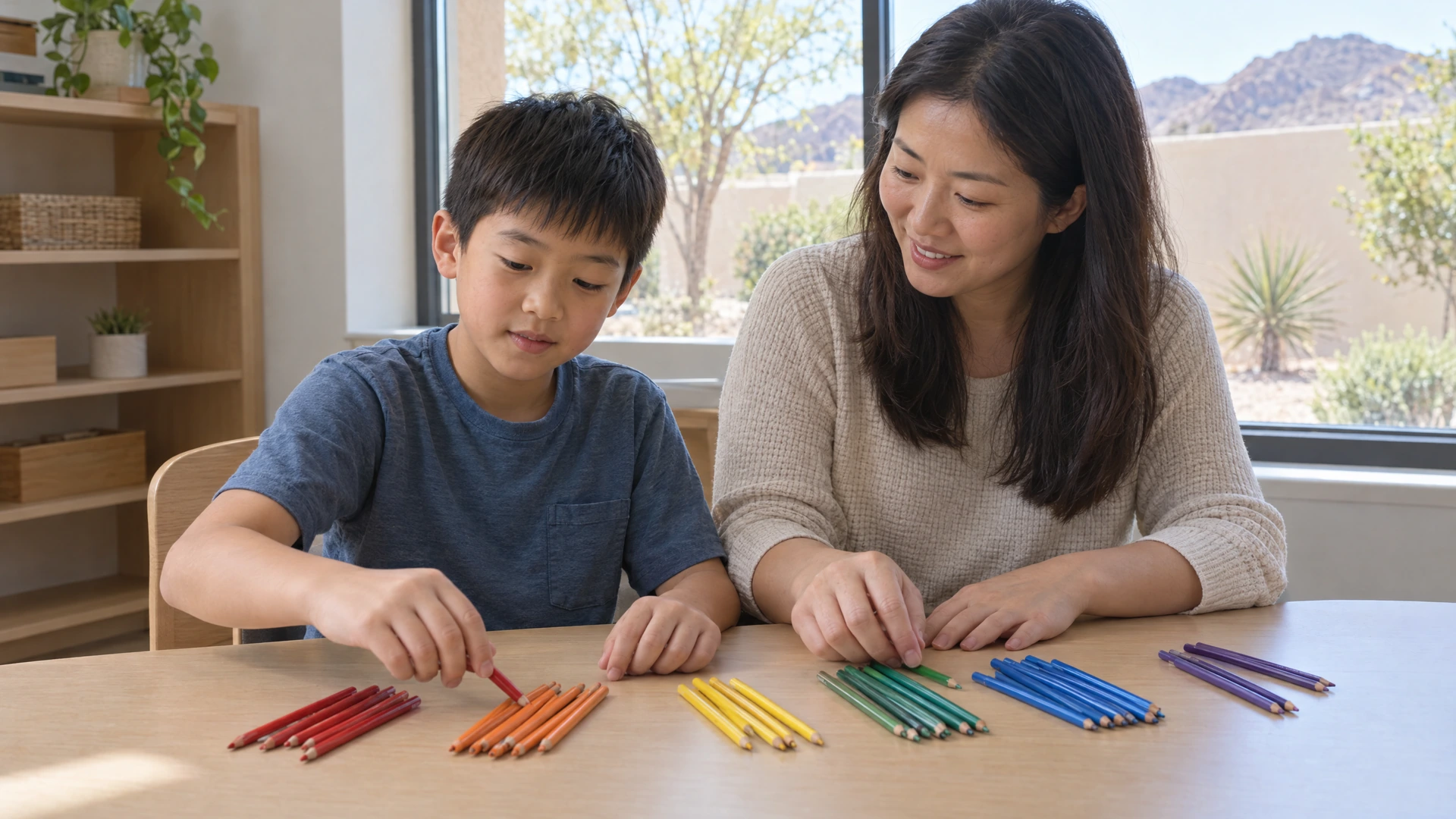
One mix-up means nothing. A pattern means something. You ask for a green apple at the Las Vegas grocery store after school pickup, and your child hovers between the red and the green. Point to the right one, keep shopping, and watch whether the same pair trips your child up with pencils, socks or worksheets.
Unusual coloring choices are a possible clue: AAPOS describes children drawing orange grass or a purple sky, and notes that most people with a color deficit still see some colors and often do not know they see differently. Let your child tell you about the drawing. Start with a neutral question about the picture. Let your child explain whether the choice was deliberate or whether the pencils looked alike.
- Which colors trip your child up, again and again?
- Did the mix-ups start early, or are they new?
- Does anyone in the family have color blindness?
- Do they show up in color-coded schoolwork?
Leave room for creativity. Your child is allowed to invent orange grass without defending it. I would rather hear about a repeated difficulty than judge a child by a drawing. Let the picture stay play, so every art project does not become another test.
What Does Color Blindness in Children Mean?
Color vision deficiency is the more precise name. Your child sees color and uses the same color words you do, yet some pairs of shades look alike. The term describes a difference in perception, never a lack of effort from your child.
Inherited red-green deficiency is more common in boys because it passes through the X chromosome, as the National Eye Institute explains. Other inherited types, including blue-yellow and complete color vision deficiency, affect the sexes equally. Your daughter’s repeated color confusion needs attention too. Sex alone does not settle the question.
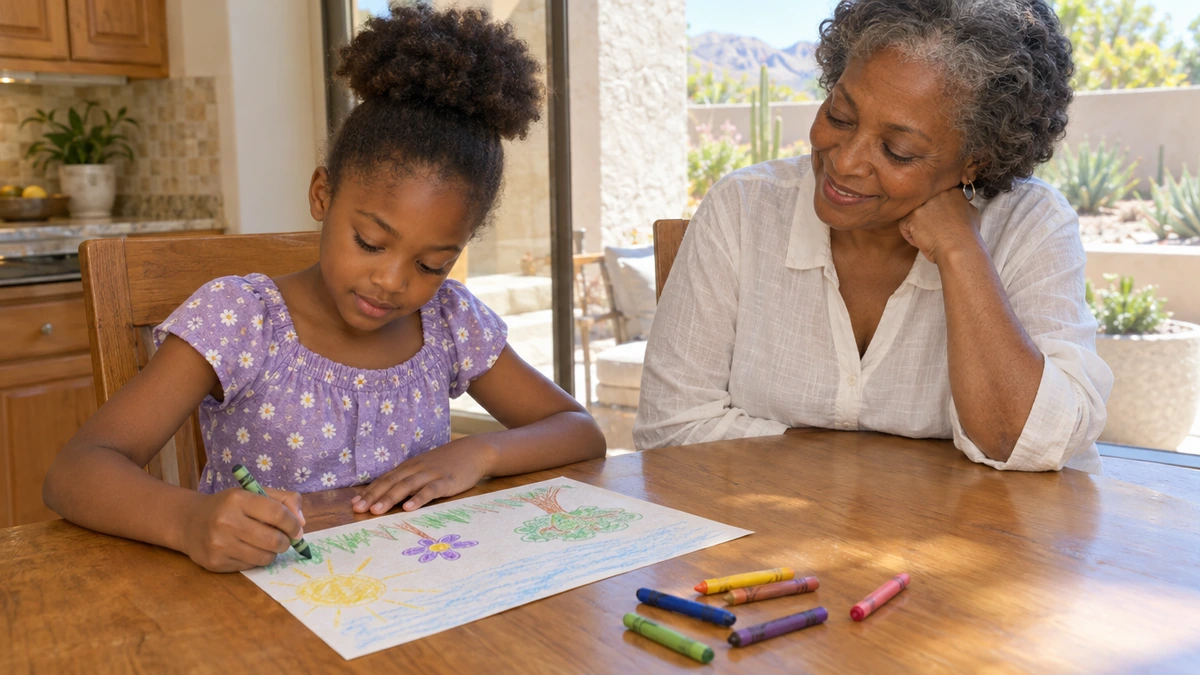
Inherited color differences remain stable throughout life. You do not need to turn practice with color names into a daily drill intended to change them. At a sunny Summerlin kitchen table, let your child describe the picture they are drawing before you sort the crayons together. Use the activity to learn which materials need clearer identification.
How Is Color Vision Tested?
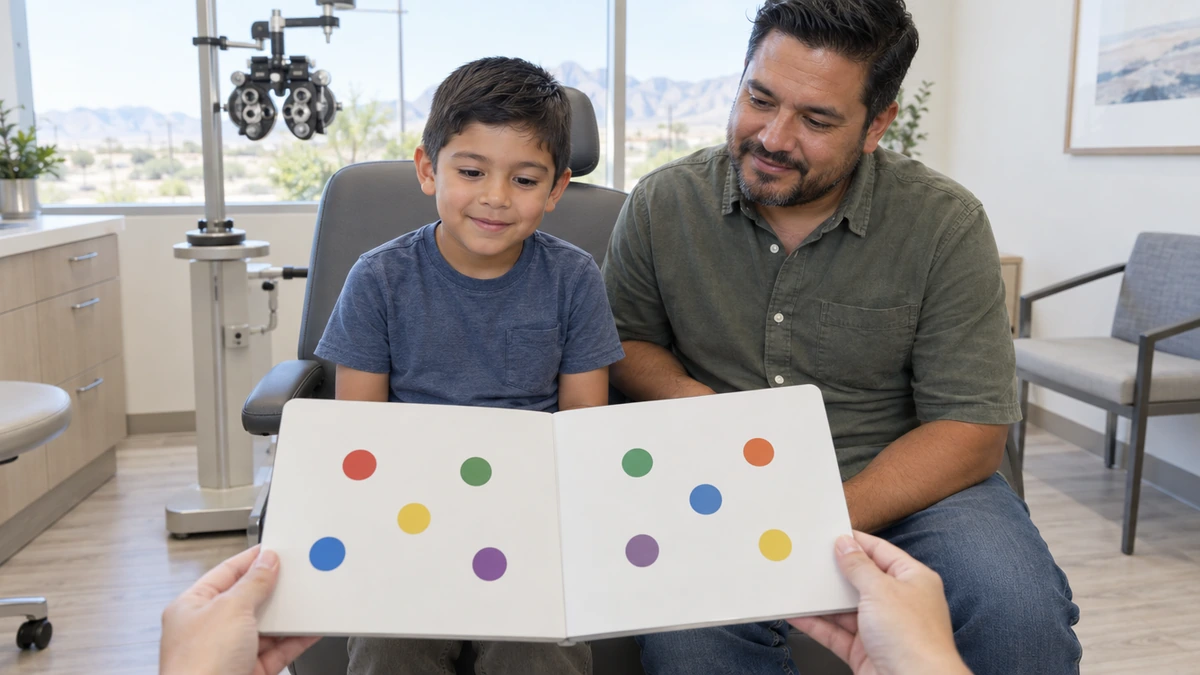
A color vision test asks about color differences directly. The National Eye Institute describes a plate test with a shape hidden among colored dots, followed by other tests when results are unclear. Your child’s task is to describe what they see. There is no benefit in rehearsing the answers.
Open your child’s pediatric eye exam with the color question. Name the exact task: the crayon, the colored chart, the sorting game. What did your child do before you stepped in? One real example tells me more than a general worry about colors.
A home color check raises a question, never a final diagnosis. Age matters too. In the MEPEDS study, only 17% of children younger than 37 months finished a color test, against 98% at 61 to 72 months, so a toddler’s shaky result is not a diagnosis. Our guide to school screening and a comprehensive exam explains what a school screening covers, and what to expect at your child’s first exam walks you through the visit.
What If Colors Suddenly Look Different?
A new change in how your child sees color is a different problem from inherited color blindness, and it needs an eye exam promptly. The American Academy of Ophthalmology says anyone with a significant change in color perception should see an ophthalmologist, because an acquired change sometimes signals a more serious condition. I check for the cause and refer you to an ophthalmologist when your child needs one. Never explain it away as the color difference a relative has.
Acquired changes come from other causes, including some diseases, some medicines and injury to the retina, optic nerve or brain, and the National Eye Institute says the doctor then treats the condition behind the change. Share when your child first noticed it, whether it affects one eye or both, and any recent illness, injury or new medicine. That timeline points the exam in the right direction.
Color and sharpness are separate jobs. Blur, squinting at the board or headaches each need their own answer for your child. A known color difference never explains away a new eye complaint.
How Do You Make School and Daily Life Easier?
Give your child another way to identify things. AAPOS recommends informing teachers, labeling coloring tools and using black ink on white reading paper. Start with the materials your child already uses. The changes below put those principles into everyday tasks.
| Color-Based Task | Practical Adjustment | Example to Try |
|---|---|---|
| Choosing pencils or crayons | Add readable color names | Label the green pencil so your child has a written cue. |
| Reading a worksheet | Use black text on white paper | Replace pale colored instructions with a clear black printout. |
| Following a chart | Add names or distinct patterns | Identify a group by its name as well as its colored box. |
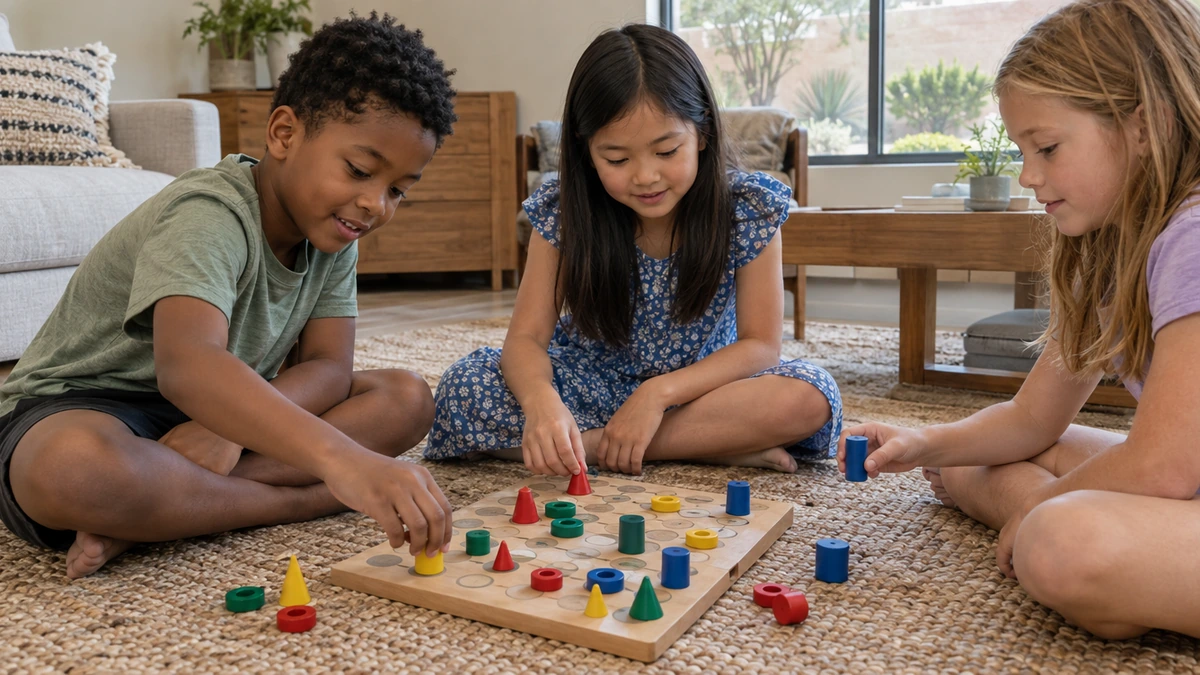
| Playing a board game | Choose pieces with different shapes | Let your child use the cone while another player uses the ring. |
| Finding a school folder | Add a subject label | Write the subject on the front instead of relying on folder color. |
Hand the teacher the worksheet that tripped your child up. Point to the color cue, agree on a word or a shape to replace it, and the fix is done. I want classroom instructions to reward understanding rather than color guessing.
- Share the confirmed color vision finding with your child’s teacher.
- Review an actual task together, including its key or instructions.
- Add words, shapes or patterns wherever color carries the answer.
- Check back with your child about which changes help them follow the task.
Use the same approach at home. On the living room rug, choose game pieces by shape and let your child name their piece before play begins. During a Summerlin school morning, identify the homework folder by its subject label instead of calling across the room for the red one. These are practical ways to make instructions clearer, with no promise about grades.
How I Approach Color Vision Concerns at Vision by Amel
Your examples belong in the history. At Vision by Amel, my evaluation includes binocular vision, a color vision test where needed and eye disease screening. My Visionix digital diagnostics back up that evaluation, and I explain each finding to you in plain language. The visit connects your concern with a plan for your child’s eye health.
You do not need to arrive with a diagnosis. Bring the work sample, your observations and any relevant family history. My team and I offer eye care for children, and a color concern is worth mentioning when you book. For a routine exam about longstanding color mix-ups, no referral is needed.
Your visit is at 2010 Festival Plaza Dr, Suite 195, Las Vegas, NV 89135, inside Festival Plaza at my Downtown Summerlin office. Book online or call (702) 858-4362, and name color vision as the concern so I know what brought you in.
Frequently Asked Questions About Color Blindness in Children
How Do I Know If My Child Is Color Blind?
Repeated mix-ups while your child learns colors, or a family history of color blindness, are reasons to test, says the National Eye Institute, and some children hide the difficulty. Color blindness rarely blurs vision: except in the most severe form, sharpness stays normal, the American Academy of Ophthalmology notes. A child who squints at the board needs a separate check.
How Common Is Color Blindness in Boys and Girls?
In the MEPEDS study of Southern California preschoolers, color vision deficiency showed up in 1.4% of Black boys, 3.1% of Asian boys, 2.6% of Hispanic boys and 5.6% of non-Hispanic white boys. Red-green color blindness is rare in girls, because a girl needs the gene on both X chromosomes, the National Eye Institute explains, while blue-yellow and complete types affect boys and girls equally. These are study figures, not Las Vegas rates or a forecast for your child.
Can Color Blindness Be Cured?
No cure exists for inherited color blindness, the National Eye Institute says, and most people adjust to it, with no trouble in everyday activities. When another health problem causes a change in color vision, the doctor treats that cause. For your child, put the effort into the tasks that rely on color.
How Do Eye Doctors Test Kids for Color Blindness?
Eye doctors use a color plate test, a shape hidden among colored dots, and add other tests when the result is unclear. By about age 4, most children are able to finish a color test, the MEPEDS study found, so a preschool exam is a good time to check your child. A recent drawing or worksheet that shows the mix-up helps too.
How Can I Help My Color Blind Child at School?
Share the finding with adults who teach your child beyond the main classroom, including art and physical education teachers. Review instructions for group assignments and activities as well as reading pages. A group name, spoken direction or distinct shape gives your child another way to follow along.
Book My Eye Exam Call (702) 858-4362
Like this article? Add Vision by Amel as a preferred source, and you are more likely to see our articles in Google’s Top Stories.
