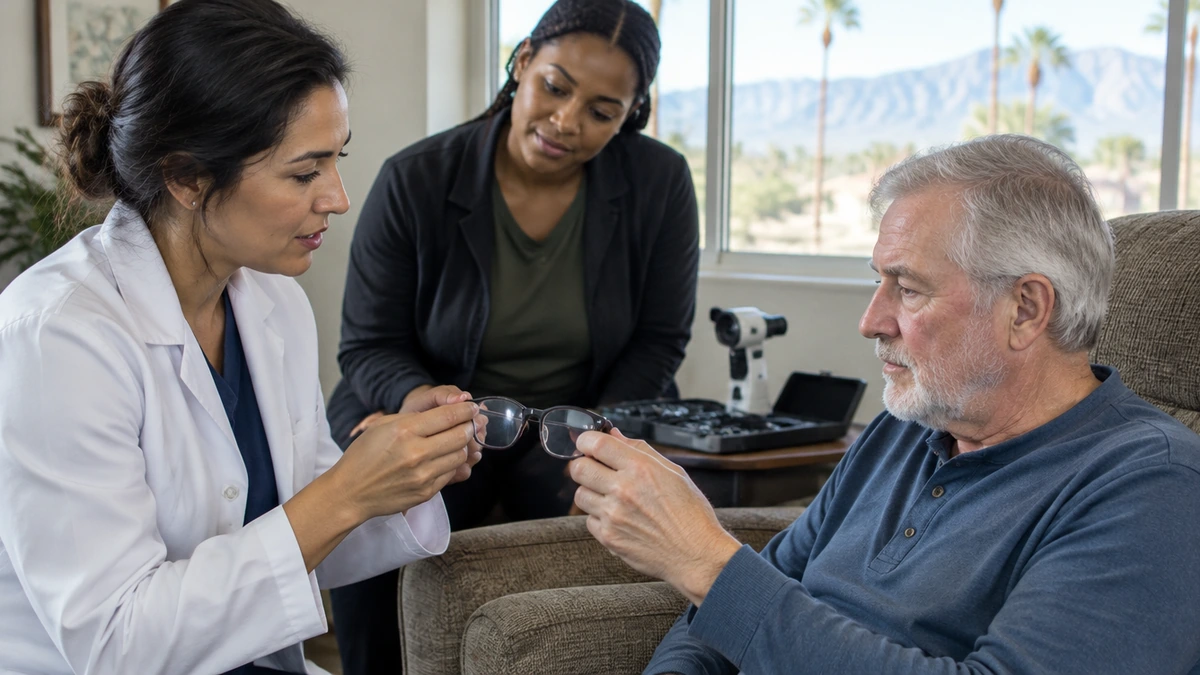
Tag: current glasses

  • What Information Is Needed Before an Assisted Living Eye Exam?
    What Information Is Needed Before an Assisted Living Eye Exam?

    What Information Is Needed Before an Assisted Living Eye Exam?

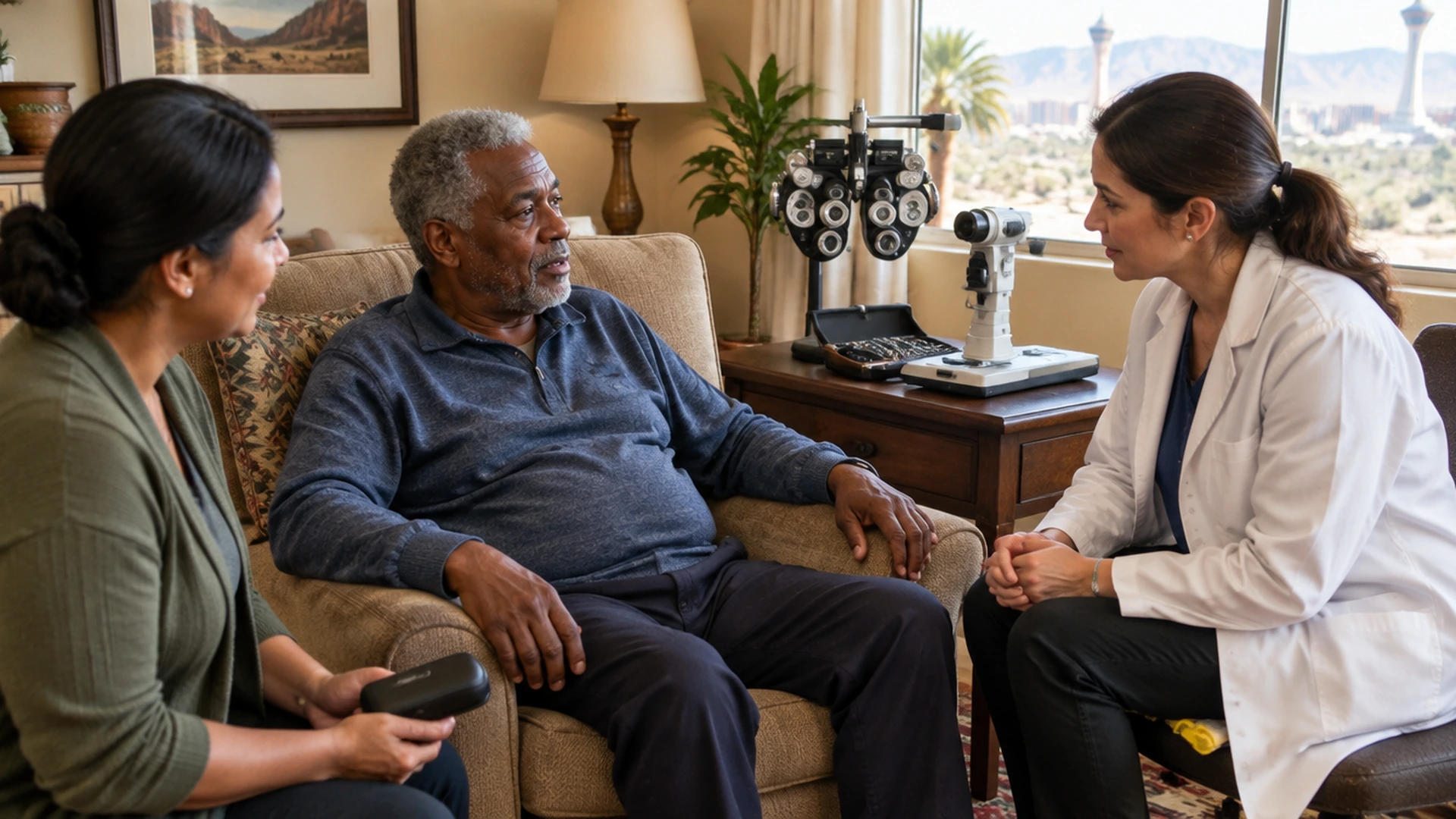
    Resident, caregiver, and eye doctor preparing for a visit for documents needed for senior eye exam

    TLDR: Gather the documents needed for senior eye exam registration before setting your resident schedule. Gather identification, current insurance cards, health history, medication details, existing glasses, and consent or representative records. Use my team’s current forms and secure intake method.

    Answer: Before an assisted living eye exam in Las Vegas, gather your resident’s current identification, insurance cards, health and medication history, glasses, and consent records. Include current guardian or healthcare representative documents when needed. My team and I use those records to prepare your visit, verify benefits before service, and handle health information securely.

    For example, your resident is ready for the visit. The medication list is in the care record, the insurance card is with a family member, and the glasses are in a bedside drawer. Give those tasks an owner before the appointment reaches the calendar.

    Give the paperwork a named owner. For assisted living eye exams, your contact gathers current records and gets them to my team before the visit. Start your assisted living vision day with voluntary interest and my team’s current intake forms. Keep missing items visible until someone supplies the answer.

    Documents Needed for Senior Eye Exam: What Belongs in the Packet?
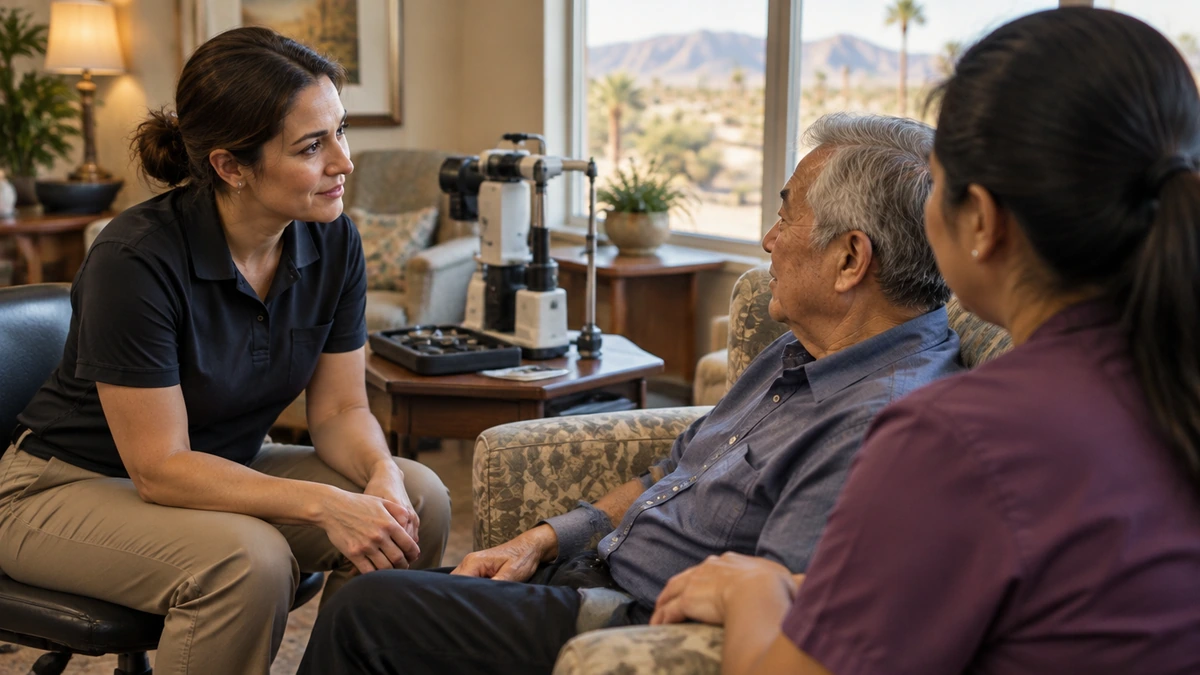
    Eye doctor greeting a resident and caregiver for documents needed for senior eye exam
    Coordinate the intake handoff before the appointment.

    Make your packet easy to read. Keep identity, insurance, health history, and permission records in clearly identified sections, with the current medication list ready to find. As your visiting optometrist, I ask you to collect the requested details. Leave unrelated records out of the packet.

    Preparation itemWhat to assembleYour check before sending
    IdentificationResident’s current identifying details and requested identificationMatch the name and date of birth across records.
    InsuranceCurrent medical and vision cards or requested plan informationAsk whether any card has been replaced.
    Health historyRelevant eye conditions, procedures, and current concernsIdentify where each item came from.
    Medication listCurrent list, eye drops, and recorded allergiesConfirm which version is current.
    GlassesPairs in use and available prescription recordsNote the purpose of each pair.
    Consent and authorityRequested consent forms and applicable representative documentsCheck completeness and arrange my review.
    Follow-up contactsResults recipients and ways to reach themConfirm who handles the next action.

    Mark missing items plainly in your preparation record. Write unknown when a date or detail is unavailable, then assign someone to seek the answer. An honest gap gives my team a useful question, while a guessed date looks like a settled fact.

    Keep resident records off the public form. Your facility name, type, address, contact details, approximate resident count, interest level, and preferred month belong there. Patient names, cards, diagnoses, and medical histories go through my team’s secure intake method. A scheduling form is for planning the visit.

    How Should You Gather Identification and Insurance Information?

    Resident and coordinator talking with an eye doctor for documents needed for senior eye exam
    Confirm the resident information requested by my team.

    Match your names before sending. Check spelling and date of birth against the current insurance card, especially when a resident uses a different preferred name. Include the identification requested on the intake forms. Flag an unavailable item for my team rather than filling its place with a guess.

    Send the cards currently in use. Gather your resident’s Medicare, Medicaid, Medicare Advantage, or other plan details, including a separate vision card when present. I verify benefits before service. Copy the exact plan name and contact details from the card.

    Send your resident’s actual payer information. CMS distinguishes partial-benefit and full-benefit dual eligibility, so the label alone does not establish full Medicaid ocular benefits. Keep those details ready for the benefit review rather than relying on a label in the care record. The Medicare and Medicaid eye care guide helps you prepare questions about the exam.

    Give each missing card an owner. Your resident or representative needs a clear request for the card they hold and a next contact. If a replacement is pending, tell my team which information is available. Keep the remaining residents’ visit preparation moving.

    What Health History, Medication Details, and Glasses Help?
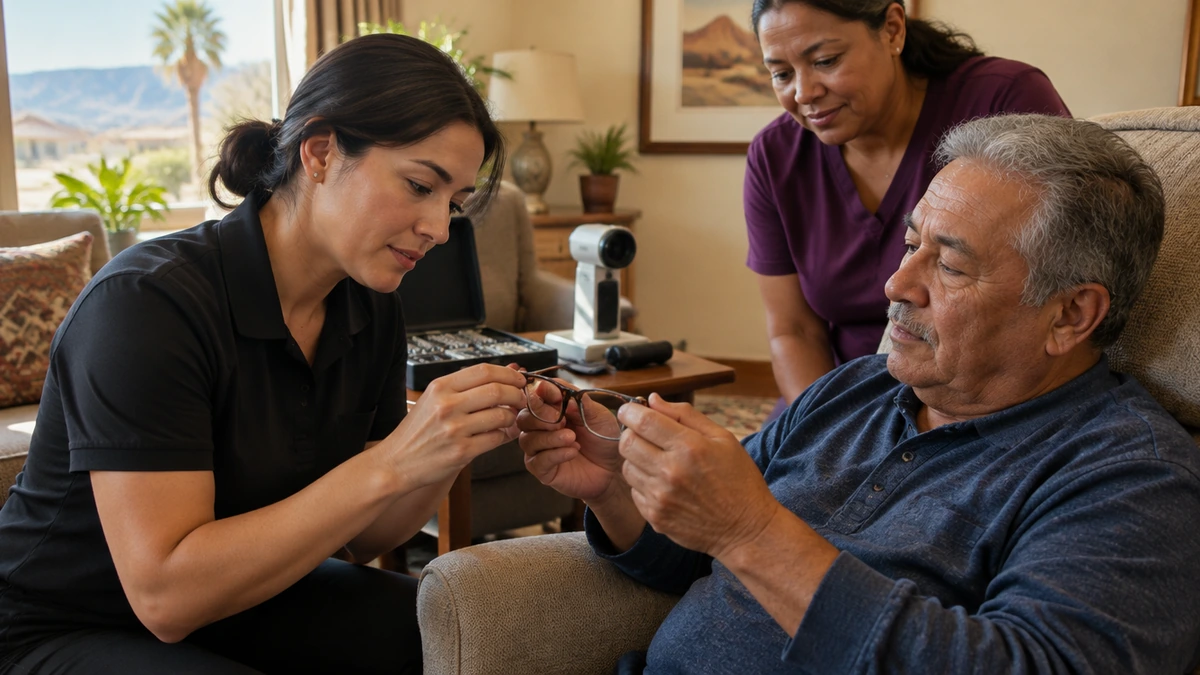
    Eye doctor looking at a resident’s current glasses for documents needed for senior eye exam
    Bring the glasses the resident uses.

    Lead with your resident’s concern. Include documented cataracts, glaucoma, diabetic retinopathy, macular degeneration, or dry eye when relevant to my review. Place the resident’s words beside staff observations. Both belong in the history.

    Write what your caregiver saw. For example, a resident moves closer to the television, stops reading a favorite magazine, or needs help finding glasses. Record the change and when staff noticed it. I interpret what it means for eye health.

    Send the current medication list. Include your resident’s recorded allergies and eye drops, with the name of the person who keeps the list up to date. Flag an older version supplied by the family. Resolve the difference in the care record before sending the packet.

    Bring your resident’s glasses, including reading glasses and other pairs still in use. Note which pair the resident chooses for reading, television, or moving around the home. Include an available prior prescription or examination report, and say when its date is uncertain.

    Keep the current frames within reach. For your Nevada Medicaid adult eyewear questions, the ocular manual generally conditions lens replacement on significant refractive change and calls for existing frames to be reused when possible. Gather the glasses and known replacement history for review before discussing new prescription eyewear. Add missing details to the intake question list.

    Describe how your resident takes part. Note the wheelchair, the request for a familiar caregiver, or the need for slowly spoken instructions. Put those details in the packet and review them with my team. Leave testing decisions and visit length to the examination plan.

    Which Consent and Representative Records Should You Check?

    Resident and family member speaking with an eye doctor for documents needed for senior eye exam
    Arrange the consent and representative conversation.

    Keep your resident’s choice visible. Use my team’s current consent forms and instructions, with time for the resident’s questions before signing. An interest list helps plan the room and schedule. Consent concerns the person receiving care.

    When reviewing your resident’s healthcare power of attorney, Nevada law makes the document effective when executed unless it specifies a future date or incapacity trigger, with the latter requiring the statutory written or recorded determination. Supply the complete current document for my review of representative authority. Flag activation language, missing pages, and unresolved contact details before requesting a signature.

    For your resident with a guardian, Nevada law authorizes a guardian of the person to approve medical care unless the court orders otherwise and identifies that guardian as the protected person’s HIPAA personal representative. Provide the current court order for review. Record any later documents or competing authority claims and bring them to me before the examination.

    Flag overlapping documents early. Your coordinator needs to identify an existing healthcare power of attorney when guardianship papers arrive, because appointment of a Nevada guardian of the person suspends an existing durable healthcare power of attorney. Send the documents for my review before selecting a signer. The resident consent coordination guide helps you organize the unresolved questions.

    Documents Needed for Senior Eye Exam: How Should You Transfer Them?

    Choose the recipient before sending. Establish your secure intake method, the member of my team receiving the packet, and how receipt is recorded. Keep paper copies in a locked folder while staff prepare the handoff. Leave resident records out of the public marketing form and shared activity messages.

    Send records for the care requested. For your handoff to me, HIPAA permits a covered entity to use or disclose health information for its own treatment, payment, or healthcare operations and to disclose it for another provider’s treatment activities. Follow the approved access process and include the information my team needs. Treat a relative’s request for results as a separate communication task.

    I reviewed 69 primary sources across five research lenses for this series, and permitted family disclosures are limited to information directly relevant to the person’s involvement in care or payment. Check your intended recipient and permission before sending the family update. Write the contact and agreed way to reach them in the restricted record. The staff member handling results needs that answer before the phone call.

    1. Use my team’s current forms and secure intake method.
    2. Assign collection tasks to the resident, representative, or appropriate staff member.
    3. Check identity, current versions, and missing information.
    4. Send the requested packet through secure intake.
    5. Confirm receipt and resolve my team’s outstanding questions.
    6. Record who will receive findings and arrange follow-up.

    Name your follow-up contact before the exam. A published Canadian facility optometry program tracked follow-up timing and sent examination reports to residents’ family physicians. For your vision day, record who receives reports, arranges referrals, and checks pending appointments. Put those names beside the tasks in the resident’s care record.

    Prepare Your Facility’s Vision Day With Vision by Amel

    Plan your vision day with me. I am Dr. Amel Youssef, OD, founder of my practice, Vision by Amel, in Downtown Summerlin. I bring on-site eye care to assisted living homes, Residential Facilities for Groups, memory care communities, adult day care programs, and senior living communities across the Las Vegas Valley. Start with your resident list. Review the practice’s eye examination services while preparing the visit and resident questions.

    You begin with voluntary resident interest, consent, representative authority, and secure transfer of requested records. Arrange a private room with electrical access and agree on the examination schedule. I verify insurance benefits before service, and participation remains voluntary. Benefits depend on each resident’s eligibility and plan terms.

    Plan past your paperwork handoff. Use this list and my team’s current preparation materials during the planning call. My team and I coordinate eyeglass selection, measurements, delivery, adjustments, and follow-up responsibilities with you. I arrange referrals for care beyond the on-site visit.

    Frequently Asked Questions About Preparing Eye Exam Information

    What if the resident has no previous eye examination report?

    Mark the prior report as missing in your packet. Record the previous eye doctor’s name if the resident or representative remembers it, then request the report through the records process. A missing copy does not mean the resident has never been examined.

    Should we send the resident’s entire facility record?

    Send the records requested for your resident’s visit. Keep unrelated administrative material out of the examination packet and use my team’s secure intake method. Include a staff contact for additional records requests.

    What if the family brings glasses after the packet was sent?

    Add the arriving glasses to your handoff note. Identify the pair and keep it with the resident’s visit belongings where staff will find them. Preserve the earlier note and explain what changed.

    What if medication information changes on examination morning?

    Give me the corrected list before your resident’s exam. Identify the staff member who verified it and clearly mark the earlier copy as replaced. Follow my team’s intake instructions for sending the updated record.

    How do we keep several residents’ packets from getting mixed up?

    Check your resident’s name against every item before sending the packet. Match the contents to the intended resident and recipient using the approved identification process. Keep a restricted receipt log showing which packets still need attention.

    Schedule an On-Site Vision Day Speak With Dr. Amel’s Team: (702) 858-4362

    Like this article? Add Vision by Amel as a preferred source, and you are more likely to see our articles in Google’s Top Stories.

    Add as a preferred source on Google

  • How to Prepare Residents for an On-Site Eye Examination

    How to Prepare Residents for an On-Site Eye Examination

    How to Prepare Residents for an On-Site Eye Examination

    Resident showing glasses to an optometrist, prepare assisted living residents for eye exam

    TLDR: I help you prepare assisted living residents for an eye exam by explaining the visit, recording their choice to participate, and gathering the requested information. Bring current glasses, plan communication and mobility support, and settle representative involvement before examination day. Leave time for each resident’s questions and follow-up instructions.

    Answer: You prepare assisted living residents for an eye exam in Las Vegas by starting with their concerns and choice to participate. Gather consent documents, current glasses, medication information, and insurance details for secure intake. Tell me who needs communication or mobility support, involve the authorized representative where needed, and assign staff to help with examination and aftercare instructions.

    I ask you to begin with the resident’s concern. Someone wants help reading a favorite book, while another person is worried about uncomfortable glasses. Ask what they want to discuss before you explain the schedule. A clear purpose gives the resident something useful to bring to the conversation.

    Prepare the staff helping your residents. Planning on-site eye examinations for senior living includes a clear handoff to me and private space for the resident to speak. Use this guide to prepare assisted living residents for an eye exam around their questions, glasses, and support needs. Keep the pace personal when the home schedules a group visit.

    Prepare Assisted Living Residents for an Eye Exam: Explain the Plan

    Optometrist explaining a visit to a resident, prepare assisted living residents for eye exam
    Explain the room, people, and purpose of the visit

    Explain the visit before the paperwork. As your optometrist, I come to your home to discuss vision concerns and perform the planned examination. Tell the resident which room they will use, who will help them get there, and when to ask questions. Describe the examination scope agreed during planning, without promising additional tests.

    Keep the resident’s own words. If someone says their glasses feel awkward, write it down so you bring that concern to me without turning it into a diagnosis. Let me ask follow-up questions about vision and eye health. Put staff observations alongside the resident’s account and leave room for the resident to explain.

    Give the visit a clear purpose. Your resident needs to know how an examination, an eyewear conversation, and an outside referral fit the plan. Review the eye examination service information before explaining those steps. Take unanswered questions about the examination scope to the planning call so staff have clear answers for residents.

    How Do You Respect Choice and Arrange Representative Participation?

    Resident speaking with an optometrist and family member, prepare assisted living residents for eye exam
    Keep the resident involved when arranging support

    Make room for the resident’s choice. Nevada protects refusal of treatment to the extent permitted by law and medical-care privacy, including consent to the presence of people not directly involved in care. Explain voluntary participation before you enter a name on the schedule, and record whom the resident wants involved. Hold the consent conversation away from the common room’s activity.

    Check the representative’s actual authority. Nevada gives a guardian of the person authority to authorize medical care unless the court orders otherwise. Send current guardian or healthcare representative documents through secure intake, and flag restrictions or later orders when you submit them. A family relationship or name on an emergency-contact sheet does not establish the person’s role in the healthcare decision.

    Resolve overlapping documents before examination day. Nevada suspends an existing durable healthcare power of attorney when a guardian of the person is appointed. If both documents appear in your resident’s record, identify both for my team’s review. Use the resident consent planning guide to prepare questions about authority and participation before the schedule is final.

    Keep the resident in the conversation. Plan extra explanation time with me when your resident needs it, while completing the required consent process. Set whether the authorized representative will attend or be available by the agreed contact method. Check that person’s availability before the appointment goes onto the final schedule.

    What Should Residents Bring to the Examination?

    Resident presenting current glasses to an optometrist, prepare assisted living residents for eye exam
    Bring the glasses the resident actually uses

    Gather the items the resident uses. Bring current glasses and the medication information requested at intake, along with relevant details from previous eye appointments. Include your resident’s concerns and instructions from the resident’s existing outside eye doctor. Send requested records through secure intake and keep them out of the shared activity folder.

    Check the bedside table for glasses. Bring the reading pair and other everyday pairs requested by my team, including glasses your resident finds uncomfortable. Report missing or damaged eyewear during intake so I have the full picture. Keep each resident’s belongings together and never substitute someone else’s pair.

    Send insurance documents before the visit. Flag incomplete or changed plan details on your preparation list until my team resolves them. Supply the requested Medicare, Medicaid, or Medicare Advantage records for benefit verification before service. Keep that conversation private and let me explain the verified details to the resident.

    Preparation itemWhat to gatherWhat to tell my team
    Current eyewearThe glasses the resident usesDiscomfort, damage, or missing pairs
    Medication informationThe current list requested at intakeChanges since information was submitted
    Vision concernsThe resident’s own descriptionWhen the change was first noticed
    Representative contact and authorityRelevant current authority documentsAvailability and unresolved questions
    Communication and mobilityCommunication and mobility supportHelp needed to reach and use the room

    Check the preparation list again when you confirm attendance. A completed form does not tell your escort where the resident’s glasses are stored. Assign someone to gather the agreed items and return them afterward. Keep possessions with the correct resident throughout the visit.

    Prepare Assisted Living Residents for an Eye Exam: Adapt the Support

    Caregiver helping a resident talk with an optometrist, prepare assisted living residents for eye exam
    Plan support around the individual resident

    Describe the support your resident needs. I reviewed 69 primary sources across five research lenses for this series, and some residents with dementia in a published Canadian facility program needed family assistance or assessment over several days. Bring the person’s communication and mobility needs to the planning call, with the familiar caregiver’s availability, so I have concrete information before setting the examination plan.

    Give the resident time to answer. Tell me your resident’s preferred language, communication aids, and who helps explain an unfamiliar activity. Identify whether a familiar caregiver will be available during the visit. Speak directly to the resident and resolve any need for additional communication support before the examination.

    Plan around the wheelchair or walker. Describe escorts and positioning help before your room is set up so I understand the resident’s needs. Review the available support before planning transfers or changing usual assistance. Include the next step for incomplete testing or outside assessment if the room does not support the required examination.

    1. Ask the resident what support they want.
    2. Tell me about communication and mobility needs during planning.
    3. Confirm the escort, room access, and representative availability.
    4. Give me a private handoff before the assessment.
    5. Record the next step if the resident needs a pause or another appointment.

    Watch for the need to pause. A familiar room does not settle how your memory care resident will feel or whether testing will be completed. Have staff report signs the resident wants a break while I direct the assessment. Use the guide to examinations with dementia or limited mobility to prepare specific questions about support.

    Which Questions and Aftercare Needs Should You Prepare For?

    Bring concerns without rehearsing answers. Record what your resident says about reading, watching television, recognizing people, or wearing glasses. Keep staff observations separate from the resident’s words so I know who noticed what. A caregiver’s note about an unread book gives me a concrete starting point for questions.

    Let the resident ask for clarification. Tell your staff to leave time for answers instead of speaking for the resident to keep the schedule moving. At the handoff, identify which instructions need reinforcement after the appointment. Name who will explain those instructions to an authorized contact if requested.

    Plan support after dilation. NEI describes blurred vision and light sensitivity lasting several hours after a dilated examination. If dilation is anticipated, review your resident’s planned activities and available assistance with me before the visit. Follow the individual instructions given at the examination when helping the resident return to the day’s routine.

    Sudden changes need attention now. New sudden floaters, flashes, or a dark curtain or shadow warrant immediate assessment by an eye doctor or emergency department. Act promptly when your resident reports these symptoms instead of waiting for the scheduled vision day. Give the clinician providing that immediate assessment the resident’s description and when the change began.

    Request a Vision Day Planning Call With Vision by Amel

    Plan your visit with me. I am Dr. Amel Youssef, OD, founder of my practice, Vision by Amel, in Downtown Summerlin. I bring on-site eye care to assisted living homes, memory care communities, and senior living communities across the Las Vegas Valley. Discuss resident interest, consent, secure intake, and the route to your private room with electrical access. I review examination scope, eyewear steps, staff support, and referrals with you on the planning call.

    Your residents participate voluntarily. My team and I coordinate preparation, examinations, eyewear selection, measurements, delivery, adjustments, and follow-up for your vision day, with insurance benefits verified before service. Benefits depend on each resident’s eligibility and plan terms. Give the preparation instructions to the staff helping each resident gather glasses and get to the room.

    Frequently Asked Questions About Preparing Residents for On-Site Eye Examinations

    What if a resident cannot find their glasses before the visit?

    Report the missing pair and what the resident uses it for while staff continue searching. Keep your resident’s concerns ready for me so the conversation still starts with what needs attention. I determine how the missing glasses affect the planned assessment.

    Should I ask residents to change their medication routine?

    Use my preparation instructions for your resident’s examination. Pass any question about changing medication to the resident’s prescribing doctor before the visit. Obtain clear instructions and share them with the staff responsible for that resident’s care.

    How do I prepare a resident who is worried about the visit?

    Explain the room, who will be there, and what the visit involves, then listen to the resident’s concern. Bring unanswered clinical questions to me so you have an accurate response. Give the resident another conversation before requesting a scheduling decision.

    What should I do if the resident speaks a different language?

    Record the resident’s preferred language during registration and settle communication support before final scheduling. Your plan needs to cover the examination conversation and the explanation of written or spoken aftercare instructions. Name who will help the resident understand those instructions.

    What if a representative cannot attend in person?

    Set the representative’s contact method, document requirements, and availability before the appointment. Keep unanswered consent questions open on your preparation list until my team resolves them. An unanswered message is still an unfinished consent task.

    Schedule an On-Site Vision Day Speak With Dr. Amel’s Team: (702) 858-4362

    Like this article? Add Vision by Amel as a preferred source, and you are more likely to see our articles in Google’s Top Stories.

    Add as a preferred source on Google