Tag: Las Vegas

  • Dry Eye Treatment in Las Vegas: What Helps and What to Expect

    Dry Eye Treatment in Las Vegas: What Helps and What to Expect

    Dry Eye Treatment in Las Vegas: What Helps and What to Expect

    Woman relaxing on a sofa with a warm eye compress mask for dry eye treatment

    TLDR: Smart dry eye treatment starts with finding why your eyes feel gritty, tired or sore. Artificial tears add moisture, eyelid care tackles blocked oils and debris, and prescription drops address inflammation. Your exam findings decide which steps earn a place in the plan.

    Answer: Dry eye treatment in Las Vegas starts with the cause of your discomfort. As your optometrist, I match artificial tears, warm compresses and eyelid hygiene to your findings. Prescription anti-inflammatory drops enter the discussion when your exam calls for them. Follow-up checks both your comfort and the condition of your eye surface.

    You leave work, join traffic on the 215 and reach for the drops in your bag again. By dinner, the grit is back. Your eyes are telling you something. Persistent dry eye has a cause, and my approach to dry eye care starts by finding yours.

    I am Dr. Amel Youssef, OD, founder of Vision by Amel in Downtown Summerlin. I reviewed 51 primary sources across five research lenses for this guide, and treatment improves dry eye symptoms and signs, but long-term care is usually needed. That finding in the AAO dry eye guideline sets a realistic goal for your eye care: improvement that we assess over time. You deserve a plan with a reason behind each step.

    Where Does Dry Eye Treatment Start?
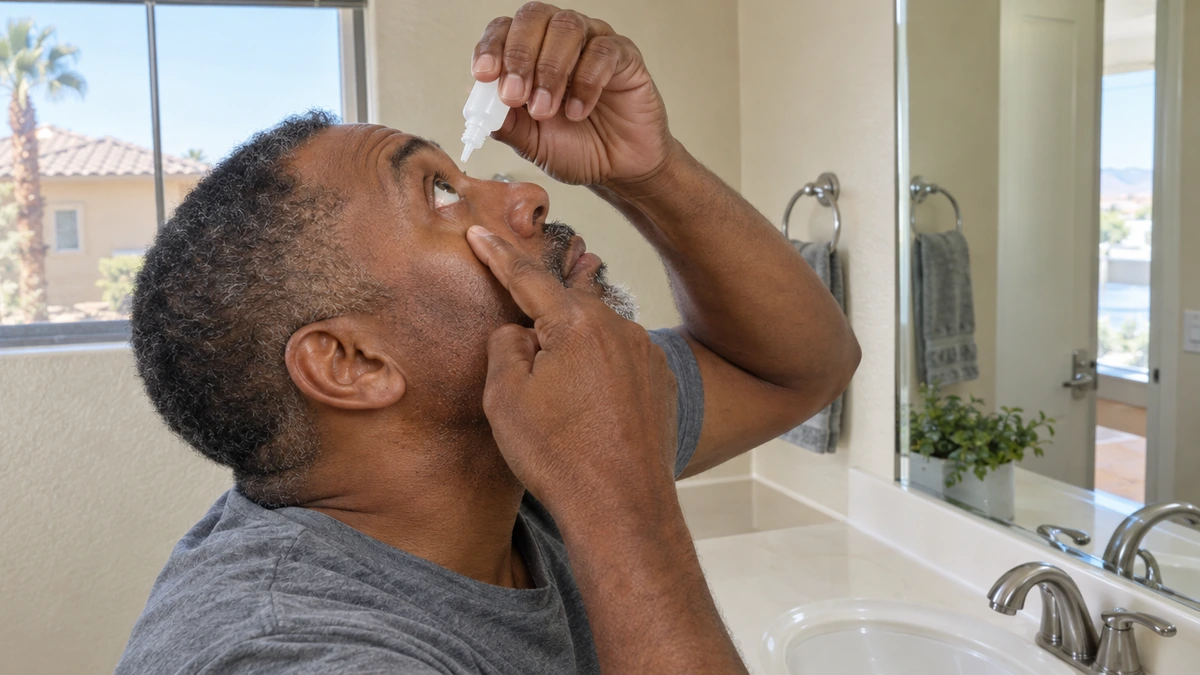
    Man applying artificial tears at a bathroom mirror for dry eye treatment
    A man applies an eye drop at his bathroom mirror.

    Artificial tears are the usual first treatment for mild dry eye. They support the tear film, the thin coating over your ocular surface, by adding lubrication. Still reaching for the bottle with little to show for it? Then drops alone are not your whole plan. Your response helps me decide what to examine next.

    Your choice of drops depends partly on how often you use them. Occasional use of a preserved drop is likely safe, but choose drops without preservatives when lubricating more than four times a day over a long period, as the AAO lubricant guide advises. Check the label for preservatives before choosing your bottle.

    Artificial tears lubricate, while other treatments address eyelid problems or inflammation. At your eye exam, tell me when drops help and when the discomfort returns. Those details help connect the bottle you use with the problem we need to treat.

    Treatment StepIts JobWhat Guides Your Choice
    Artificial tearsLubricate the eye surfaceYour symptoms, frequency of use and response
    Warm compressesSoften blocked eyelid gland oilsOil gland findings and a workable home routine
    Eyelid hygieneGently remove debris along the lash lineInflammation and crusting at the eyelid margins
    Prescription anti-inflammatory dropsAddress inflammationSeverity, earlier treatment and follow-up findings
    Punctal plugsSlow tear drainageWhether conserving your tears fits the problem

    How Do I Choose Your Next Treatment Step?
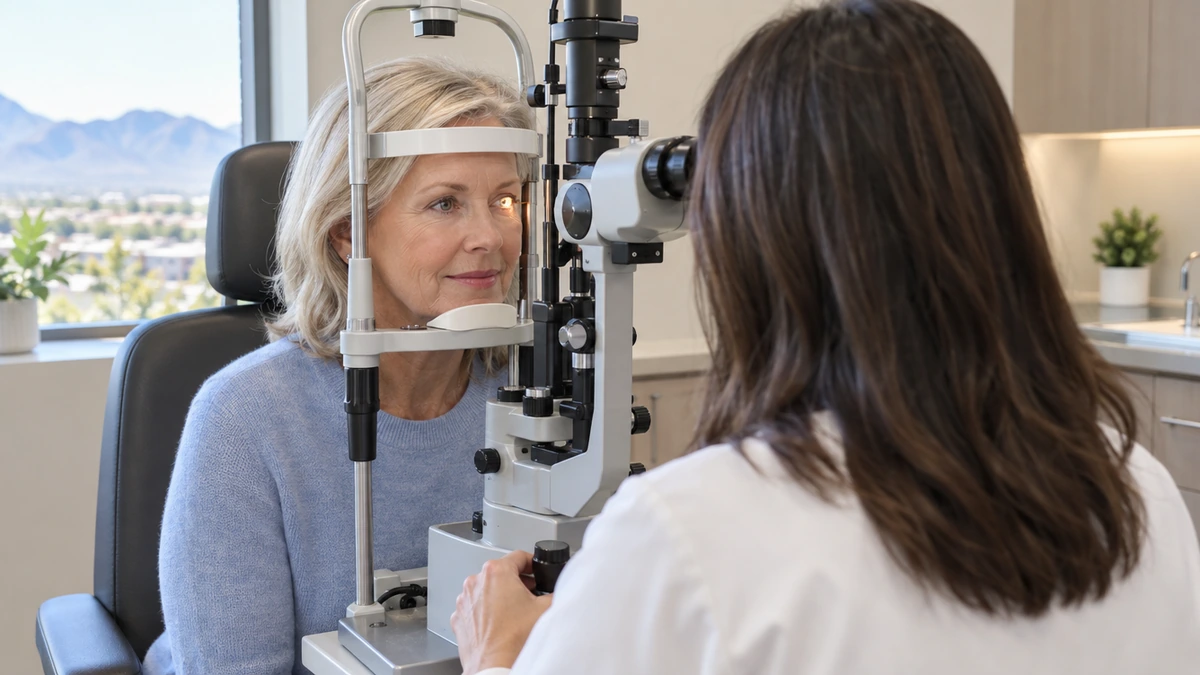
    Woman seated at a slit lamp with an eye doctor behind it during a dry eye treatment evaluation
    A woman rests her chin at a slit lamp during an eye examination.

    Too few watery tears and tears evaporating too quickly often occur together. Your treatment needs to account for both, with a comprehensive eye exam placing the tear and eyelid findings in the context of your broader eye health.

    One bottle rarely explains the whole picture. I check your tears and eyelids alongside your symptoms, because most people with dry eye have several contributing factors. A drop might help the surface while an eyelid problem remains, which is a reason to refine your plan.

    I favor the simplest plan with a clear job for every step. You should understand what each part is meant to change before making room for it in your day. A longer shopping list is no substitute for a clear explanation of warmth, cleaning or medication.

    Think back to the grit that followed you home from the 215. Getting through dinner without that familiar discomfort is a useful comfort goal to discuss. I also evaluate the eye surface, because treatment decisions include both how you feel and what the examination shows. What would a worthwhile change look like in your evening? Bring that goal into our discussion. It gives us something concrete to assess at follow-up.

    How Do You Use Warm Compresses and Clean Your Lids?

    Man gently cleaning his eyelid margin with a cleansing pad as part of dry eye treatment
    A man gently cleans his eyelid margin with a pad.

    Your eyelid oil glands affect how quickly tears evaporate. Meibomian gland dysfunction means the eyelid oil glands are blocked or working poorly, leaving the tear film more prone to evaporation. Warmth helps soften blocked gland oils. Gentle cleaning addresses debris along the lashes, especially with blepharitis, or eyelid inflammation.

    Your lids need two things: warmth to soften blocked oil and a gentle clean along the lash line. Here is the method from the AAO blepharitis guide, step by step.

    1. Wet a clean washcloth with warm water and wring it out, then hold it over your closed eyes for at least one minute and rewarm it as needed.
    2. For the cleaning step, soak a washcloth, cotton swab or pad that leaves no lint in baby shampoo diluted in warm water and gently scrub at the base of your eyelashes.
    3. Use gentle contact along the lash line, keeping pressure off your eye.

    The bathroom sink after brushing your teeth gives the routine a place in your day. Put the clean washcloth where you will see it, then follow the warming and cleaning instructions we discussed. A routine that looks simple on paper still has to work in your bathroom. Tell me when a step feels awkward so I know which instructions to clarify.

    Blepharitis care centers on keeping your eyelid margins clean. We will discuss how that care fits the problem I find and where it belongs alongside your drops. At follow-up, describe which steps you managed and which you struggled with. I want to understand the routine you used, including anything you left out.

    When Does Dry Eye Treatment Need Prescriptions or Plugs?

    Persistent symptoms are a reason to review your treatment. For more serious dry eye, the National Eye Institute names cyclosporine and lifitegrast as prescription drops that help your eyes make more tears. I choose the next step from your findings and treatment history.

    Prescription treatment needs a clear timetable. Anti-inflammatory drops address inflammation involved in dry eye, and some plans include a short course of steroid drops with monitoring for increased eye pressure and cataract. Follow your prescribed duration and keep the monitoring visit. Before leaving, make sure you know which bottle the instructions refer to and when I want to see you again. Keep that plan beside your usual routine so the next step is clear.

    Punctal plugs slow drainage through the small openings where tears leave your eyes. The 2017 TFOS DEWS II management report finds no large, high-level studies proving their benefit.

    A stalled plan needs review. Continued discomfort after treatment is a reason to reassess what your eyes need. For non-response or severe disease, I refer you to an ophthalmologist when your eyes need one. Repeating an unsuccessful routine should never become the goal.

    When Should You Stop Treating Dry Eye at Home?

    Seek emergency eye care right away when your eye is red and painful with blurred vision, a medical emergency described by MedlinePlus. Stop trying another bottle for a red eye: you need a diagnosis, as the AAO lubricant guide explains. Do not wait for your routine dry eye follow-up.

    How I Build Your Plan at Vision by Amel

    Couple listening to an eye doctor seen from behind during a dry eye treatment consultation
    A couple listens during a consultation with an eye doctor seen from behind.

    You should leave knowing what each treatment is for. My dry eye plans address the findings in front of me, including meibomian gland dysfunction and blepharitis when present. Depending on your eyes, the plan includes artificial tears, targeted prescription drops, warm compresses or eyelid hygiene.

    Your eye examinations give me the findings needed to explain a treatment choice. During our discussion, I connect what I find with the care we are considering and the changes you want to see. Leave room for questions about a step that feels unclear. I would rather explain it during your visit than have you guess at home.

    Every step in your plan earns its place. When a product sounds tempting, ask three questions. What problem does it solve? What evidence backs it? How will we know it works for you?

    Plan your visit around your week. You will find me at Vision by Amel, 2010 Festival Plaza Dr, Suite 195, Las Vegas, NV 89135, in Downtown Summerlin at Festival Plaza. Book online or call, with no referral needed for an eye exam. My Dry Eye Treatment topic page offers more reading before your visit.

    Frequently Asked Questions About Dry Eye Treatment

    Does Dry Eye Go Away for Good?

    Usually, dry eye needs ongoing management. Treatment aims to improve your symptoms and the condition of your eye surface, and long-term care is typical. A short course of drops rarely ends the problem permanently.

    Does Fish Oil Help Dry Eye?

    You should not count on fish oil as a proven dry eye treatment. The DREAM trial followed 535 people with moderate to severe dry eye for 12 months and found no significantly better outcomes with omega-3 supplements than with an olive oil placebo. Both groups improved. That is exactly why a placebo comparison matters.

    Do Artificial Tears Actually Work?

    Often, especially when your dry eye is mild. A Cochrane review of 43 trials and 3,497 people found over-the-counter tears may be safe and effective, though the evidence quality was low. No formula is proven best for everyone, so your response still matters.

    How Long Until Dry Eye Treatment Works?

    Expect a timetable tied to your treatment. Before you leave, I explain what change we are looking for and when I want to assess it. Your follow-up gives us a chance to compare that goal with what happened at home. I set your treatment goal and follow-up around your findings.

    When Do I Need Prescription Eye Drops for Dry Eye?

    More serious dry eye is a reason to discuss prescription treatment. Anti-inflammatory therapy sometimes accompanies tear supplementation, so your plan might include both. A prescription does not automatically replace every other step.

    Book My Eye Exam Call (702) 858-4362

    Like this article? Add Vision by Amel as a preferred source, and you are more likely to see our articles in Google’s Top Stories.


    Add as a preferred source on Google

  • School Vision Screening vs a Comprehensive Eye Exam in Las Vegas

    School Vision Screening vs a Comprehensive Eye Exam in Las Vegas

    School Vision Screening vs a Comprehensive Eye Exam in Las Vegas

    Father and daughter arriving at elementary school for a school vision screening article

    TLDR: A school vision screening flags possible vision problems, while an eye exam investigates your child’s vision and determines the next step. Book the exam when a referral note comes home, even when your child seems to see well. A passing screening does not rule out a vision problem.

    Answer: In Las Vegas, school vision screening helps identify children who need further evaluation. A comprehensive eye exam examines your child’s vision and eye health in more detail, including eye alignment and the structures of the eyes. Take a school referral to an optometrist or ophthalmologist for evaluation and a plan based on the findings.

    A referral note slides out beside the lunchbox. Your child swears the board looks fine. Trust the note anyway. Book the exam first, then gather what the school sent. My eye exams at Vision by Amel page explains the visit and booking options.

    I reviewed 73 primary sources across five research lenses for this guide, and passing a screening does not rule out a vision disorder. As Prevent Blindness explains, a screening flags a concern, while an eye doctor diagnoses the problem. That difference decides your next move.

    What Does a School Vision Screening Check in Nevada?

    Boy leaning forward toward a classroom board, illustrating school vision screening concerns
    A boy leans forward and squints toward the classroom board.

    Your child’s screening looks for signs worth investigating. A chart-based check measures visual acuity, meaning how clearly your child sees the chart, while other screenings use an instrument. The school nurse has the details about the method and result. A screening report is a snapshot of one morning’s check of children’s vision. Your child’s vision deserves the full picture.

    Nevada sets a school screening schedule so your child’s vision gets attention during the school years. Under NRS 392.420, schools with a school nurse check for visual problems before the end of the first elementary year, in at least one additional elementary grade, and in one middle and one high school grade, with parent notification of concerns and an option to decline in writing. The requirement covers school checks. A referral tells you to take the next step toward an exam.

    Get the result directly. An empty backpack tells you nothing about whether your child completed the screening or needs follow-up. Contact the nurse for the recorded outcome and any instructions sent home. On a busy Las Vegas pickup afternoon, a quick call beats searching through another pile of school papers.

    What Should You Do With a School Referral Note?

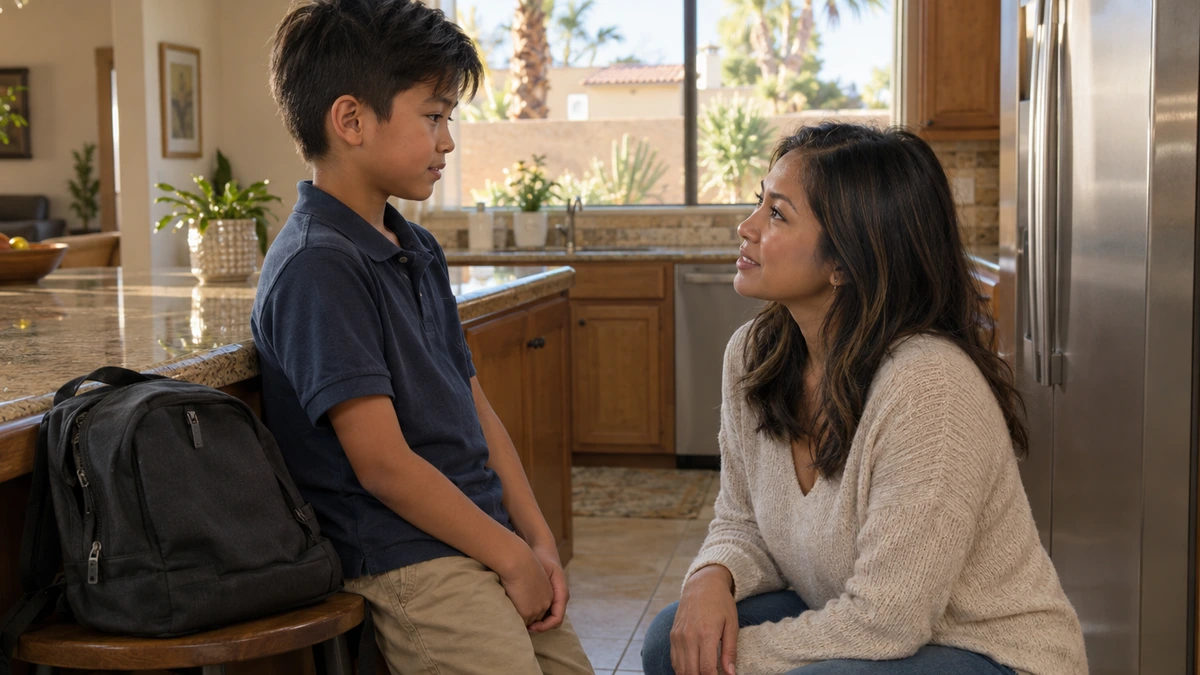
    Mother kneeling beside her son at a kitchen counter after school vision screening
    Ask your child about the screening and bring questions to the exam.

    Book the follow-up. The American Academy of Pediatrics advises an eye exam after a failed screening, even when you have noticed no problem. The exam determines whether your child needs glasses or other care. Your child has done nothing wrong.

    1. Read the requested action. Find the screening result, the eye involved and the follow-up instructions. Have the nurse explain any unfamiliar abbreviation.
    2. Arrange the exam. Explain to my team that a school screening prompted your call, and mention concerns from home or the classroom.
    3. Check the paperwork route. Find out which form the school wants back and who should receive it after the visit.
    4. Confirm your benefits. Give my team your insurance details before the appointment so we have the information needed to check them.
    5. Finish the handoff. Return the requested information after the exam and save a copy with the original screening result.

    Give the note a job. Put it beside your appointment details so it reaches the exam room instead of disappearing under homework. Let your child describe the screening without rehearsing chart answers or trying to prove the result wrong. The useful question is what the exam finds.

    What Happens When You Book a Comprehensive Eye Exam?

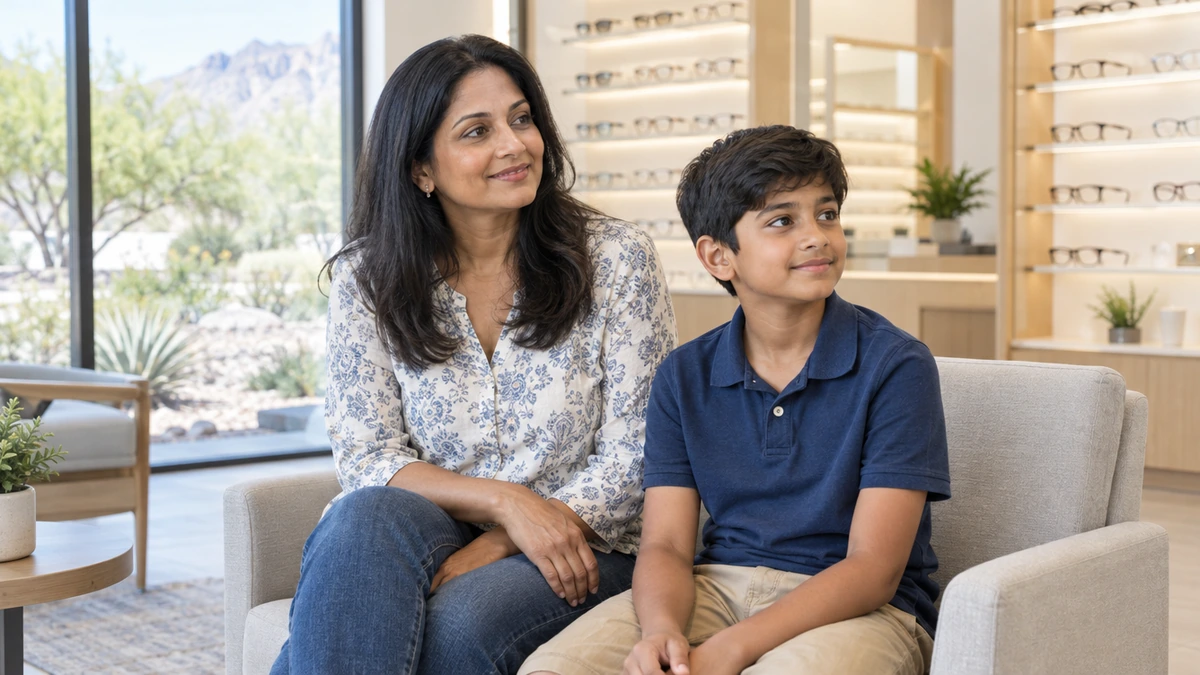
    Mother and son in an optometry waiting area for follow-up after school vision screening
    Bring the school referral and your questions to the appointment.

    A screening is a sorting tool. An eye exam is a diagnosis. Your child’s chart result belongs alongside the history, eye alignment and examination findings. I use those pieces to decide what care is needed and explain the next step.

    Your QuestionSchool ScreeningComprehensive Exam
    What is its purpose?Flag a possible vision problem needing follow-up.Evaluate vision and eye health and determine a plan.
    What does a chart result show?How clearly your child sees the chart during that check.Visual acuity interpreted with history and other findings.
    Does it diagnose a condition?The result identifies a concern for evaluation.I evaluate the findings to make a diagnosis.
    Does it prescribe glasses?The screening supplies no glasses prescription.I determine whether prescription glasses or other care are needed.
    What happens afterward?You complete the recommended follow-up.You follow the individual plan and return requested information to school.

    Leave knowing what the findings mean. A pediatric eye exam gives us room to discuss the concern behind the referral, beyond the letters your child read during screening. Tell me whether the difficult task is seeing the front board, reading a book or finishing homework comfortably. A specific example gives our conversation a clear starting point.

    You do not need a diagnosis before booking. Previous records sometimes contain terms such as amblyopia or strabismus, and I want to hear about those findings when we discuss your child’s history. Have me explain any unfamiliar terms. Leave the visit knowing what the findings mean for the school referral and what happens next.

    What Does a Passing School Vision Screening Miss?

    A pass is good news. Your child’s complaints still win the argument. In the 2004 Vision In Preschoolers study of 2,588 Head Start children aged 3 to 5, the best tests run by eye care professionals at 90% specificity detected about two-thirds of children with an eye condition targeted by the study and nearly 90% of those with the most important conditions. Those results describe the study’s preschool tests. Book the exam when those complaints keep coming.

    Homework discomfort deserves its own answer. The American Optometric Association’s parent guidance says school screenings look for amblyopia and its risk factors but do not check for most vision conditions behind digital eye strain. Your child reading the classroom chart does not settle a complaint about uncomfortable screen work at the kitchen counter. Tell me when the discomfort starts and which task brings it on.

    Watch what happens after the reassuring result. Your second grader still leaning toward the whiteboard gives us a concern to investigate. A parent in Summerlin hearing another complaint over evening homework has a reason to arrange an exam. My pediatric eye exam guide covers timing, Medicaid and school screenings when you need the wider overview.

    Why Does Completing the Follow-Up Matter?

    The referral needs a finished follow-up. A 2026 BMJ Open Ophthalmology review of 30 studies reported a median follow-up rate of 43.1% after school vision screening referrals. That median spans those studies. Make sure your child lands on the follow-through side of it.

    Choose a date you will keep. Check transportation and your work schedule before confirming the visit, especially when pickup and an afternoon shift compete for the same hour. A change of plans calls for a replacement date during the same phone call. Keep the school informed when arranging follow-up takes longer than expected.

    Showing up is half the job. Walking out with a plan you understand is the other half. Before you leave, confirm what the findings mean for the referral, whether your child needs glasses or other care, and when to return. A clear next step belongs beside the appointment on your calendar.

    Close the paperwork loop. Check the school’s instructions before sending the completed form, and keep your copy somewhere easier to find than the bottom of a backpack. Report continuing concerns to me even after the form is returned. The paperwork records the visit, while the plan guides your child’s care.

    How I Follow Up on Your School Referral at Vision by Amel

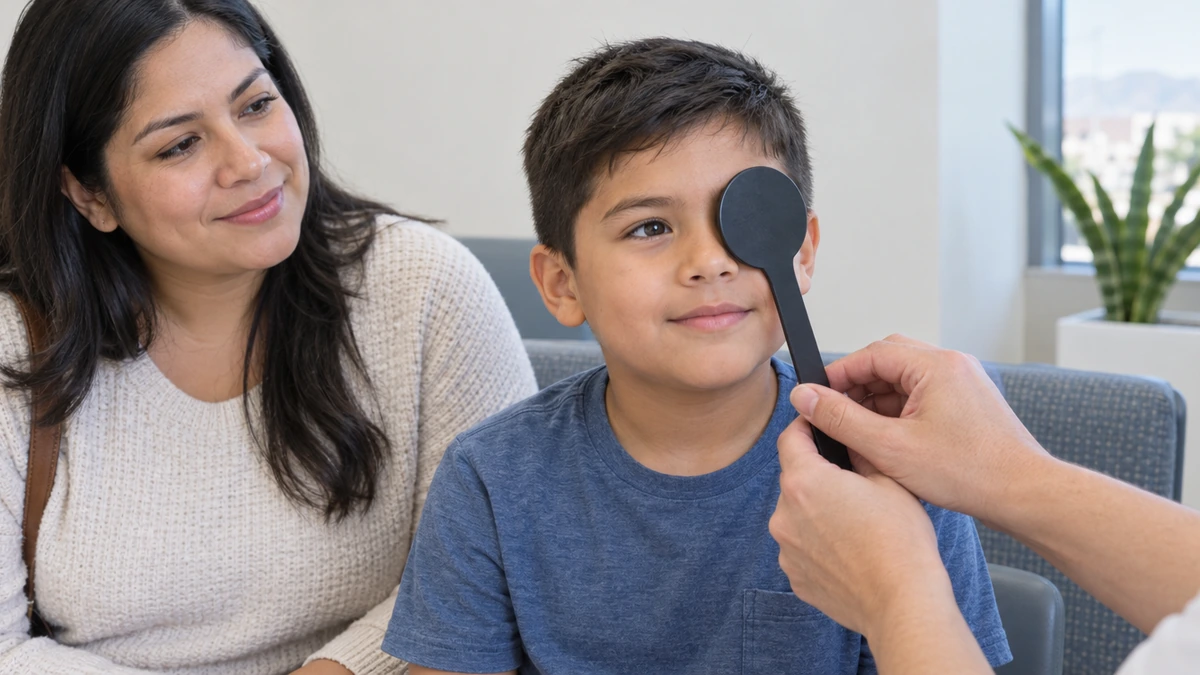
    Doctor's hands holding an occluder at a boy's left eye during school vision screening follow-up
    The eye exam evaluates the concern raised by screening.

    You do not need a referral for an eye exam at Vision by Amel, and we accept Nevada Medicaid. Mention the school screening when you book. A missing form need not delay that call.

    Put your main concern first when we talk. Start with what prompted the school referral, then describe anything you have noticed since the screening. Leave room for your child to explain what feels difficult, too.

    Plan your route to Festival Plaza in Downtown Summerlin before the appointment. Choose a time around your family’s school and work commitments. Keep the school’s contact details handy for returning the requested findings after the visit.

    Frequently Asked Questions About School Vision Screening

    What If I Lost the Referral Note From School?

    Request a replacement from your school nurse, including the screening date and recorded results. Tell my team you are waiting for the copy when you book. Confirm whether the school also has a separate form for the exam findings, so the replacement packet includes what you need.

    Should I Buy Glasses Based on the School Eye Test?

    Wait for my findings before buying prescription glasses for your child. The screening note supplies a reason to investigate, while the exam determines whether glasses belong in the plan. During the visit, have me explain what any prescription means and how the glasses should be worn.

    Which Grades Get Vision Screening in Clark County Schools?

    The Clark County School District screening schedule lists kindergarten and grades 4, 7 and 10, plus students new to the district, repeating a grade or with disabilities. Your child’s grade is therefore only part of the answer. Check with the school nurse about your child’s screening status and follow-up instructions.

    Does Nevada Medicaid Need Prior Approval for the Follow-Up Exam?

    No, Nevada Medicaid’s ocular services manual allows optometrists to examine Healthy Kids members without a referral or prior authorization and covers routine exams once every 12 months. Give my team your child’s plan details when you arrange the follow-up. Confirm the coverage for the planned visit before you arrive.

    Are Weekend Appointments Available at Vision by Amel?

    Yes, you have weekend booking options because my office opens seven days. Our hours are Monday to Saturday 9 am to 6 pm and Sunday 11 am to 5 pm. Call or use online booking to check appointment availability for your child.

    Book My Eye Exam Call (702) 858-4362

    Like this article? Add Vision by Amel as a preferred source, and you are more likely to see our articles in Google’s Top Stories.

    Add as a preferred source on Google