Category: Vision Care for Children

Vision care for children in Las Vegas and Summerlin: eye exams for kids, what school screenings miss, the signs a child needs glasses, screens and sun protection. Plain guidance from an optometrist for Las Vegas parents.

  • Eye Allergies in Kids: Itchy, Watery Eyes in Summerlin
    Eye Allergies in Kids: Itchy, Watery Eyes in Summerlin

    Eye Allergies in Kids: Itchy, Watery Eyes in Summerlin

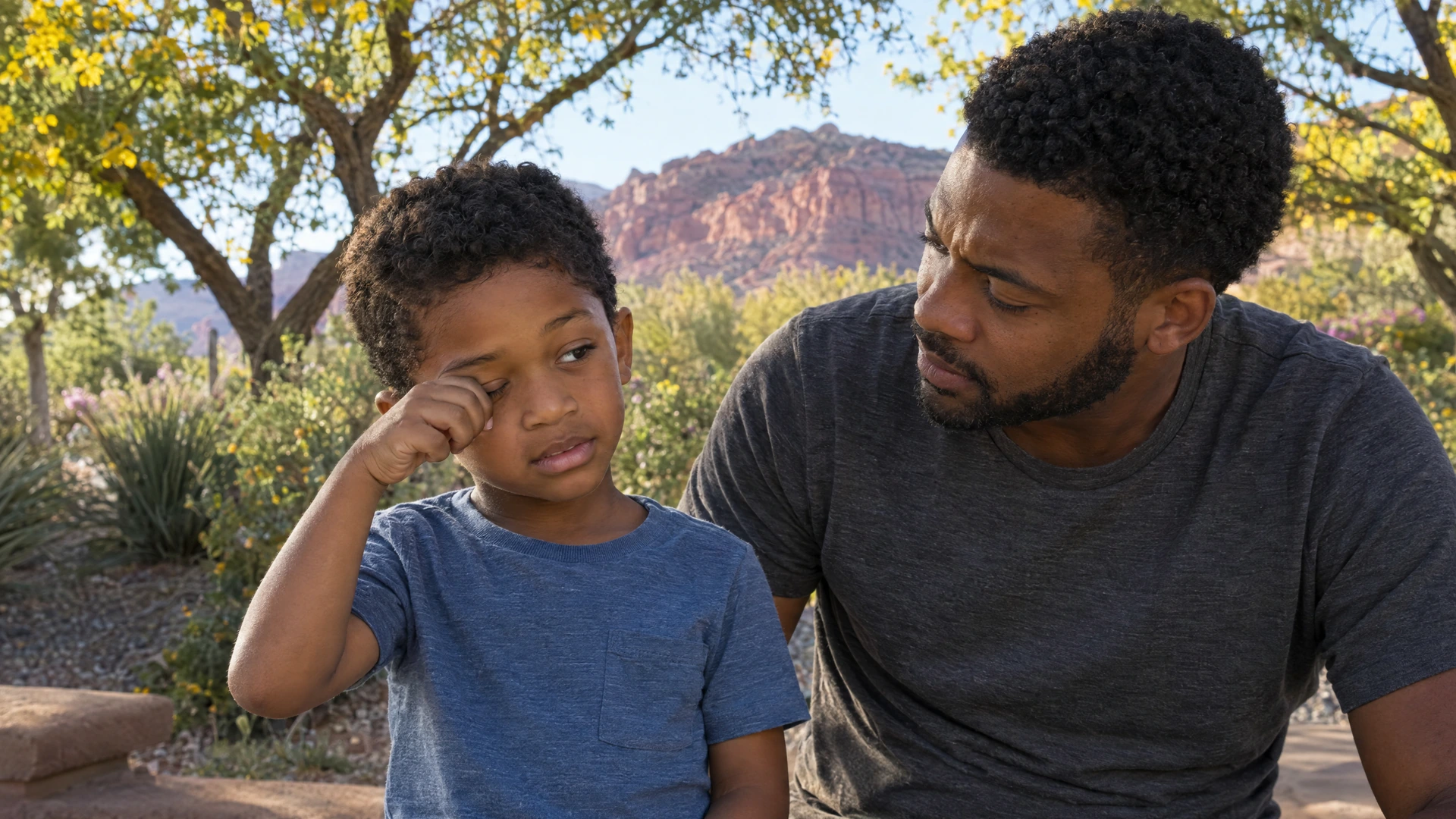
    Boy rubbing an eye beside his father at a Summerlin park, eye allergies in kids

    TLDR: Itching is the main clue to eye allergies in kids, often alongside redness and watering. Start with a cool compress and help your child stop rubbing. Eye pain, light sensitivity, blurred vision or intense redness need medical care right away.

    Answer: Eye allergies in kids cause itchy, watery, red eyes after contact with allergens such as pollen or pet dander. In Summerlin, your child’s outdoor routine offers useful clues, but itching alone does not establish the cause. Cool compresses and removing allergens help with comfort. Persistent symptoms need an eye exam, and warning signs need care right away.

    Your child leaves a Summerlin park rubbing both eyes, still carrying a dusty soccer ball. Back home, the rubbing continues through snack time. You need to know what helps, whether this spreads, and when to stop treating it as an ordinary itchy afternoon.

    I reviewed 168 primary sources across five research lenses for this guide, and itching is the main symptom of allergic conjunctivitis. AAPOS identifies itching as the hallmark and describes redness, watering and swelling alongside it. As your optometrist, I use your observations as part of the history, then examine the eyes. Our eye exams page explains the practice’s approach to evaluating your child’s concerns.

    How Do You Soothe Eye Allergies in Kids?
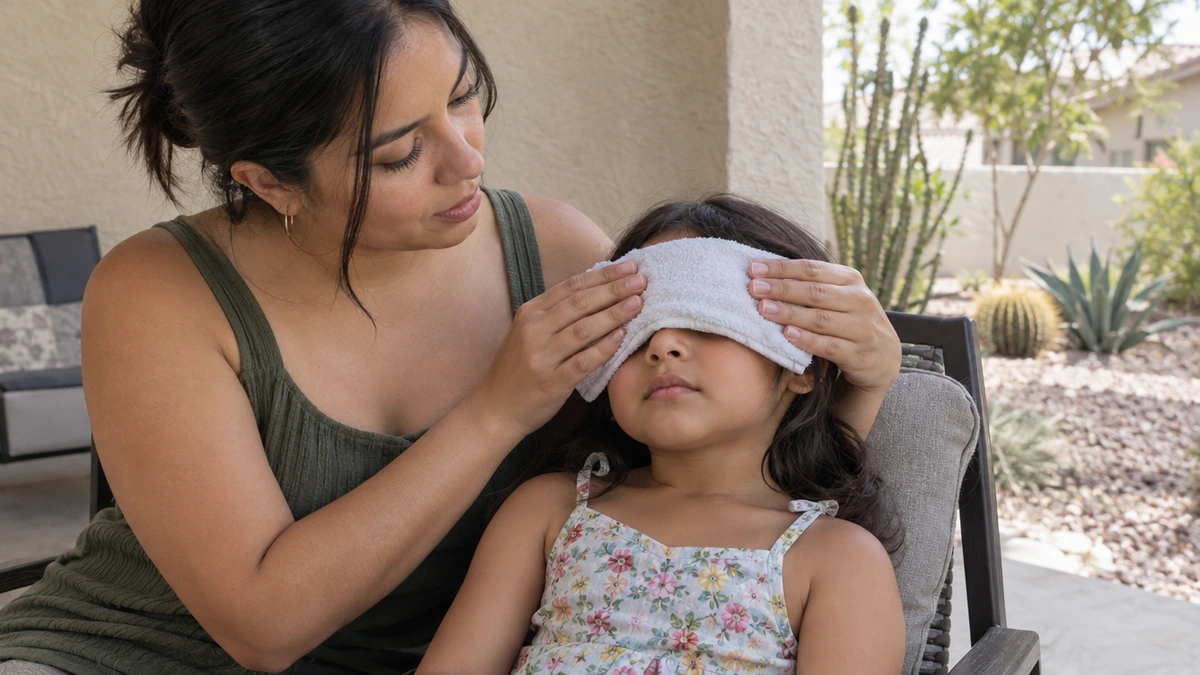
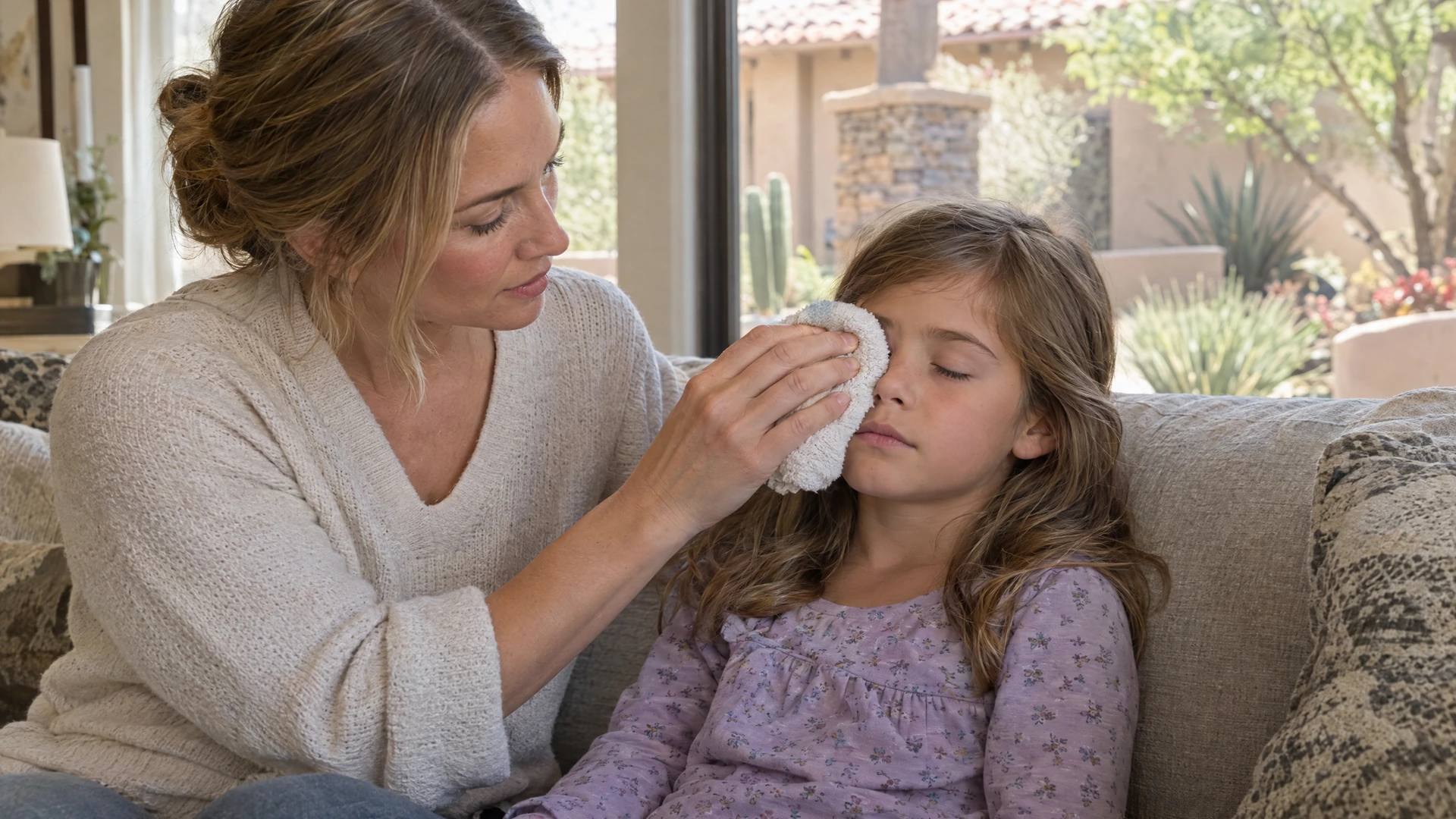
    Mother placing a cool cloth over her daughter's closed eyes, eye allergies in kids
    A cool damp cloth offers a simple comfort measure.

    Cool the itch first. A clean, cool, damp cloth over your child’s closed eyes is the simplest relief you own. Then take away the trigger: wash off the pollen, move away from the cat, close the window. Watch how your child feels over the next day.

    Hands up to the eyes? Hand over the cool cloth. You might see your child press a fist into one eye, blink hard or squeeze both eyes shut. Name the plan in words your child understands, and the cloth becomes the thing to reach for.

    I favor a simple comfort routine parents repeat without a struggle. For you, that means putting the cloth within reach and choosing a quiet place to sit together. A patio chair in the shade or a comfortable seat indoors works for the pause. The goal is a manageable response to the itching while you watch how your child feels.

    Is It Eye Allergies in Kids or Infectious Pink Eye?

    Pink eye describes more than infection. According to the CDC, allergies and irritants cause noncontagious pink eye, while viral and bacterial forms spread between people. Symptoms overlap, so your child’s red eyes alone do not settle the cause. Use the distinctions below to describe what happened before the redness began.

    Possible CauseUseful ClueWhat It Means for Your Family
    Allergic conjunctivitisItching with exposure to pollen, pets or indoor allergensThe allergy itself does not spread to siblings.
    Viral or bacterial conjunctivitisContact with someone who has infectious pink eyeThese infections spread, and overlapping symptoms need assessment.
    Irritant conjunctivitisExposure to blowing dust, smoke or fumesIrritation is not automatically an allergy and is not contagious.

    Start with what your child reports. Is the main complaint itching, or is the eye painful? Was there outdoor play, a dusty gust, or time around a pet before symptoms began? Those answers matter even when the eyes look the same as last time, because your child’s history is where I start.

    Leave the diagnosis to me. Your job is the story: itch or pain, park or pet, today or all week. My guide to pink eye in kids covers the contagious kinds and the school rules, so this guide stays with allergy and what you control at home.

    What Should You Do After Outdoor Play?
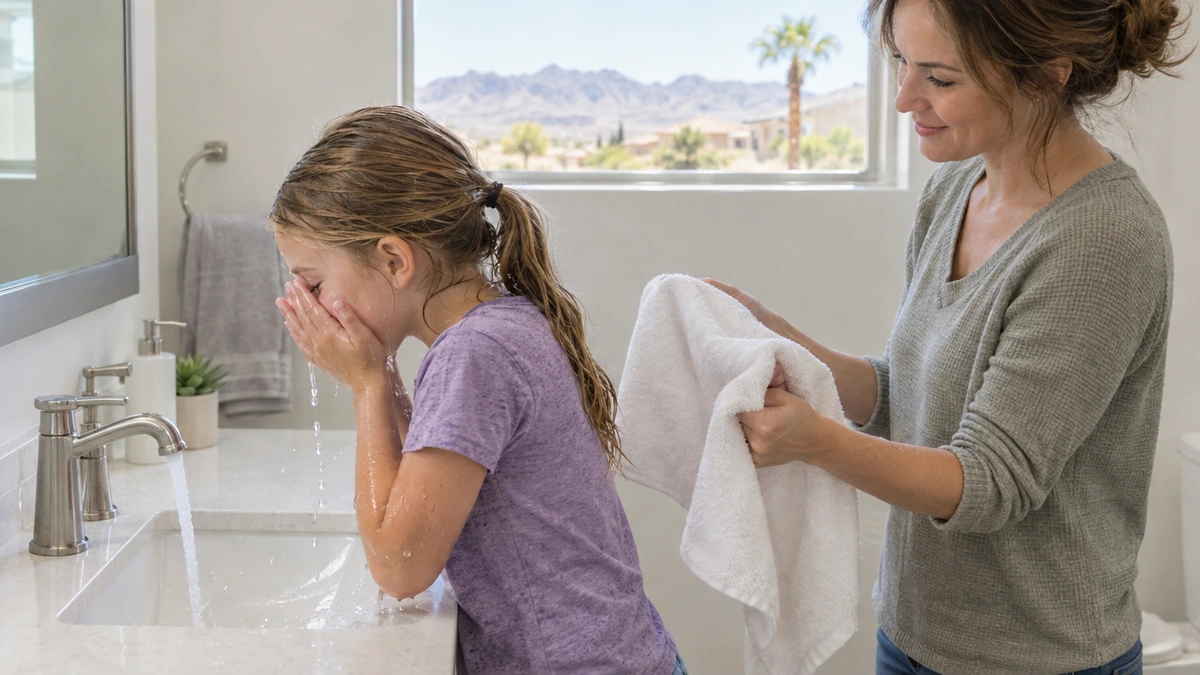
    Girl washing her face and hands as her mother offers a towel, eye allergies in kids
    Washing the face helps remove allergens after outdoor play.

    Make cleanup part of coming home. After your child runs across the grass at a Summerlin park, shoes land by the door and a parent sets a clean towel beside the bathroom sink. Wash your child’s face and hair to clear away pollen, and steer little hands away from the eyes, because rubbing makes allergic conjunctivitis worse, as AAPOS advises. Build that step into the transition from outdoor play to the rest of your afternoon.

    1. Help your child wash their hands with soap and water before touching the face.
    2. Wash the face and hair to remove allergens picked up outdoors.
    3. Offer a clean, cool damp cloth over closed eyes for itching.
    4. Redirect rubbing and notice whether symptoms settle, persist or worsen.

    Outdoor preparation matters too. Sunglasses or eyeglasses help keep pollen out of your child’s eyes, and nasal allergy symptoms often accompany eye allergies, according to the American Academy of Ophthalmology. Notice sneezing or an itchy nose along with the eye symptoms. For choosing eyewear, our children’s sunglasses guide covers UV protection separately.

    What Do Las Vegas Pollen and Dust Mean for Your Child?
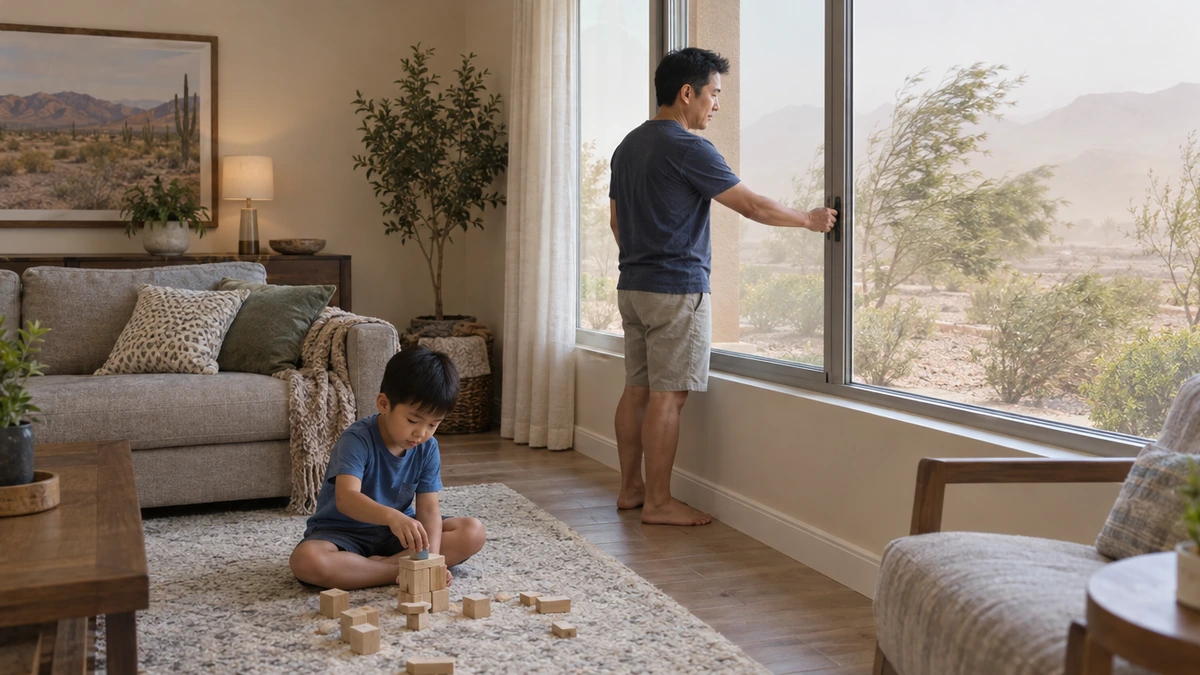
    Father closing a living room window while his son plays nearby, eye allergies in kids
    Closed windows help limit exposure to blowing dust.

    Desert surroundings still contain pollen. In Las Vegas, researchers found tree pollen contributed the largest share of airborne pollen, with spring and fall weed peaks in a UNLV pollen study covering a single year. Those findings give you an observed pattern rather than fixed annual start and end dates. Use your child’s symptom history alongside the season.

    A windy afternoon adds another possibility. You are gathering toys from a stucco home’s patio when a gust lifts dust from the edge of the yard. Your child comes inside blinking and rubbing. Outdoor dust irritates eyes without necessarily causing an allergic reaction, so describe the exposure without deciding the diagnosis.

    Close your windows and doors when dust blows, as Clark County advises. That guidance addresses airborne dust exposure, not proof of an eye allergy. Move the afternoon’s quiet play indoors while you assess the symptoms. Persistent discomfort still deserves attention after the window closes.

    No pollen calendar knows your child like you do. Where did your child play? When did the itching start? Did a bath fix it, or did it last through dinner? Those answers, plus any pets at home, tell me more than any forecast.

    When Is an Itchy Eye More Than Allergies?

    Itching points to allergy. Pain points somewhere else. The CDC says to see a provider for eye pain, light sensitivity, blurred vision that stays after you wipe away discharge, or intense redness, and I want your child seen right away for any of them. These symptoms take priority over an allergy explanation. Do not wait for the next routine appointment to have them assessed.

    Itching that gets worse, or never lets up, earns an exam. Share what you have tried and how your child responded. A new pattern, such as itching on indoor days too, matters. The next step is an eye exam, not another round of guesswork drops.

    Leave leftover eye drops in the cabinet. A sibling’s old bottle or a relative’s prescription says nothing about what your child’s eyes need today. Bring the bottle to the visit instead, so I see exactly what your child used.

    How I Approach Your Child’s Itchy Eyes at Vision by Amel
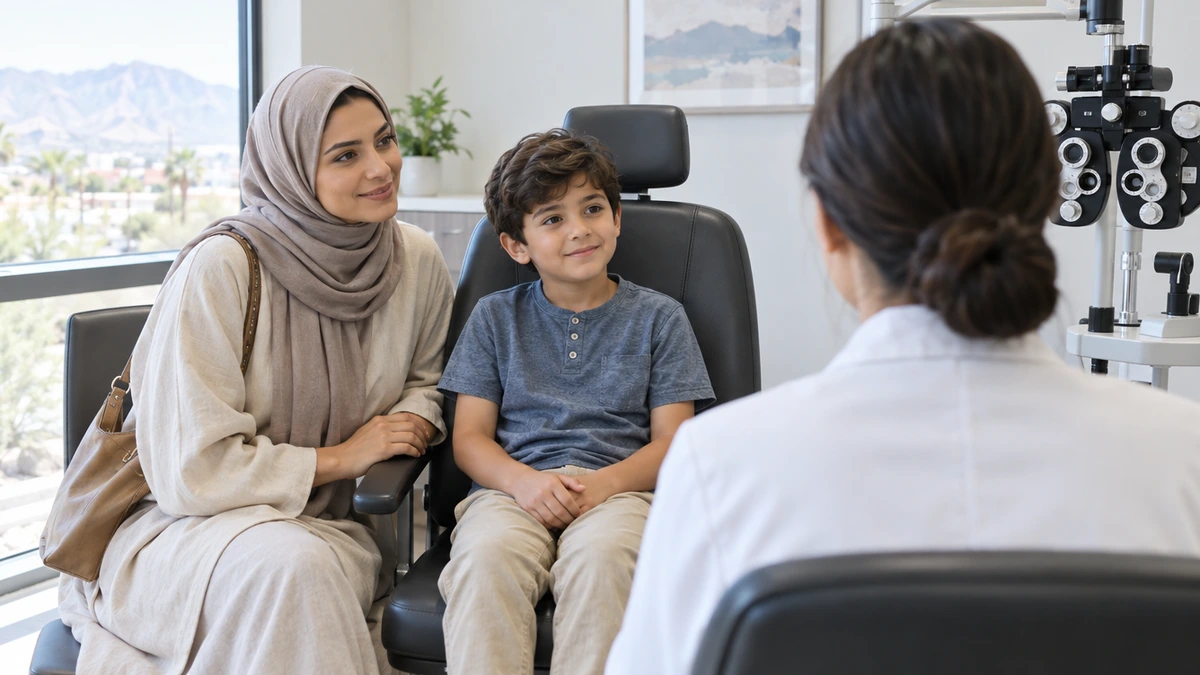
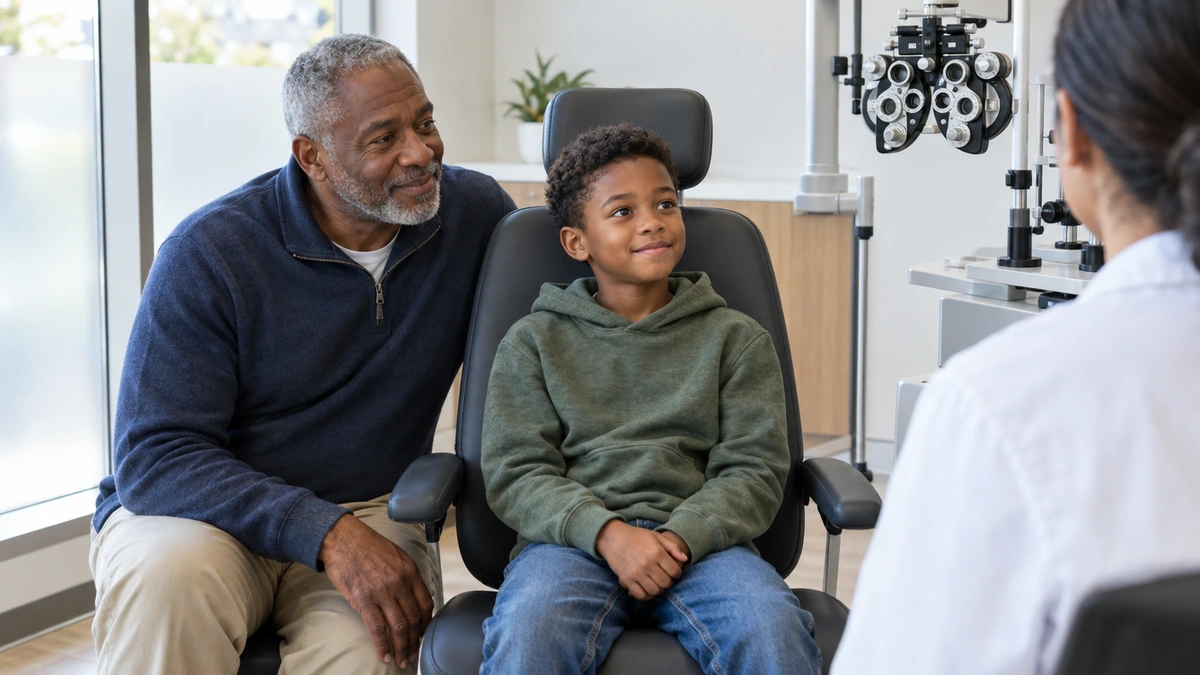
    Mother beside her son in an exam chair, clinician seen from behind, eye allergies in kids
    A mother sits beside her son in the exam chair as the eye doctor listens.

    Your observations belong at the start of the visit. I am Dr. Amel Youssef, OD, founder of Vision by Amel, and Summerlin families come to me every week for their children’s eye care. After we discuss the itching, I use digital diagnostics and examine your child’s eyes to build a plan around what I find. For itchy eyes, explain the timing, exposures and home measures you have tried.

    A clear history is worth more to me than a parent’s best guess at a diagnosis. Skip the medical names. Does the rubbing stop your child’s play, or follow your child indoors? My evaluation brings those answers together with the examination.

    You will find us at Downtown Summerlin at Festival Plaza, at 2010 Festival Plaza Dr, Suite 195, Las Vegas, NV 89135. You do not need a referral for an eye exam. For a routine visit, book online or call our team. Mention the itching when you book, so your child’s visit starts with the history.

    Frequently Asked Questions About Eye Allergies in Kids

    Are My Child’s Itchy Red Eyes Allergies or Pink Eye?

    Allergies are one cause of pink eye, and itching supports that possibility. Your child’s history of asthma or eczema also belongs in the discussion because allergic eye conditions are more likely in children with those conditions. Neither that history nor the appearance of the eyes establishes the diagnosis.

    What Helps My Child’s Eye Allergies at Home?

    Wash up, cool the eyes and stop the rubbing. Cold compresses and artificial tears ease the inflammation, and allergic pink eye usually improves once the allergen is gone, says the CDC. AAPOS adds that keeping artificial tears in the refrigerator gives extra relief for some children, and that washing bedding often and vacuuming your child’s bedroom cuts indoor triggers.

    When Is Pollen Season in Las Vegas, and Can Desert Dust Bother My Child’s Eyes?

    Spring is a major tree pollen period, and weed pollen also appears in fall. Your child’s exposures also include pollen from grass, so notice symptoms after playing on lawns as well as around flowering trees. Desert dust also irritates eyes, while indoor dust is an allergy trigger.

    When Should My Child See an Eye Doctor for Eye Allergies?

    Book an eye exam when your child’s symptoms get worse or do not improve, and get care right away for the warning signs above. You usually skip allergy testing: AAPOS says the history and the eye exam make the diagnosis. AAPOS also says steroid eye drops should be prescribed and monitored only by an ophthalmologist, because overuse risks glaucoma, cataract and infection.

    Can My Child Wear Contacts If They Have Eye Allergies?

    Seasonal allergies often make children poor candidates for contact lenses, according to the Food and Drug Administration. Discuss your child’s allergies at the contact lens visit. For itching, burning, irritation or redness during lens wear, remove the lenses and contact me right away. Our guide to contacts for kids and teens covers the broader readiness decision.

    Book My Eye Exam Call (702) 858-4362

    Like this article? Add Vision by Amel as a preferred source, and you are more likely to see our articles in Google’s Top Stories.

    Add as a preferred source on Google

  • Eye Injuries in Kids: First Aid Every Las Vegas Parent Should Know

    Eye Injuries in Kids: First Aid Every Las Vegas Parent Should Know

    Eye Injuries in Kids: First Aid Every Las Vegas Parent Should Know

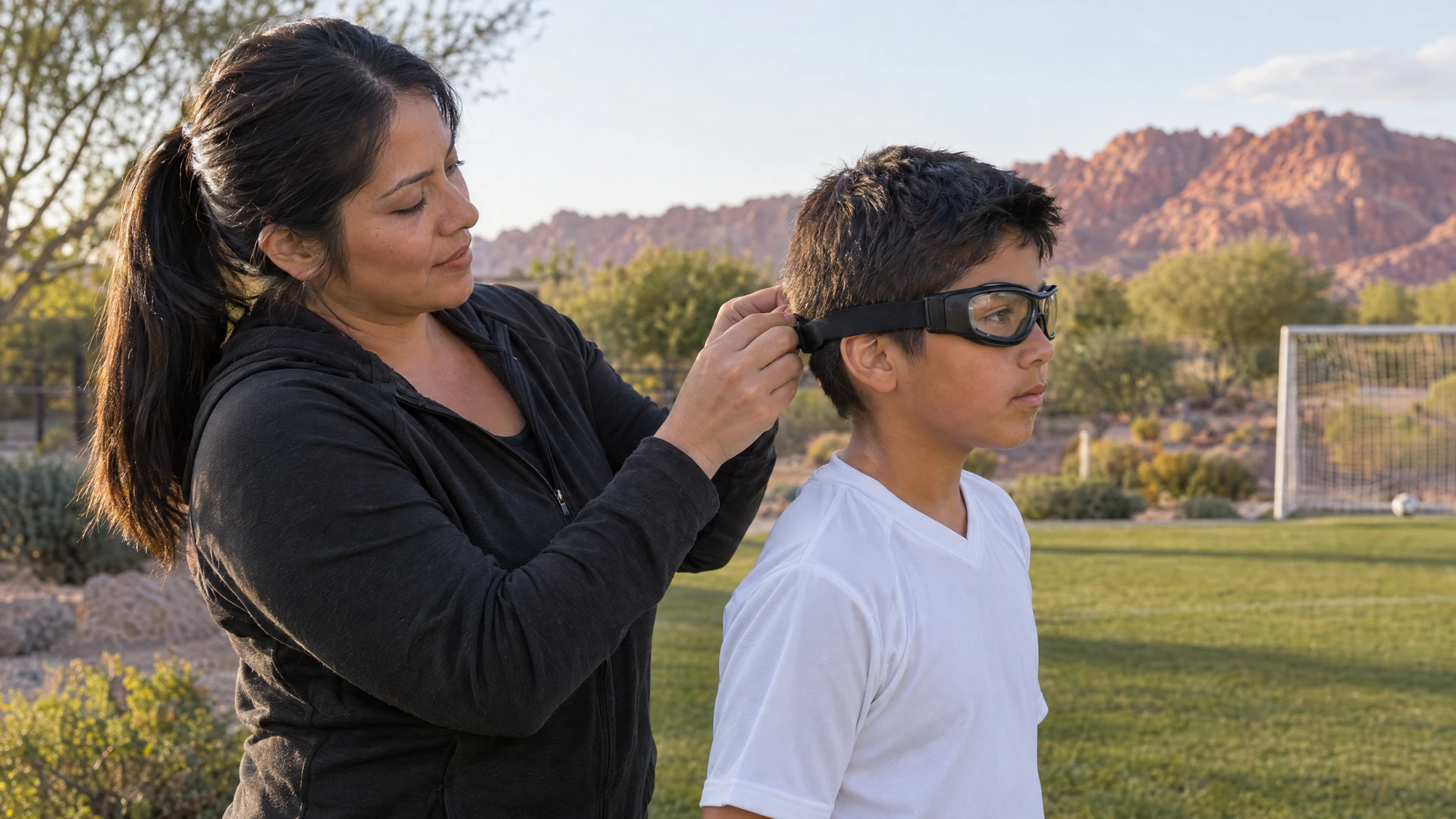
    Mother adjusts a Latino boy's sports goggles on a soccer field, prevention of eye injuries in kids

    TLDR: For chemical eye injuries in kids, flush your child’s eye with water right away and get emergency care. For a cut, puncture or embedded object, protect the eye without pressure, do not rinse or remove the object, and go to the ER right away. Vision changes after an injury also need the ER right away.

    Answer: First aid for eye injuries in kids depends on what happened. Flush a chemical splash with water right away, for at least 15 minutes. Never rinse a cut, a puncture or a fireworks injury, and leave any stuck object in place. Use a cold compress without pressure after a blow. In Las Vegas, take your child to the ER right away for any serious injury.

    You are on the soccer sideline in Summerlin when a ball catches your child in the face. The game stops, and you need a clear next step. I reviewed 168 primary sources across five research lenses for this guide, and chemical splashes and punctures require different first aid.

    Get emergency help right away if your child has any of these serious injury signs listed by the American Academy of Ophthalmology: ongoing pain, trouble seeing, cut eyelid, one eye not moving as well, one eye sticking out, odd pupil, blood in the eye, something that will not come out. Go to the ER rather than waiting for a routine eye exam. Once the emergency is handled, my eye exams overview explains the follow-up visit.

    What Should You Do After a Chemical Splash?

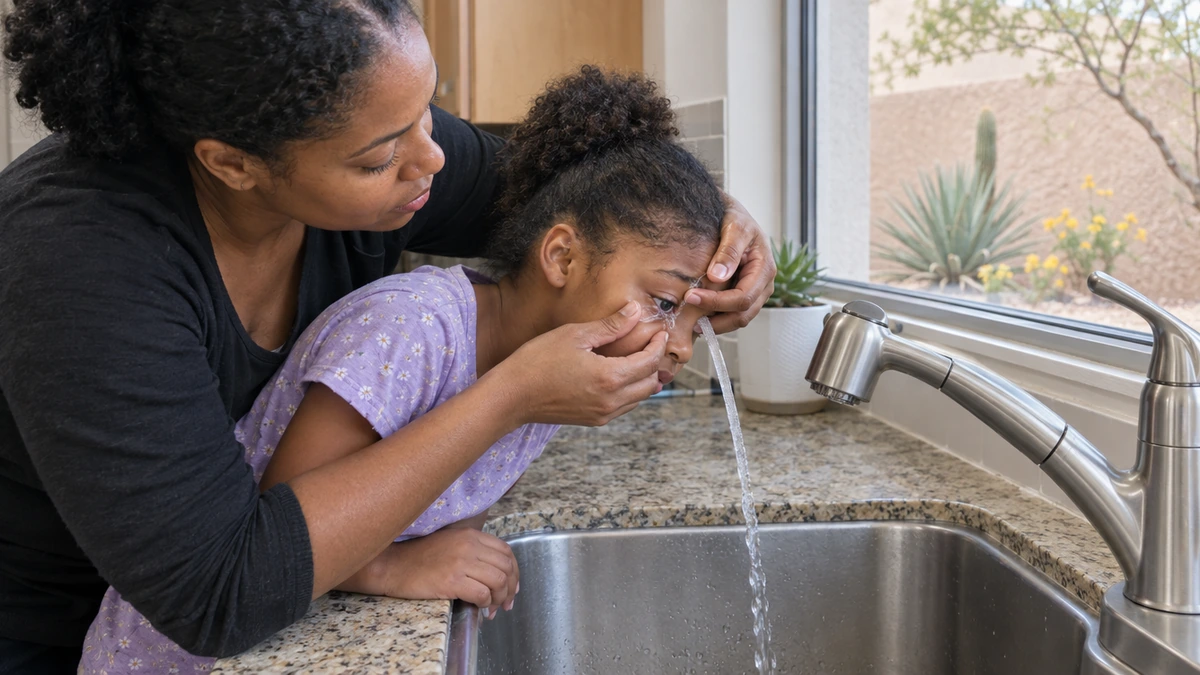
    Black mother rinses her daughter's eye at a kitchen sink, first aid for chemical eye injuries in kids
    A mother rinses her daughter's eye under a gentle stream at the kitchen sink.

    Start flushing right away. Hold your child’s eye open under a faucet or shower, and continue flushing with water for at least 15 minutes, as Prevent Blindness directs. Get emergency care right away after flushing. Do not delay rinsing to find special eyewash or book a visit.

    1. Move straight to running water, the kitchen sink or the shower. At a park or in the car, use bottled water or any drinkable liquid.
    2. Hold the affected eye open so water reaches it. Start rinsing before searching for the product’s ingredients.
    3. Keep flushing for at least 15 minutes by the clock. Another adult calls for emergency help while you stay with your child.
    4. Leave the eye unbandaged. Head for emergency care once flushing is complete.

    A spray bottle tips while you clean a Las Vegas kitchen, and your child cries out beside the sink. Your first job is getting water into the affected eye. The bottle and phone wait while you start flushing. A second adult is useful here: one stays at the sink, the other handles the next steps.

    Prevention starts under your sink. Chemical products were the leading cause (34.2%) of product-related eye injuries in children younger than 5 treated in US emergency rooms from 1997 to 2019, a study in Ophthalmic Epidemiology found. Lock cleaners up high and out of your child’s reach. A sharp object or a fireworks injury needs the different steps below.

    Which First Aid Fits Eye Injuries in Kids?

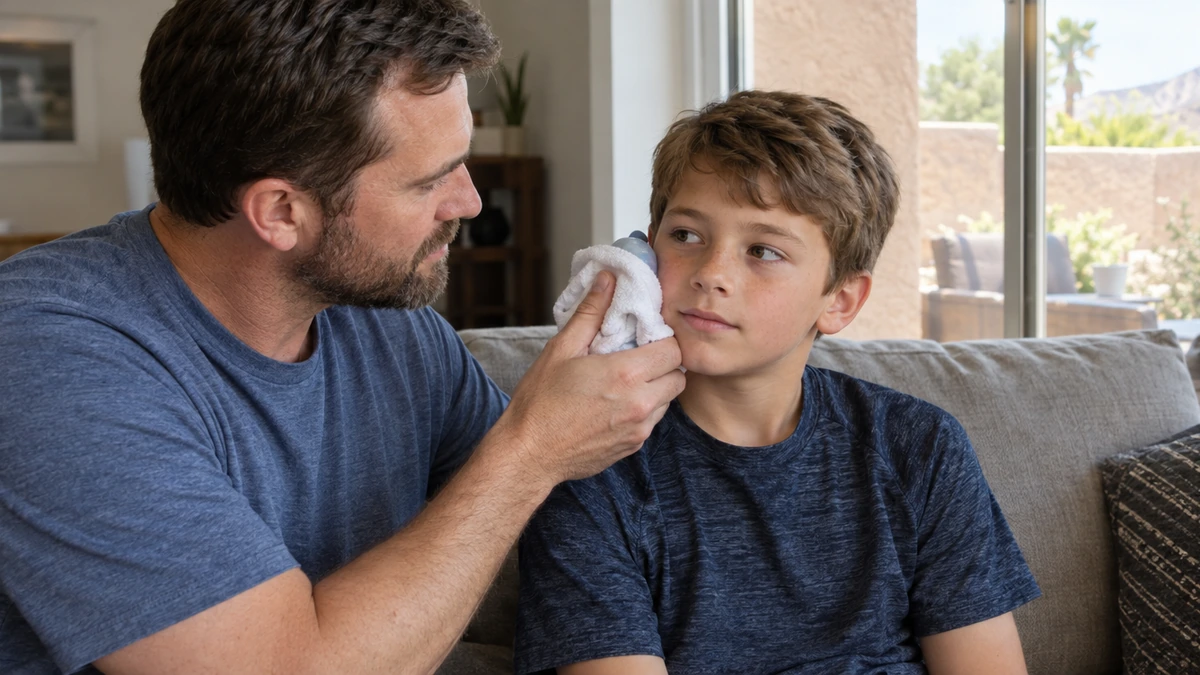
    White father holds a wrapped cold pack near his son's cheek, first aid for eye injuries in kids
    A father holds a cloth-wrapped cold pack near his son's cheek, away from the eye.

    Match your response to the injury. The American Academy of Ophthalmology recommends a cold compress without pressure after a blow, a shield without rinsing for a puncture, and prompt examination even when an injury seems minor. A toy edge, a flying fragment and a loose grain of dust call for different decisions. Use this table to choose the first action, then follow the emergency signs above.

    What HappenedYour First ActionWhen to Get Help
    Loose sand or dustEncourage blinking and let tears wash it out. Do not rub or use tweezers.Get help right away when the speck stays or the feeling persists.
    Ball, elbow or toy hits the eyeApply a small cold compress without pressure.Go to the ER right away for pain, blurry vision, one eye sticking out, blood inside the eye or a black eye.
    Cut, puncture or object embedded in the eyeProtect with a rigid shield without pressure. Do not rinse or remove the object.Go to the ER right away.
    Possible scratch after contact with a toy or fingerPrevent rubbing. Do not put ointment or medication into the eye yourself.Arrange examination as soon as possible. Serious injury signs mean emergency help right away.

    Loose dust often washes away with tears. Metal, glass and other man-made fragments are more serious than dust, because they sometimes embed in the eye. Your role is to prevent rubbing and get help, not to explore beneath the eyelid with a household tool. Do not attempt to remove an embedded fragment.

    For a cut or puncture, never rinse the eye, never rub it and never pull out a stuck object. Tape a rigid shield, or the bottom half of a paper cup, to your child’s brow and cheekbone so nothing presses on the eye. Then go to the ER right away.

    A cold compress is first aid, not permission to resume the game. Your child still needs emergency care right away for the warning signs in the table. I would rather interrupt a game than let a child’s wish to play decide whether an injured eye gets checked.

    What Changes After a Fireworks Injury?

    South Asian family on a Summerlin patio at dusk, children in safety glasses, eye injuries in kids
    A family stands together on a Summerlin patio at dusk, the children in safety glasses.

    A fireworks eye injury is an emergency: call 911 or get emergency care right away, following the American Academy of Ophthalmology guidance. Do not rub, rinse, press or remove anything stuck in your child’s eye. These instructions apply even when you think a burn or chemical caused the problem. Follow the emergency dispatcher’s directions.

    The safest July 4 plan for your family is a professional show, says the American Academy of Ophthalmology, which warns that bystanders, especially children, are at high risk around home fireworks. Safety glasses and a few extra steps of distance do not make a backyard show safe for your child. Planning a Summerlin patio evening anyway? Decide in daylight who stays with the children and who makes the 911 call.

    You do not need to identify the exact injury before seeking help. Describe the firework, where your child was standing and what happened next. Do not spend that time searching for drops or trying to wash away debris. Get emergency help right away.

    How Do You Protect Eyes Before Play Starts?

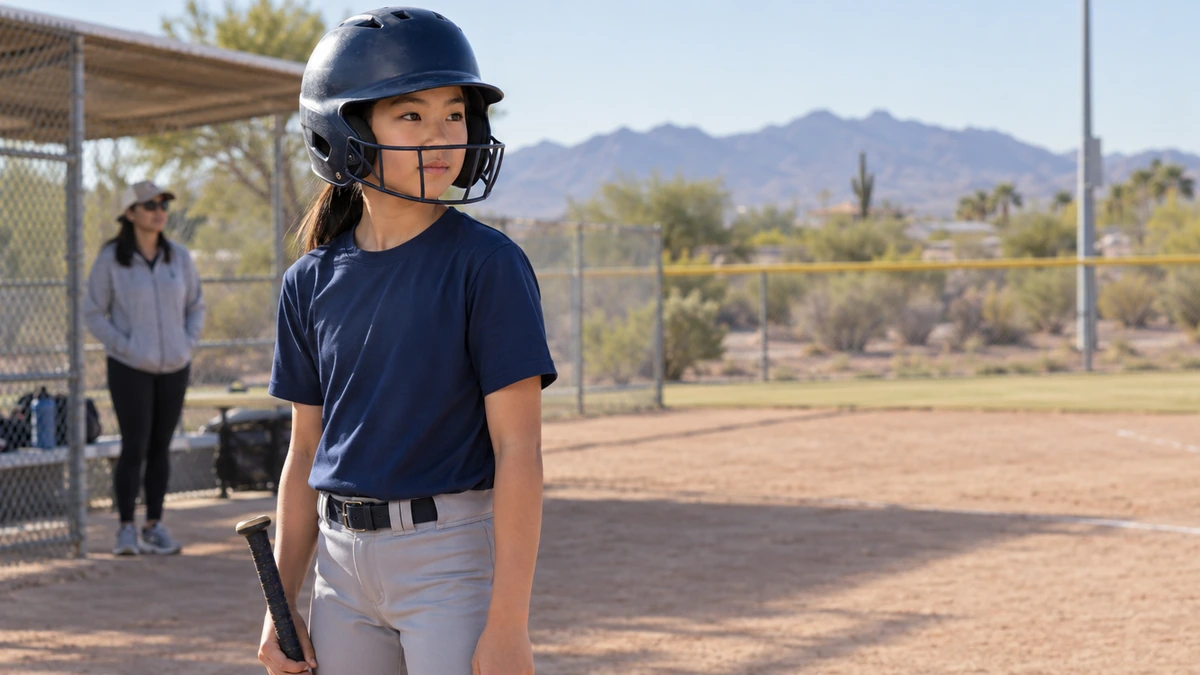
    East Asian girl wears a batting helmet with a face guard at practice, prevention of eye injuries in kids
    A girl in a batting helmet with a face guard waits at baseball practice.

    Choose protection for the sport. Sports eyewear has to meet that sport’s own requirements, says the American Academy of Ophthalmology, and everyday glasses do not protect against impact. No safety eyewear is foolproof, the AAO adds, yet the right pair lowers your child’s risk. My guide to sun and sports eyewear for kids covers lens and frame choices.

    At a youth baseball practice, your child has a helmet, a glove and a bag full of equipment. Put eye protection on that packing list before leaving home. Ask which protection fits the sport and works with the helmet or face guard. I consider protective eyewear part of getting dressed for sport.

    • Name the activity when choosing protection, whether soccer, basketball or baseball.
    • Check the protector’s sport labeling instead of relying on its appearance.
    • Include prescription needs in the discussion.
    • Pack the protection with the equipment your child already takes to practice.

    How I Approach Your Child’s Follow-Up at Vision by Amel

    The ER handles the emergency. Routine eye care comes after, and that is where I fit in for your child. I am Dr. Amel Youssef, founder and optometrist at Vision by Amel in Downtown Summerlin at Festival Plaza, and children’s eye care is central to my work. Follow the treating team’s plan first, then book your child’s follow-up visit with me.

    Your child’s story comes first: what happened, what the ER did and what still worries you. Then I examine your child’s eyes with digital diagnostics and walk you through a plan for your child’s eye health. You leave knowing what to watch for and when to come back.

    For a non-urgent pediatric eye exam, my team accepts online bookings or phone calls. You do not need a referral for an eye exam. Lens wearers need their own rules, and my contact lens guide for kids and teens lays them out for your family. Save the booking options below for planned care after urgent needs have been addressed.

    Frequently Asked Questions About Eye Injuries in Kids

    My Child Got a Chemical in Their Eye. What Should I Do?

    Flush with water right away, then get emergency care right away. When your child wears a contact lens, start flushing over it immediately rather than stopping to remove it, as Prevent Blindness advises. Take the chemical label to the ER if possible, without delaying care.

    Something Is Stuck in My Child’s Eye. Should I Rinse It or Go to the ER?

    Loose dust and an embedded object need different responses. For a loose speck, blinking and tears are appropriate, but an object stuck in your child’s eye needs protection without rinsing or removal and the ER right away. A lingering feeling of something in the eye still needs help right away even when you no longer see a speck.

    My Child Got Hit in the Eye. When Should We Go to the ER?

    Go right away for pain, blurry vision, one eye sticking out, blood inside the eye or a black eye. A light blow still deserves attention because even a small impact risks serious internal injury. Use a cold compress without pressure while getting help for your child, and avoid steaks or other food against the eye because they introduce bacteria.

    Are Sparklers and Fireworks Safe for Kids?

    No. Sparklers burn at about 2,000 degrees Fahrenheit, the American Academy of Ophthalmology notes, and young children should never handle them. Watching nearby still carries a risk of injury, which is why the AAO points your family to a professional show. Plan the celebration around that choice.

    Does My Child Need Different Eye Protection for Each Sport?

    Your child needs protection made and labeled for the specific sport, including when wearing contacts. The Prevent Blindness sports guide lists different standards for different activities, so check the current requirement with your eye doctor or league. Name each sport your child plays rather than assuming one protector suits them all.

    Book My Eye Exam Call (702) 858-4362

    Like this article? Add Vision by Amel as a preferred source, and you are more likely to see our articles in Google’s Top Stories.
    Add as a preferred source on Google

  • Color Blindness in Children: Signs, Testing and School Tips

    Color Blindness in Children: Signs, Testing and School Tips

    Color Blindness in Children: Signs, Testing and School Tips

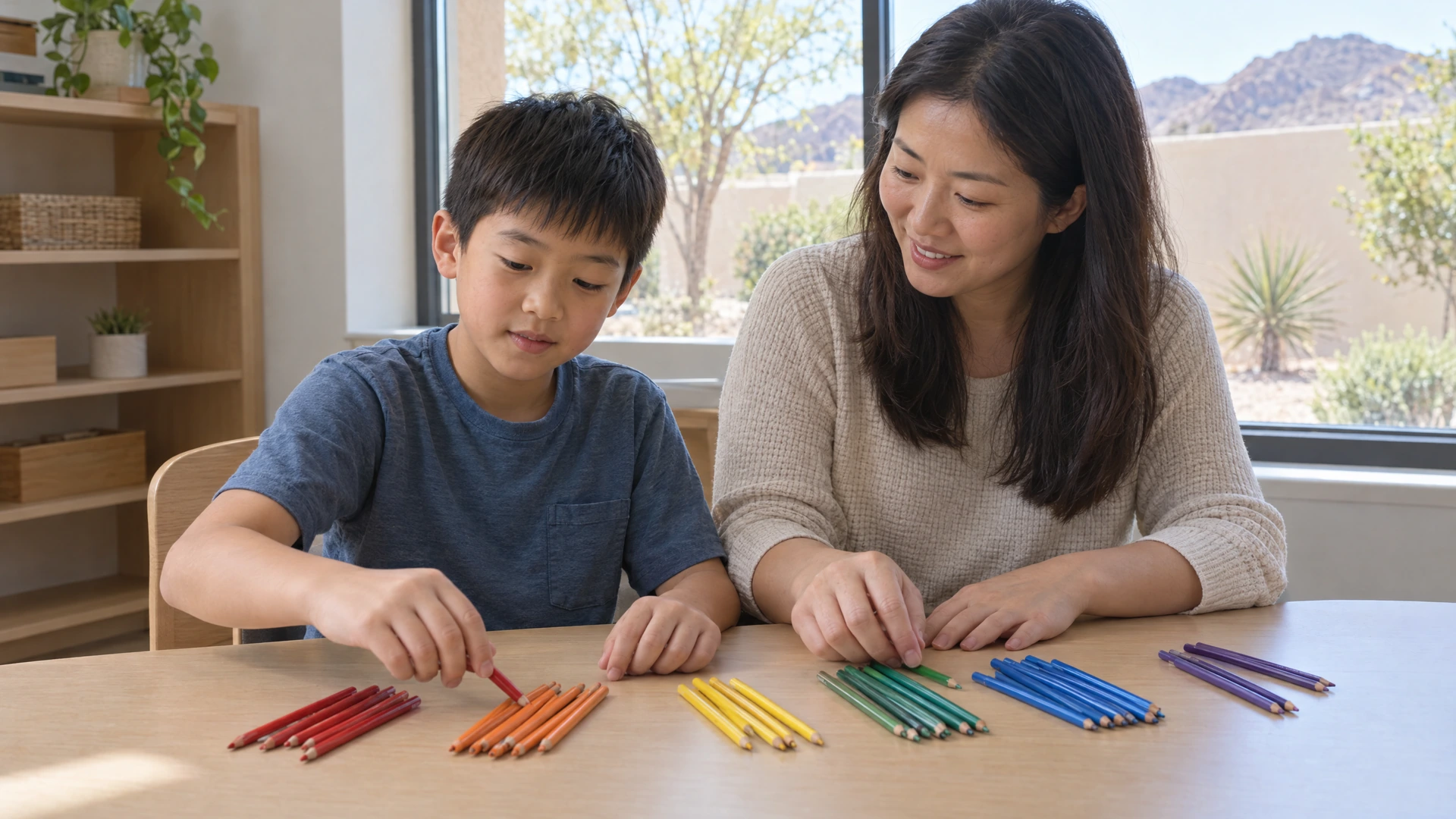
    Mother helping her son sort colored pencils at a table, color blindness in children

    TLDR: Repeated color mix-ups deserve attention: color blindness in children usually means difficulty telling certain colors apart. An eye exam helps identify what your child sees, while clear labels and classroom changes make color-based tasks easier to follow.

    Answer: Color blindness in children usually shows up as the same color mix-ups, again and again, often while your child is learning colors. In Las Vegas, an eye exam with a color vision test tells you what your child sees. Inherited color blindness has no cure and lasts for life, yet simple school changes help. A new change in color vision needs an eye exam promptly.

    Your child reaches for a brown pencil when the worksheet asks for green. You explain the instruction again, yet the same mix-up returns tomorrow. As an optometrist, I read a repeated mix-up as a clue, never as careless work. A comprehensive eye exam gives us a place to investigate, and our eye exams page explains the visit.

    I reviewed 168 primary sources across five research lenses for this guide, and inherited color vision deficiency is lifelong. The National Eye Institute recommends testing when your child struggles to learn colors or has a family history of color vision deficiency. For parents in Summerlin, those details help me understand what prompted your visit. Good children’s vision care starts with understanding the task your child finds hard.

    What Signs Suggest Color Blindness in Children?

    Father and son pointing at fruit in a produce aisle, color blindness in children
    A father and son point at apples in a grocery produce aisle.

    One mix-up means nothing. A pattern means something. You ask for a green apple at the Las Vegas grocery store after school pickup, and your child hovers between the red and the green. Point to the right one, keep shopping, and watch whether the same pair trips your child up with pencils, socks or worksheets.

    Unusual coloring choices are a possible clue: AAPOS describes children drawing orange grass or a purple sky, and notes that most people with a color deficit still see some colors and often do not know they see differently. Let your child tell you about the drawing. Start with a neutral question about the picture. Let your child explain whether the choice was deliberate or whether the pencils looked alike.

    • Which colors trip your child up, again and again?
    • Did the mix-ups start early, or are they new?
    • Does anyone in the family have color blindness?
    • Do they show up in color-coded schoolwork?

    Leave room for creativity. Your child is allowed to invent orange grass without defending it. I would rather hear about a repeated difficulty than judge a child by a drawing. Let the picture stay play, so every art project does not become another test.

    What Does Color Blindness in Children Mean?

    Girl drawing with crayons as her grandmother watches at a kitchen table, color blindness in children
    A girl draws with crayons while her grandmother watches.

    Color vision deficiency is the more precise name. Your child sees color and uses the same color words you do, yet some pairs of shades look alike. The term describes a difference in perception, never a lack of effort from your child.

    Inherited red-green deficiency is more common in boys because it passes through the X chromosome, as the National Eye Institute explains. Other inherited types, including blue-yellow and complete color vision deficiency, affect the sexes equally. Your daughter’s repeated color confusion needs attention too. Sex alone does not settle the question.

    Inherited color differences remain stable throughout life. You do not need to turn practice with color names into a daily drill intended to change them. At a sunny Summerlin kitchen table, let your child describe the picture they are drawing before you sort the crayons together. Use the activity to learn which materials need clearer identification.

    How Is Color Vision Tested?

    Clinician hands holding a color plate book before a boy beside his father, color blindness in children
    An eye doctor's hands hold a color plate book for a boy and his father.

    A color vision test asks about color differences directly. The National Eye Institute describes a plate test with a shape hidden among colored dots, followed by other tests when results are unclear. Your child’s task is to describe what they see. There is no benefit in rehearsing the answers.

    Open your child’s pediatric eye exam with the color question. Name the exact task: the crayon, the colored chart, the sorting game. What did your child do before you stepped in? One real example tells me more than a general worry about colors.

    A home color check raises a question, never a final diagnosis. Age matters too. In the MEPEDS study, only 17% of children younger than 37 months finished a color test, against 98% at 61 to 72 months, so a toddler’s shaky result is not a diagnosis. Our guide to school screening and a comprehensive exam explains what a school screening covers, and what to expect at your child’s first exam walks you through the visit.

    What If Colors Suddenly Look Different?

    A new change in how your child sees color is a different problem from inherited color blindness, and it needs an eye exam promptly. The American Academy of Ophthalmology says anyone with a significant change in color perception should see an ophthalmologist, because an acquired change sometimes signals a more serious condition. I check for the cause and refer you to an ophthalmologist when your child needs one. Never explain it away as the color difference a relative has.

    Acquired changes come from other causes, including some diseases, some medicines and injury to the retina, optic nerve or brain, and the National Eye Institute says the doctor then treats the condition behind the change. Share when your child first noticed it, whether it affects one eye or both, and any recent illness, injury or new medicine. That timeline points the exam in the right direction.

    Color and sharpness are separate jobs. Blur, squinting at the board or headaches each need their own answer for your child. A known color difference never explains away a new eye complaint.

    How Do You Make School and Daily Life Easier?

    Three children playing a board game with colored pieces on a rug, color blindness in children
    Three children play a board game with pieces in different shapes.

    Give your child another way to identify things. AAPOS recommends informing teachers, labeling coloring tools and using black ink on white reading paper. Start with the materials your child already uses. The changes below put those principles into everyday tasks.

    Color-Based TaskPractical AdjustmentExample to Try
    Choosing pencils or crayonsAdd readable color namesLabel the green pencil so your child has a written cue.
    Reading a worksheetUse black text on white paperReplace pale colored instructions with a clear black printout.
    Following a chartAdd names or distinct patternsIdentify a group by its name as well as its colored box.
    Playing a board gameChoose pieces with different shapesLet your child use the cone while another player uses the ring.
    Finding a school folderAdd a subject labelWrite the subject on the front instead of relying on folder color.

    Hand the teacher the worksheet that tripped your child up. Point to the color cue, agree on a word or a shape to replace it, and the fix is done. I want classroom instructions to reward understanding rather than color guessing.

    1. Share the confirmed color vision finding with your child’s teacher.
    2. Review an actual task together, including its key or instructions.
    3. Add words, shapes or patterns wherever color carries the answer.
    4. Check back with your child about which changes help them follow the task.

    Use the same approach at home. On the living room rug, choose game pieces by shape and let your child name their piece before play begins. During a Summerlin school morning, identify the homework folder by its subject label instead of calling across the room for the red one. These are practical ways to make instructions clearer, with no promise about grades.

    How I Approach Color Vision Concerns at Vision by Amel

    Your examples belong in the history. At Vision by Amel, my evaluation includes binocular vision, a color vision test where needed and eye disease screening. My Visionix digital diagnostics back up that evaluation, and I explain each finding to you in plain language. The visit connects your concern with a plan for your child’s eye health.

    You do not need to arrive with a diagnosis. Bring the work sample, your observations and any relevant family history. My team and I offer eye care for children, and a color concern is worth mentioning when you book. For a routine exam about longstanding color mix-ups, no referral is needed.

    Your visit is at 2010 Festival Plaza Dr, Suite 195, Las Vegas, NV 89135, inside Festival Plaza at my Downtown Summerlin office. Book online or call (702) 858-4362, and name color vision as the concern so I know what brought you in.

    Frequently Asked Questions About Color Blindness in Children

    How Do I Know If My Child Is Color Blind?

    Repeated mix-ups while your child learns colors, or a family history of color blindness, are reasons to test, says the National Eye Institute, and some children hide the difficulty. Color blindness rarely blurs vision: except in the most severe form, sharpness stays normal, the American Academy of Ophthalmology notes. A child who squints at the board needs a separate check.

    How Common Is Color Blindness in Boys and Girls?

    In the MEPEDS study of Southern California preschoolers, color vision deficiency showed up in 1.4% of Black boys, 3.1% of Asian boys, 2.6% of Hispanic boys and 5.6% of non-Hispanic white boys. Red-green color blindness is rare in girls, because a girl needs the gene on both X chromosomes, the National Eye Institute explains, while blue-yellow and complete types affect boys and girls equally. These are study figures, not Las Vegas rates or a forecast for your child.

    Can Color Blindness Be Cured?

    No cure exists for inherited color blindness, the National Eye Institute says, and most people adjust to it, with no trouble in everyday activities. When another health problem causes a change in color vision, the doctor treats that cause. For your child, put the effort into the tasks that rely on color.

    How Do Eye Doctors Test Kids for Color Blindness?

    Eye doctors use a color plate test, a shape hidden among colored dots, and add other tests when the result is unclear. By about age 4, most children are able to finish a color test, the MEPEDS study found, so a preschool exam is a good time to check your child. A recent drawing or worksheet that shows the mix-up helps too.

    How Can I Help My Color Blind Child at School?

    Share the finding with adults who teach your child beyond the main classroom, including art and physical education teachers. Review instructions for group assignments and activities as well as reading pages. A group name, spoken direction or distinct shape gives your child another way to follow along.

    Book My Eye Exam Call (702) 858-4362

    Like this article? Add Vision by Amel as a preferred source, and you are more likely to see our articles in Google’s Top Stories.
    Add as a preferred source on Google

  • Styes and Eyelid Bumps in Kids: When to Treat at Home and When to Call

    Styes and Eyelid Bumps in Kids: When to Treat at Home and When to Call

    Styes and Eyelid Bumps in Kids: When to Treat at Home and When to Call

    White mother holding a warm washcloth to her daughter's closed eye for stye in kids care

    TLDR: A stye in kids needs gentle care: a clean warm compress, no squeezing, and attention to changes in your child’s symptoms. Call for an eye exam when a bump persists or returns. Get care right away for spreading redness or swelling around the eye, fever, vision change, or pain moving the eye.

    Answer: For families in Las Vegas, a small eyelid bump without warning signs often starts with warm compresses at home. A stye involves infection, while a chalazion involves a blocked oil gland. Arrange an exam for a lasting or recurring bump, and seek care right away when your child has spreading swelling, fever, vision change, or pain moving the eye.

    You’re getting ready for school in Summerlin when your child points to a bump in the bathroom mirror. Shoes are waiting by the door. You need to know whether to reach for a washcloth, call for an appointment, or leave for urgent care.

    I reviewed 168 primary sources across five research lenses for this guide, and a blocked eyelid gland is different from an infected one. That distinction helps you understand the next step. My eye examination service gives you a place to start for a persistent bump without emergency symptoms.

    Is It a Stye in Kids or a Chalazion?

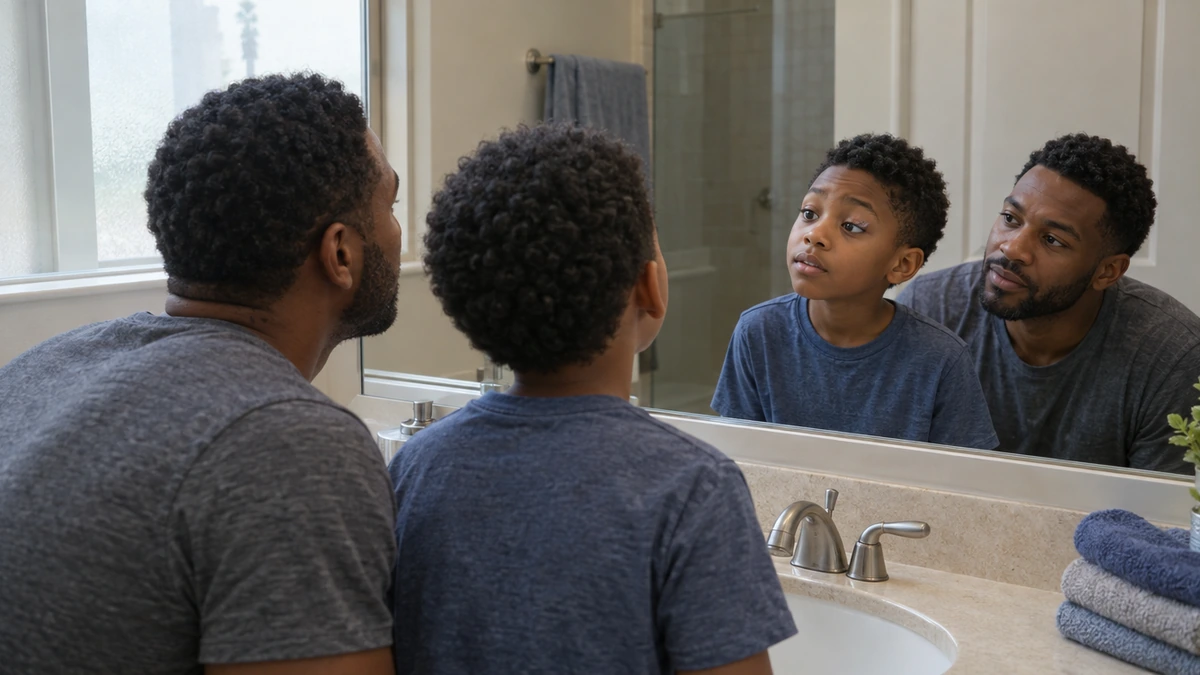
    Black boy looking at his eyelid in a bathroom mirror beside his father, illustrating stye in kids
    A father stays beside his son as he looks at his eyelid.

    A bump is a sign, not a diagnosis. A chalazion is a blocked oil gland, while a stye, also called a hordeolum, is an infected eyelid gland, as AAPOS explains. Most styes start with a bacterial infection, says the American Academy of Ophthalmology, and the AAO adds that the two are sometimes hard to tell apart. Your child’s bump gets its real name at an eye exam.

    Skip the mirror diagnosis. Notice where the bump is, when it appeared, and whether your child reports pain or a change in sight. Those observations are more useful than choosing a label from a photograph.

    What You’re ConsideringWhat It MeansWhat to Do
    Stye, or hordeolumAn infected eyelid glandUse gentle warm compresses when there are no warning signs. Never squeeze.
    ChalazionA blocked eyelid oil glandArrange an exam when it is large, persistent, or returning.
    Spreading swelling or changed visionSigns that need care right away, whatever the bump is calledGet care right away. Eye movement pain or reduced vision means emergency care.

    Listen to your child even when the bump looks small. Tell me in their own words whether the lid hurts or the view across the room has changed. A photo records appearance, but it does not replace an examination. For redness elsewhere in the eye, our guide to pink eye in children addresses that separate concern.

    How Do You Care for a Stye in Kids at Home?

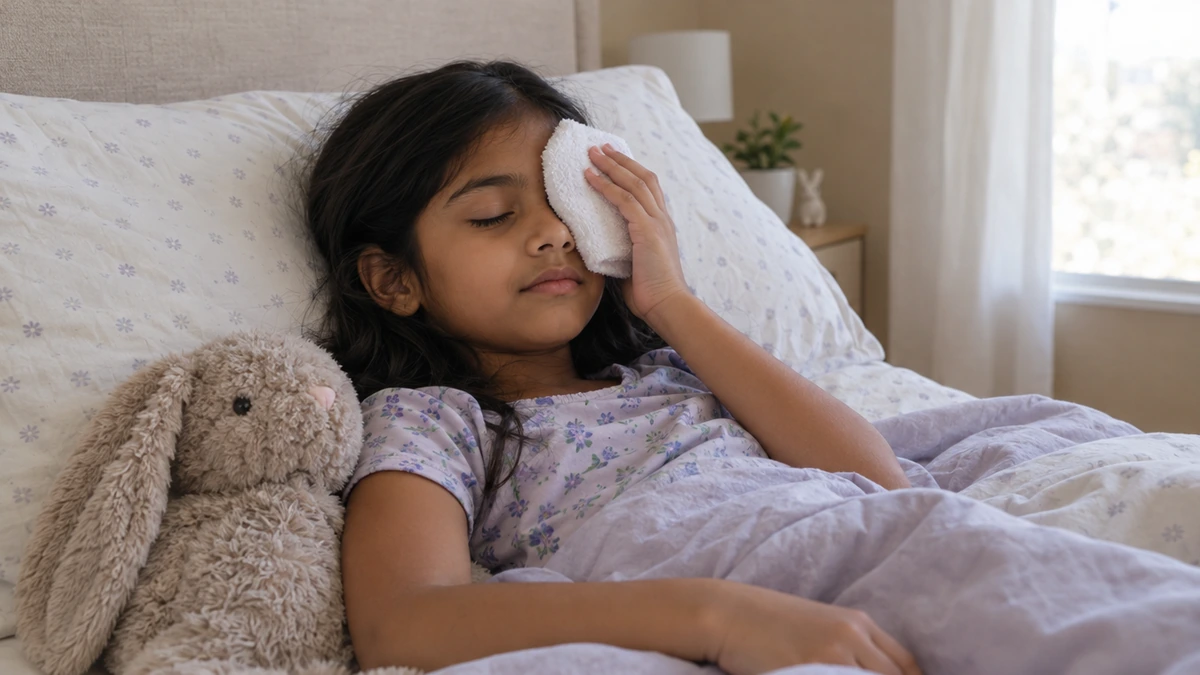
    Indian-American girl resting with a warm compress over one eye for stye in kids care
    A girl rests with a warm compress over her closed eye.

    Start with gentle warmth. The American Academy of Ophthalmology recommends holding a warm compress against the eyelid for 10 to 15 minutes, 3 to 5 times a day, without burning your child’s skin. Published schedules differ, so follow the plan given for your child. Treat this as a care routine, not a deadline for the bump to disappear.

    1. Wash your hands and choose a clean washcloth.
    2. Wet it with warm water. Check the temperature yourself so the cloth feels comfortably warm, not hot.
    3. Help your child settle with the affected eye closed. Rest the cloth gently against the lid without pressing on the bump.
    4. Rewarm the cloth as it cools, checking the temperature again before replacing it.
    5. Leave the bump alone afterward. Do not squeeze, pop, or puncture it.

    Make the setup simple for your child. After a Las Vegas school pickup, set the backpack down and settle together on the couch with the clean washcloth. Let your child choose a story to hear while you hold it gently in place. A familiar routine makes the instructions easier to follow.

    The AAO says never squeeze or pop a stye or chalazion, because squeezing risks spreading the infection into the eyelid, and to skip eye makeup and contact lenses until the bump is gone. Your fingers hold the cloth, never the lump. For a teen who wears lenses, my guide to contact lenses for kids and teens covers the everyday lens habits.

    I prefer a calm, repeatable care plan over a crowded shelf of remedies. You should leave the visit knowing what to do and what change means you need help. Share the plan with everyone caring for your child, from the parent handling breakfast to the grandparent taking over after school. Walk through the cloth placement together so the next adult knows exactly what you mean.

    Which Eyelid Warning Signs Send You Straight to Care?

    Get care right away if your child has spreading redness or swelling around the eye, fever, vision change, or pain moving the eye. The American Optometric Association says redness and swelling extending beyond the eyelid to the cheek or face require an immediate call to your eye doctor. Stop the home-care routine and describe the spreading redness or swelling when you call.

    Go to the emergency room right away for a swollen, red eyelid with pain when your child moves the eye, trouble moving the eye, a bulging eye, double or reduced vision, or fever. Those signs point to orbital cellulitis, an infection of the eye socket, which MedlinePlus calls a medical emergency and warns sometimes gets worse fast in children. Skip the online booking form and go.

    Skip the home test. Whether the infection stays in the lid or reaches deeper around the eye is a call for a doctor to make in person, right away. A home eye-movement check never proves that waiting is safe for your child.

    What Should You Do When Eyelid Bumps Return?

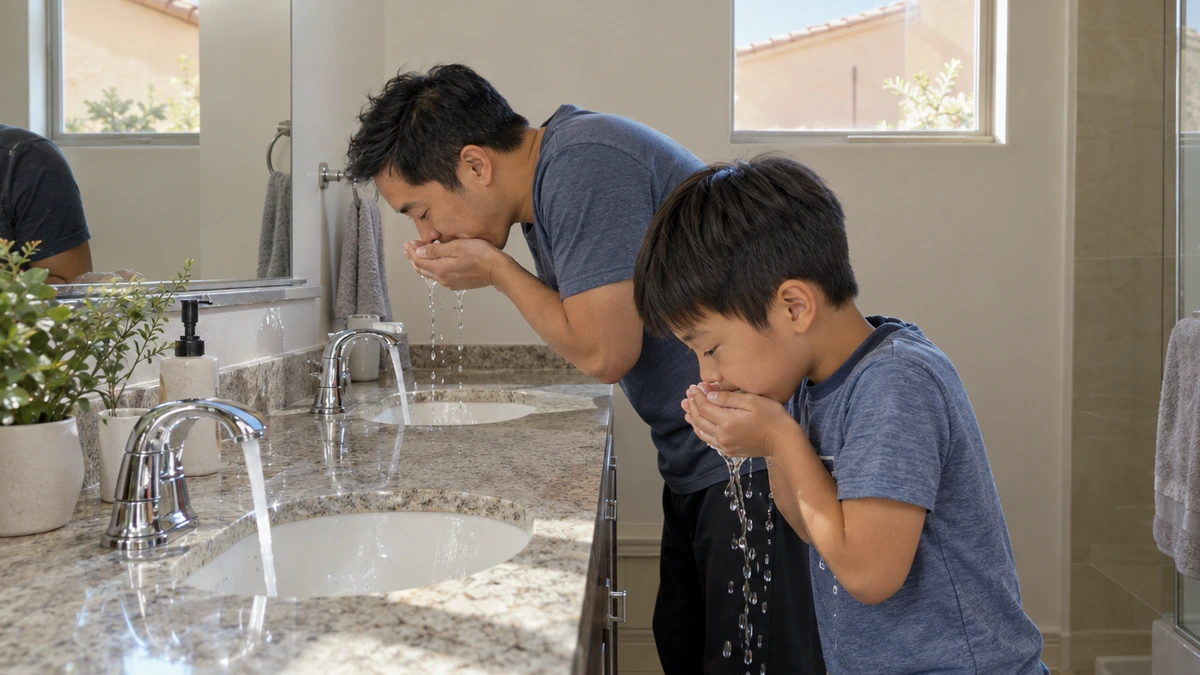
    Vietnamese-American father and son washing their faces at a double sink, illustrating stye in kids care
    A father and son wash their faces before the day begins.

    A returning bump needs a fresh look. Tell me whether your child has had the same problem before and what care you used. Mention any past diagnosis of blepharitis, an inflammation of the eyelid edges. When blepharitis is part of the picture, your child’s plan often includes an eyelid hygiene routine, and my medical eye care page explains how I approach eyelid inflammation.

    Mornings tell the story. At the double sink in your Summerlin bathroom, while you both wash up before school, take one look at the lid. Bigger, smaller, redder? Snap a photo, skip the poking, and show me at the visit.

    Give me the plain version. “It shrank, then it came back on the same lid” is exactly what I want to hear. Share what you tried and whether it helped, and your child’s visit starts in the right place.

    When Should You Book an Exam for a Lasting Bump?

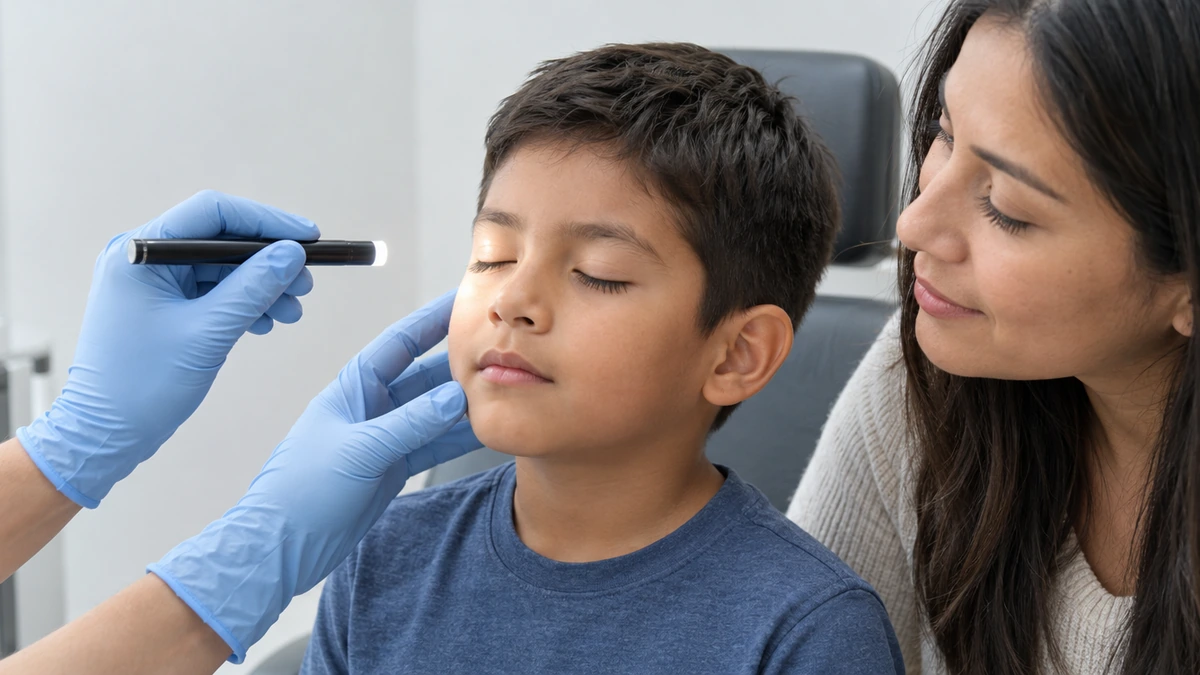
    Gloved hands holding a penlight near a Latino boy's closed eye, mother beside him, for stye in kids
    An eye doctor's gloved hands check a boy's eyelid as his mother sits beside him.

    Book for a large, persistent, or recurring bump even without emergency symptoms. The American Optometric Association advises contacting an optometrist if a chalazion has not drained and healed within a month. You do not need to wait that long when the bump is growing or you are concerned. Changed vision belongs in the right-away guidance above.

    Protecting your child’s eye health means looking past how the lid looks. Report any change in sight right away, even if your child says the bump looks better. A smaller bump is good news, and clear vision is the news that counts.

    A pediatric eye exam gives the whole story room. Bring any earlier care instructions and the products you have used near your child’s eye, and I sort out what helped from what did not. Nothing you tried is a wrong answer.

    How I Approach Your Child’s Eyelid Concern

    I’m Dr. Amel Youssef, your optometrist at Vision by Amel, and your story about the bump opens the visit. When it started, what you tried, what changed. Then I examine the lid, explain what I see in plain English and hand you a plan for the days ahead. Clear instructions are part of your child’s eye care.

    My team sees families from Summerlin every week, and children’s vision is central to the questions parents bring us. For your child’s non-urgent visit, explain whether the concern is a lid bump, a comprehensive eye exam, or both when you book. I put your account together with the examination findings and explain what they mean for the concern you came in with. Before you leave, we go over the next step and the symptoms that mean you should seek care sooner.

    Bring your child to Suite 195 at 2010 Festival Plaza Dr, Las Vegas, NV 89135, inside Festival Plaza in Downtown Summerlin. No referral is needed for an eye exam. Book online or call for a non-urgent appointment, and describe the eyelid concern when arranging the visit. Use emergency care right away for the warning signs above.

    Frequently Asked Questions About Styes and Eyelid Bumps in Kids

    Is the Bump on My Child’s Eyelid a Stye or a Chalazion?

    A stye is an infected eyelid gland, and a chalazion is a blocked oil gland. Chalazia show up more often in adults than in children, the American Optometric Association notes, most often between ages 30 and 50. Your child’s bump still gets its name at an eye exam, because the two sometimes look alike.

    How Do I Treat My Child’s Stye at Home?

    Use the warm compress routine above, and never squeeze the bump. In most cases a stye goes away on its own, says the American Optometric Association, though no fixed timeline fits every child. Call me if your child’s bump keeps growing, and get care right away for the warning signs above.

    Does a Stye Need Antibiotics?

    Not always. Most styes clear on their own, the American Optometric Association notes, and the American Academy of Ophthalmology says an ophthalmologist might prescribe an antibiotic for an infected stye, a decision made at the exam. Before you leave with drops or ointment, know the dose, where it goes and how many days it runs.

    When Does an Eyelid Bump Need a Doctor?

    Book an exam for a bump that is large, lasts or keeps coming back, and get care right away if your child’s vision changes. A large chalazion sometimes presses on the eye and blurs vision, the AAO notes, and AAPOS warns that a big chalazion that does not go away sometimes causes eye problems, especially in young children. When surgery is the answer, children usually need anesthesia, says AAPOS, and I refer you to an ophthalmologist for it.

    My Child’s Eyelid Is Swollen and Red. When Is It an Emergency?

    A swollen, red eyelid with pain when your child moves the eye, trouble moving the eye, a bulging eye, double or reduced vision, or fever needs emergency care right away. Your child’s lack of fever does not rule out orbital cellulitis, as AAO EyeWiki notes. Go to the emergency room rather than waiting for every sign to appear.

    Book My Eye Exam Call (702) 858-4362

    Like this article? Add Vision by Amel as a preferred source, and you are more likely to see our articles in Google’s Top Stories.

    Add as a preferred source on Google

  • Contact Lenses for Kids and Teens in Las Vegas: Is Your Child Ready?

    Contact Lenses for Kids and Teens in Las Vegas: Is Your Child Ready?

    Contact Lenses for Kids and Teens in Las Vegas: Is Your Child Ready?

    Teen girl holding a contact lens case beside her mother at a kitchen table, contact lenses for kids

    TLDR: Readiness for contact lenses for kids rests on hygiene, motivation and your supervision, with no fixed starting age. A contact lens fitting and a dependable care routine come before regular wear. A painful red eye in a lens wearer means remove the lenses and get care right away.

    Answer: No single birthday makes your child ready for contact lenses. Maturity, hygiene and motivation decide, and your supervision matters. In Las Vegas, an eye exam and a contact lens fitting show whether your child is ready. Daily disposables reduce some risks, yet water, sleep and a painful red eye still need firm rules.

    Your teen wants contacts before basketball season. You want to know who will remember the handwashing when practice runs late and homework waits at home. As an optometrist, I start with those ordinary decisions. I value a reliable routine more than an eager promise.

    I reviewed 168 primary sources across five research lenses for this guide, and readiness for contacts depends on maturity, hygiene and motivation. The American Optometric Association identifies those factors, sets no universal starting age and emphasizes your supervision. Start during your child’s comprehensive eye exam, using our eye exam services page to plan the visit.

    Are Contact Lenses for Kids a Good Fit for Your Family?

    Black teen boy dribbling on a Summerlin basketball court without glasses, contact lenses for kids
    A boy dribbles a basketball on a Summerlin court, no glasses on.

    Readiness shows up on a rushed school morning. Does your child wash up without bargaining over every step? Does your child speak up when something feels wrong? Those two answers tell you more than any birthday.

    On a Summerlin outdoor basketball court, your child stops mid-drill to push slipping glasses back up their nose. Contacts appeal because there is no everyday frame to adjust during play. Eye protection still belongs in the sports bag, and my sun and sports eyewear guide shows what to pack. The American Academy of Ophthalmology and American Academy of Pediatrics state that contact lenses offer no protection, so your athlete needs sport-appropriate protective eyewear over them.

    Use this table to check whether your child is ready. It translates readiness into things you have already seen at home. Work through the hesitant answers together before making contacts the next morning’s expectation.

    Readiness QuestionA Useful SignA Reason to Pause
    Who wants contacts?Your child wants to learn.The pressure comes from friends or adults.
    How does hygiene go?Your child follows the whole routine.Handwashing becomes a daily argument.
    How do they handle trouble?Your child speaks up and accepts help.They hide discomfort to stay in the game.
    Who supervises?You have a clear role at home and away.Each adult assumes someone else checked.

    A hesitant child deserves room to decide. You might be ready to move beyond glasses before your child wants to touch a lens. Let them explain what appeals to them and what worries them. I would rather revisit contacts later than turn lens handling into a daily argument.

    What Comes Before the First Pair?

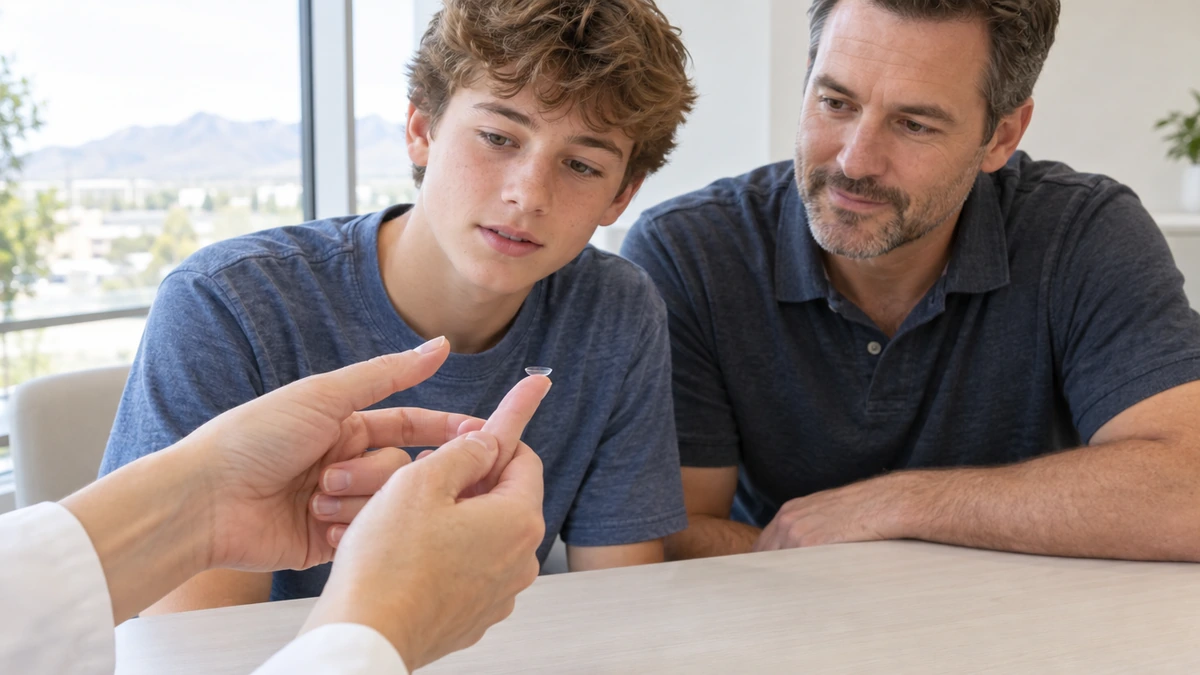
    Eye doctor hands showing a white teen and his father a lens on a fingertip, contact lenses for kids
    An eye doctor's hands show a teen and his father how to hold a lens.

    The fitting is where the plan gets real. Vision by Amel offers contact lens fittings, including daily disposables, and I weigh every lens choice against your child’s eye health. Sports, school or weekends only? Your child’s real week shapes the lens and the schedule.

    Use your visit to discuss the lens prescription and care instructions together. Start with what your child finds difficult. Your child needs room to speak, especially about touching their eyes or removing a lens. Let them describe the difficult part in their own words.

    The Food and Drug Administration says daily disposables reduce some risks because your child starts with a fresh pair each day. That benefit has limits. Handling habits still matter, even when there is no reusable lens to clean overnight.

    Daily disposable means use once and discard, according to the CDC, so your child should never save that pair for another day. Make disposal part of the routine before the first wear. A lens that looks clean has still been used. Agree who checks supplies before school trips and weekends away.

    Your child’s first visit deserves its own preparation. Our guide to a child’s first eye exam explains what to expect without crowding this contact lens decision. Read it together if the appointment itself feels unfamiliar. Leave time for your child to name their questions.

    Which Contact Lens Symptoms Need Care Right Away?

    A painful red eye in a lens wearer means one thing: take the lenses out and get care right away. Irritated red eyes, worsening pain, light sensitivity, sudden blurry vision, unusual watering or discharge all count, says the CDC, and each one means you call your eye doctor right away. Leave the lenses out until your eye doctor clears your child to wear them again.

    Explain this before the first game in contacts. Your child needs to know that eye pain ends lens wear, even during warmups or a close match. Skip the debate over whether they should finish practice. Getting care takes priority.

    When you call, describe the symptoms and say your child wears contacts. Tell me when the trouble started and whether lenses were worn during sleep or around water. Our pink eye guide for parents offers background on red eyes, but reading it should never delay care for these symptoms.

    Which Habits Matter Most With Contact Lenses for Kids?

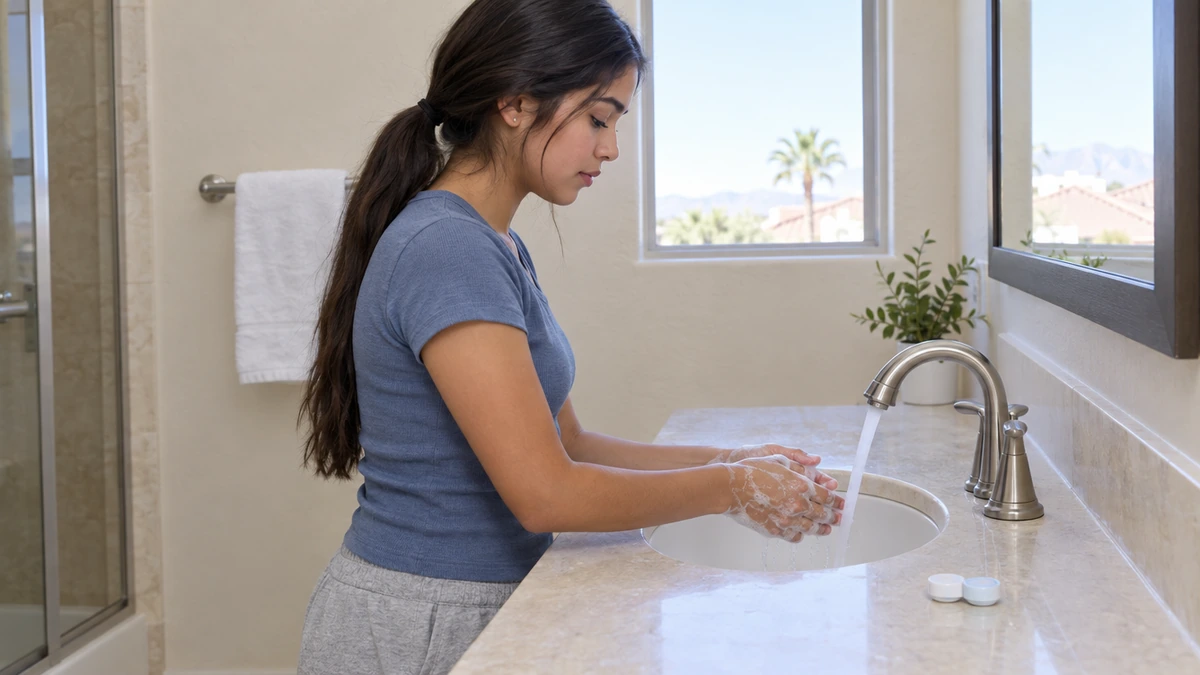
    Latina teen washing hands beside an untouched plain lens case, contact lenses for kids
    A teen washes her hands before she touches her lens case.

    Set the routine before the busy day. Your child needs clear instructions for hands, water, sleep and storage. Follow the sequence below with them until everyone knows their part. Give each step enough time.

    1. Wash hands with soap and water, then dry them completely with a clean cloth before touching lenses.
    2. Handle lenses with clean, dry hands. Follow the wear instructions given with the fitting.
    3. Remove lenses before swimming or showering. Keep lenses away from all water, including tap water used as a rinse.
    4. Take lenses out before sleep, including naps.
    5. For reusable lenses, follow the prescribed cleaning routine and use fresh solution. Never add fresh solution to old solution in the case.
    6. Replace a reusable lens case at least once every three months.

    These handwashing, water, sleep, solution and case rules come from CDC guidance for your child’s contact lens routine. Make the order easy to remember at home. The bathroom sink is for washing hands. Lenses stay clear of the running water.

    Put the case date on the family calendar, right beside the practice schedule, so your child’s case never outlives its three months. Review the cleaning steps together before every sleepover bag gets packed. Small habits, repeated daily, protect your child’s eyes.

    How Do You Share Responsibility With a Teen?

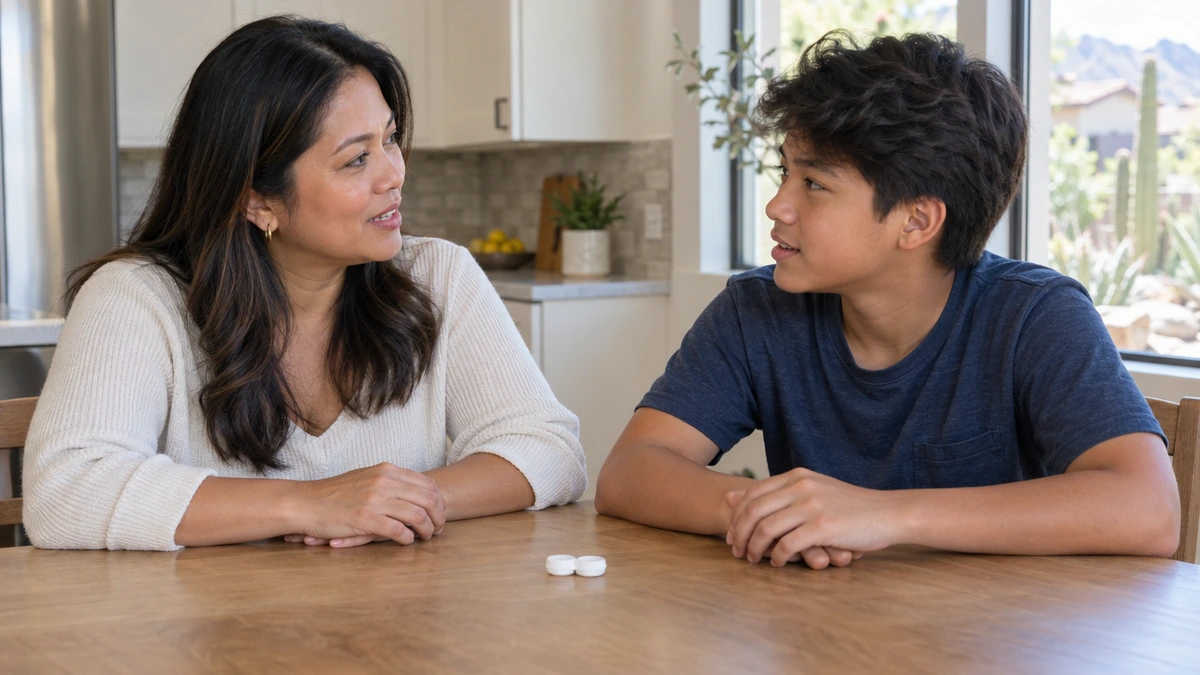
    Filipino-American mother and son talking beside a plain lens case, contact lenses for kids
    A mother and her son talk through the lens routine at the kitchen table.

    Make the plan fit a real evening. Your teen gets home from practice in Las Vegas, drops a gym bag beside the kitchen table and heads toward the shower. This is the moment to remember lens removal. Decide on that order together while nobody is tired or rushed.

    Give your teen ownership of the routine while keeping your role clear. Agree who notices supplies running low and who checks the bag before a sleepover. Talk through what happens when plans change and swimming gets added to a friend’s afternoon. The answer needs to be settled before everyone reaches the pool.

    Leave room for honest reports. Your child should feel comfortable saying they forgot a step, struggled with removal or felt something unusual. Start with what happened, then address it together. Treat speaking up as part of responsible eye care.

    How I Approach Your Child’s Contact Lens Visit

    I am Dr. Amel Youssef, founder and eye doctor at Vision by Amel. My practice offers pediatric eye exams and contact lens fittings, from daily disposables onward. Your child gets the exam first, then a fitting planned around school, sports and your home routine.

    Your child’s exam uses Visionix digital diagnostics, and I walk you through every result. When a lens feels wrong, your child tells me, and I adjust the lens material, the wear schedule or the fit. A painful red eye never waits for a routine visit: follow the steps above.

    You will find us at 2010 Festival Plaza Dr, Suite 195, Las Vegas, NV 89135. Our Downtown Summerlin location is at Festival Plaza. For a routine exam and contact lens fitting, book online or call. Include your child’s interest in contacts when arranging the visit.

    Frequently Asked Questions About Contact Lenses for Kids

    How Old Does My Child Have to Be to Wear Contacts?

    No birthday decides it. The American Optometric Association sets no single starting age, and your child’s maturity, hygiene and motivation matter more. Younger children often need more practice: in the CLIP study, children aged 8 to 12 needed about 42 minutes of insertion and removal training, against about 30 for teens. That was a short, 3-month study, so read it as a guide to patience, not a rule.

    Are Daily Disposable Contacts Safer for Kids?

    Daily disposables reduce some risks, because your child starts each day with a fresh pair, yet no lens is infection-proof. A 2023 review of seven studies by Bullimore and Richdale found serious corneal infection no more common in children wearing soft lenses than in adults. Those are study rates, not your child’s own odds, so the water, sleep and handwashing rules apply every single day.

    Can My Teen Swim, Shower or Sleep in Contacts?

    No. Take the lenses out before the pool, the shower or bed, because water carries germs and sleeping in lenses raises the chance of a serious eye infection. Eye care professionals generally do not recommend overnight lenses for kids and teens, the Food and Drug Administration says, since they raise the rate of corneal ulcers. Pack the lens case and backup glasses in your teen’s sleepover bag.

    My Child’s Eye Is Red and Hurts With Contacts In. What Do I Do?

    Take the lenses out now and call your eye doctor right away. Leave them out until your eye doctor says your child is ready to wear them again. The most severe lens-related infections sometimes lead to blindness or a corneal transplant, the CDC warns, which is why this call never waits for morning.

    Can Kids Wear Colored or Costume Contacts?

    Only with a prescription. The Food and Drug Administration treats lenses without corrective power as medical devices, so Halloween lenses from a costume shop are off the table for your child. Never let your child share a friend’s lenses or wet a lens with saliva.

    Book My Eye Exam Call (702) 858-4362

    Like this article? Add Vision by Amel as a preferred source, and you are more likely to see our articles in Google’s Top Stories.
    Add as a preferred source on Google

  • Pink Eye in Kids: When to See an Eye Doctor in Summerlin

    Pink Eye in Kids: When to See an Eye Doctor in Summerlin

    Pink Eye in Kids: When to See an Eye Doctor in Summerlin

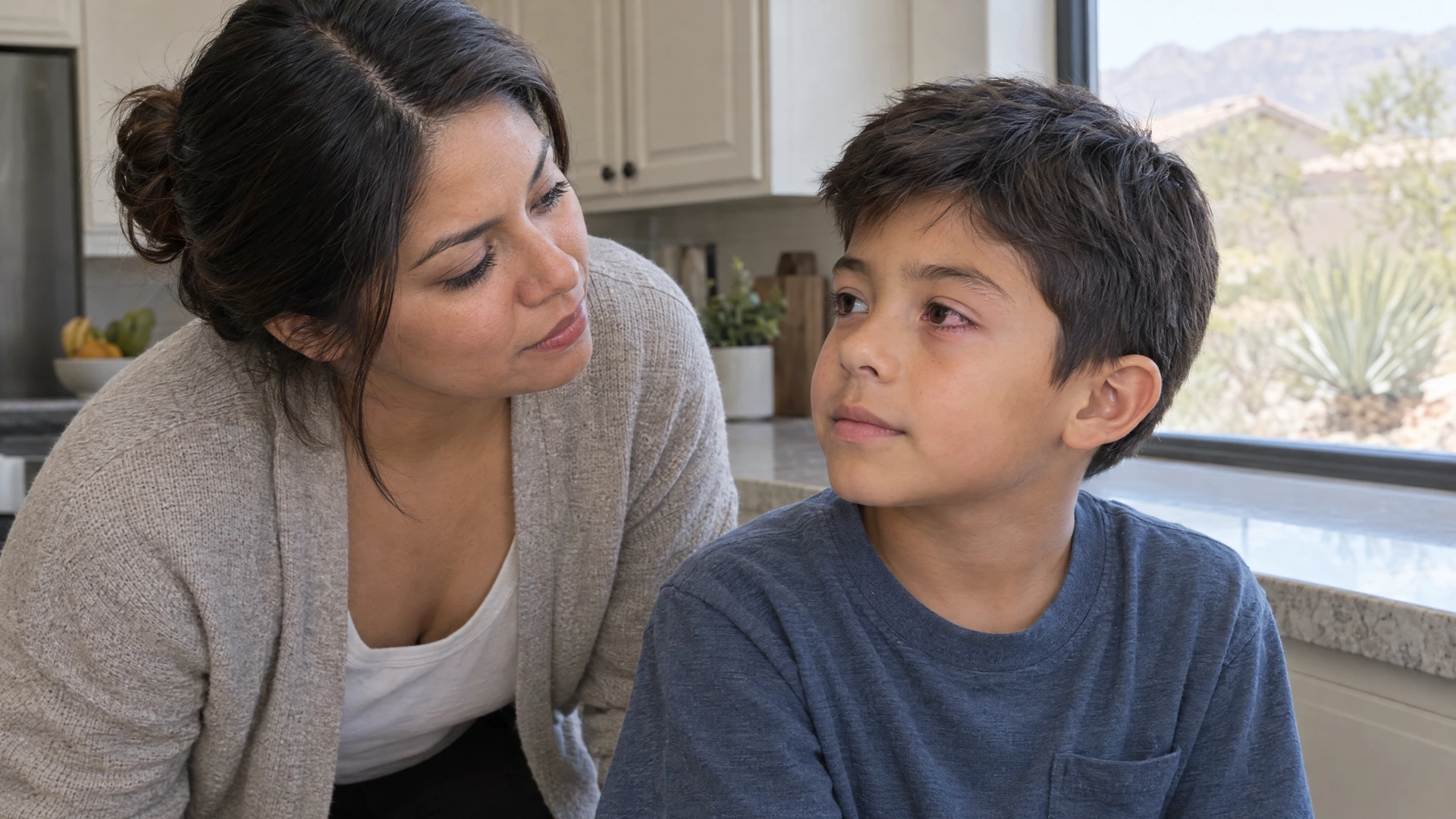
    Latina mother checking her son's slightly red eye at a kitchen counter, illustrating pink eye in kids

    TLDR: With pink eye in kids, your first decisions are whether your child needs prompt care and how to limit spread. Get care right away for the warning signs below, and check the school or daycare policy before sending your child back.

    Answer: Seek an eye doctor right away in Summerlin for your child’s pink eye with pain, light sensitivity or blurred vision that persists after discharge is wiped away. A newborn with pink eye symptoms, or a contact lens wearer with a red, painful eye, needs care right away too. For other concerns, call to arrange an eye exam and discuss school return.

    Your child wakes up with one red, sticky eye. The lunch is packed, the carpool leaves at 7:40, and you have five minutes to decide. Start with how your child feels, then sort out school. At your Summerlin kitchen counter, the car keys sit beside an untouched bowl of cereal.

    I reviewed 113 primary sources across five research lenses for this guide, and the cause of pink eye is sometimes hard to tell from symptoms alone. You do not need to name the infection before calling for help. As an optometrist in Las Vegas, I want your first call to describe what changed and how your child feels. Our eye exam service page explains the broader exam process.

    What Should You Do First for Pink Eye in Kids?

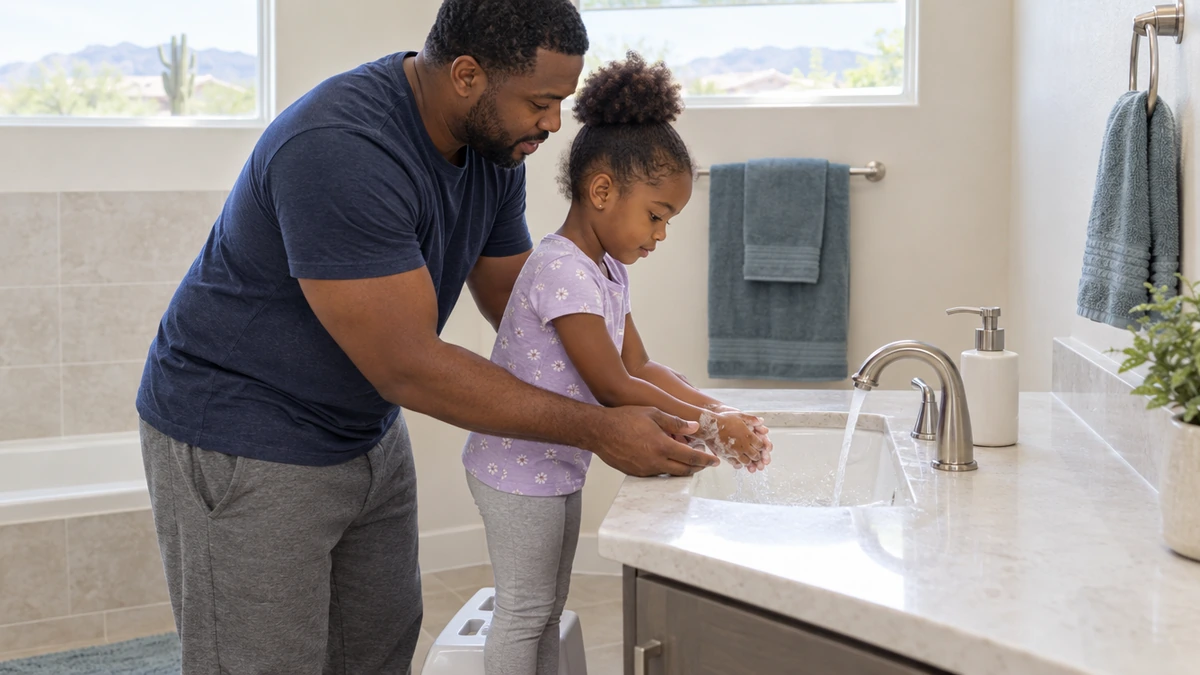
    Black father helping his daughter wash her hands at a bathroom sink, a hygiene step for pink eye in kids
    A father helps his daughter wash her hands with soap at the sink.

    Start at the sink. Wash your hands often with soap and water for at least 20 seconds, as the CDC recommends to limit spread. Help your child follow these hygiene steps while you arrange any needed eye care.

    1. Wash your own hands and help your child wash theirs.
    2. Discourage touching and rubbing the eyes.
    3. Set aside separate towels, washcloths and pillows.
    4. Keep eye drops for the person using them, without sharing bottles.
    5. Wash used linens in hot water, then wash your hands after handling them.

    Make the routine easy to follow. Put your child’s towel where they reach for it, and show siblings which towel belongs to them. Explain the plan to the adult handling pickup or bedtime. A clear handoff keeps everyone following the same steps.

    When Does Pink Eye in Kids Need Care Right Away?

    Eye pain, light sensitivity and blurred vision that does not clear when you wipe away the discharge are on the CDC list of reasons to see a provider. With pink eye, I want your child seen for those right away. The CDC also wants a provider to check intense redness, symptoms that get worse or do not improve, bacterial pink eye that is not better after 24 hours of antibiotics, and any child with a weakened immune system. Say which sign you noticed when you call. Do not wait for a routine appointment slot.

    Have your newborn seen right away for pink eye symptoms, as the CDC directs. Start the call with your baby’s age and symptoms. This call takes priority over planning your routine infant visit.

    Wear contacts? Take them out now. A red, painful eye in a contact lens wearer needs care right away. The CDC warns that bacterial pink eye in lens wearers raises the risk of bacterial keratitis and calls for antibiotics plus a prompt ophthalmologist exam. Mention your child’s contact lenses when calling for care.

    Is Your Child’s Pink Eye Viral, Bacterial or Allergic?

    The cause matters. Viral and bacterial pink eye spread between people, allergic pink eye does not, and overlapping symptoms complicate identifying your child’s cause, according to the CDC. Use this comparison to understand those distinctions before discussing treatment.

    TypeDoes It Spread Between People?What It Means for Your Family
    ViralYesFollow the handwashing and separate towel routine.
    BacterialYesFollow the same hygiene routine and discuss treatment.
    AllergicNoDiscuss allergy care once the cause has been assessed.

    Describe what you see without trying to label it. Note when the redness began, whether an eye is draining and what your child says about discomfort. Include anything already used on the eye. I would rather hear your child’s own words than a guessed diagnosis.

    One red eye, one question. Save the glasses and screening questions for another day, and read my pediatric eye exam guide once the redness clears. Your notes about today’s redness deserve their own space.

    How Do You Keep Pink Eye From Spreading at Home?

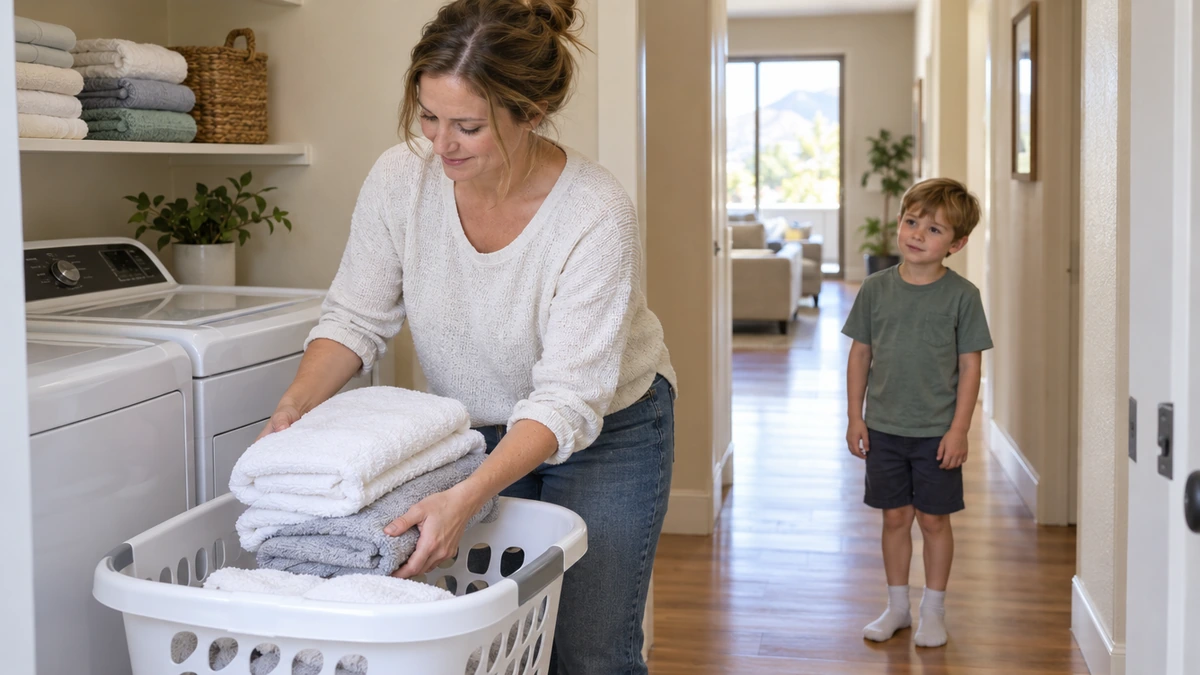
    White mother placing fresh towels in a laundry basket as her son watches, home hygiene for pink eye in kids
    A mother sets out fresh towels while her son watches from the hallway.

    One towel per person. That single rule protects your whole household, including whoever does the laundry. Set clean towels within reach and put used ones straight into the laundry basket. Avoid leaving a damp washcloth beside the shared hand towel.

    Your child needs a simple explanation. Try, “This towel is yours while we look after your eye.” Show them where it belongs instead of repeating a warning from across the room. When another caregiver takes over, point out the towels and explain the handwashing routine.

    At a Las Vegas school pickup, your child climbs into the back seat rubbing an eye while another parent waits behind you. Park before calling about the symptoms. Tell the teacher or daycare staff what symptoms you noticed and what guidance you received. Explain whether your child still needs help keeping hands away from the eyes. That detail belongs in the return discussion alongside the attendance policy.

    What Helps Your Child Feel More Comfortable?

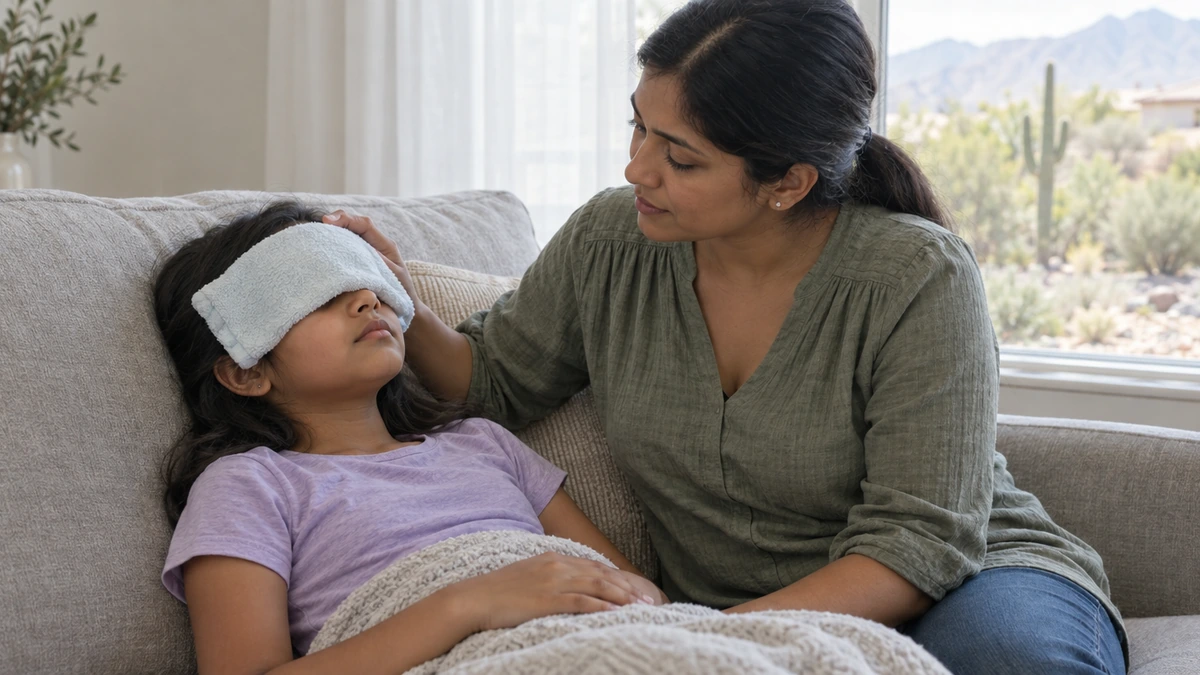
    South Asian girl resting with a cool damp washcloth over closed eyes beside her mother, comfort for pink eye in kids
    A cool compress is a comfort measure for pink eye.

    Match your child’s care to the cause. Antibiotics do nothing for viral pink eye, mild bacterial pink eye often clears without them, and cold compresses with artificial tears ease the irritation, says the CDC. For allergic pink eye, the same guidance points to allergy medicine or antihistamine eye drops. Discuss which drops fit your child’s symptoms before choosing a bottle.

    Your child’s treatment decision belongs with the assessment. Bring the school policy to that discussion, along with the symptoms you have observed. Describe what has changed since the morning, including anything your child says feels worse.

    Make your questions practical. Write down what to use, how to use it and when to check back. Repeat those instructions to anyone helping with care so the plan stays consistent. I want you to leave with instructions you understand and know how to follow.

    When Should Your Child Return to School or Daycare?

    Rules depend on the type of pink eye and on your child’s school or daycare. Nevada’s state health guidance does not require keeping your child home for clear, watery pink eye without fever, eye pain or red eyelids, unless your child cannot keep hands away from the eyes, says the Nevada OSE provider sheet. Thick white or yellow discharge with eye pain means a provider exam and approval before your child goes back.

    The Nevada OSE parent sheet says your child needs to stay home for fever or being too unwell for routine activities, and says antibiotics or a provider note are not required for return. These are health guidance documents. Confirm how your school or daycare handles the differing instructions.

    Ask staff for their written policy. Explain the symptoms, the assessment and any treatment instructions rather than promising a return date before the visit. Save the response with your child’s care notes. I believe a clear return plan is part of caring for the whole family.

    How I Approach Your Child’s Visit at Vision by Amel

    Mother and son walking from a parked car toward a glass-front optometry boutique, a visit for pink eye in kids
    A mother and son walk toward an optometry boutique on a late Sunday morning.

    Call with the red eye first. Tell my team your child’s age, when the redness started and whether your child wears contacts. Act on the urgent signs above before making a routine booking request. Your child’s eye health comes before finding the most convenient appointment.

    I am Dr. Amel Youssef, OD, founder of Vision by Amel. You are welcome to book a pediatric eye exam without a referral. For visit preparation, our guide to your child’s first eye exam in Summerlin walks through what to expect. List your red eye questions ahead of any broader vision concerns. My medical eye care page explains how my team handles red, irritated eyes.

    You will find our Summerlin office at 2010 Festival Plaza Dr, Suite 195, Las Vegas, NV 89135, in Downtown Summerlin at Festival Plaza. We open seven days, Monday to Saturday 9 am to 6 pm and Sunday 11 am to 5 pm. Book online or call (702) 858-4362. Use the weekend hours to plan a visit, while acting right away on urgent symptoms.

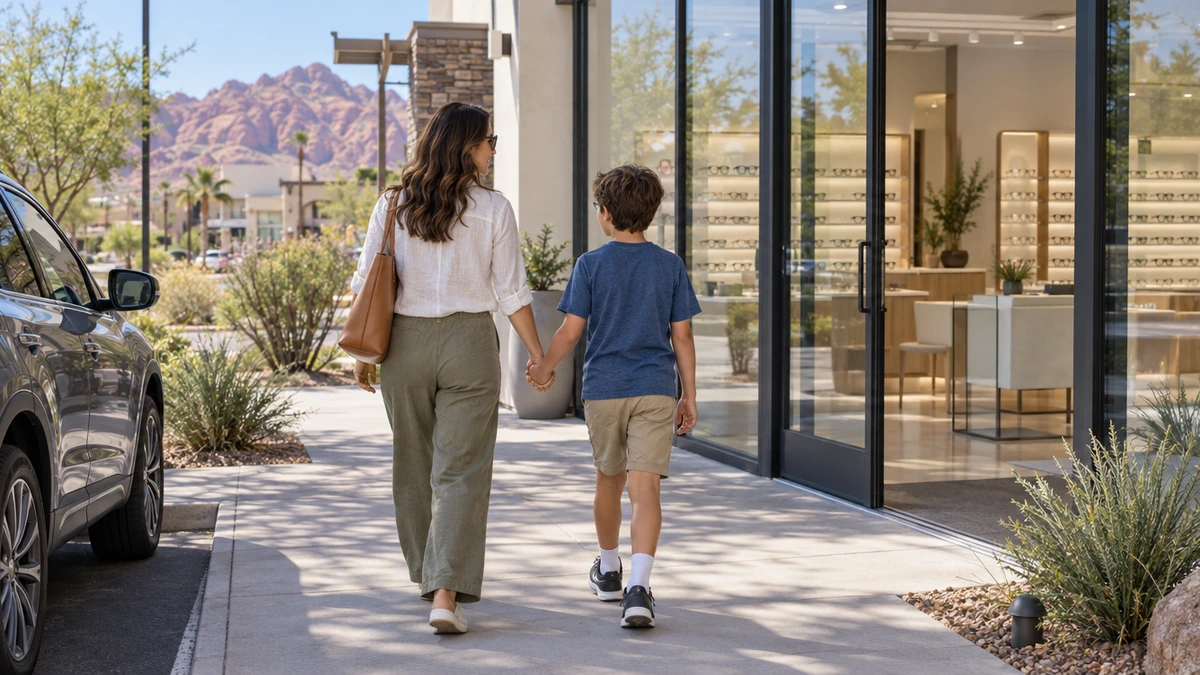
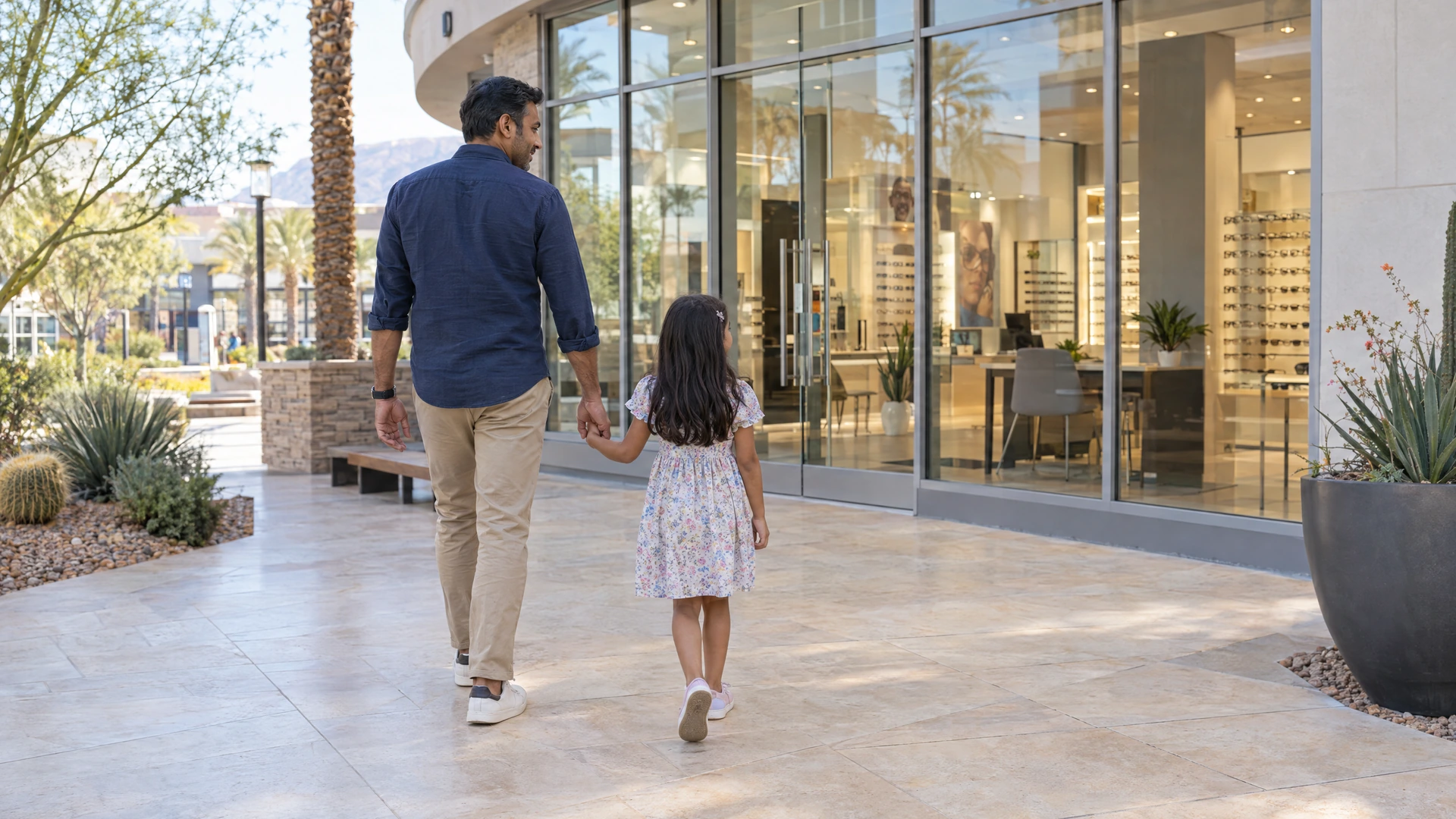
    On a Sunday at Festival Plaza, your child holds your hand as you cross the walkway from the parked car. Before heading over, call with the symptoms and your visit questions. Put the care instructions beside the car keys so whoever takes your child has the same information. The next step should be clear before you leave home.

    Frequently Asked Questions About Pink Eye in Kids

    How Long Is Pink Eye Contagious?

    For infectious pink eye, Nevada’s provider sheet lists the contagious period as the time symptoms are present. It lists symptom onset 1 to 12 days after exposure, usually 1 to 3 days. Your child’s symptom timeline helps you explain when the redness began, but it does not establish who passed the infection along.

    How Long Does Pink Eye Last in Kids?

    Most children improve after 5 or 6 days without antibiotics, according to Nevada’s parent sheet. The CDC says mild bacterial pink eye usually clears in 2 to 5 days, though complete recovery sometimes takes 2 weeks. Your child’s return date still needs its own discussion with the school or daycare.

    Should My Child Stop Wearing Contact Lenses With Pink Eye?

    Yes, stop your child’s contact lenses until symptoms are gone or I say wearing them again is appropriate, following the CDC prevention guidance. Make the restart instruction part of your care notes. A school return date does not settle when to put the lenses back in.

    What Should I Ask My Child’s School About a Return Note?

    Request the exact wording of the policy and find out who handles return decisions. Bring any form your school wants completed to the visit. Keep a copy of the instructions so the adult taking your child back has the same information.

    Why Does My Newborn Have Pink Eye?

    The CDC lists a blocked tear duct, irritation from antimicrobial drops given at birth, and infection passed during birth among the causes. You do not need to identify which one applies before seeking help. Have your newborn seen right away for pink eye symptoms.

    Book My Eye Exam Call (702) 858-4362

    Like this article? Add Vision by Amel as a preferred source, and you are more likely to see our articles in Google’s Top Stories.
    Add as a preferred source on Google

  • Crossed or Wandering Eyes in Children: What Strabismus Means

    Crossed or Wandering Eyes in Children: What Strabismus Means

    Crossed or Wandering Eyes in Children: What Strabismus Means

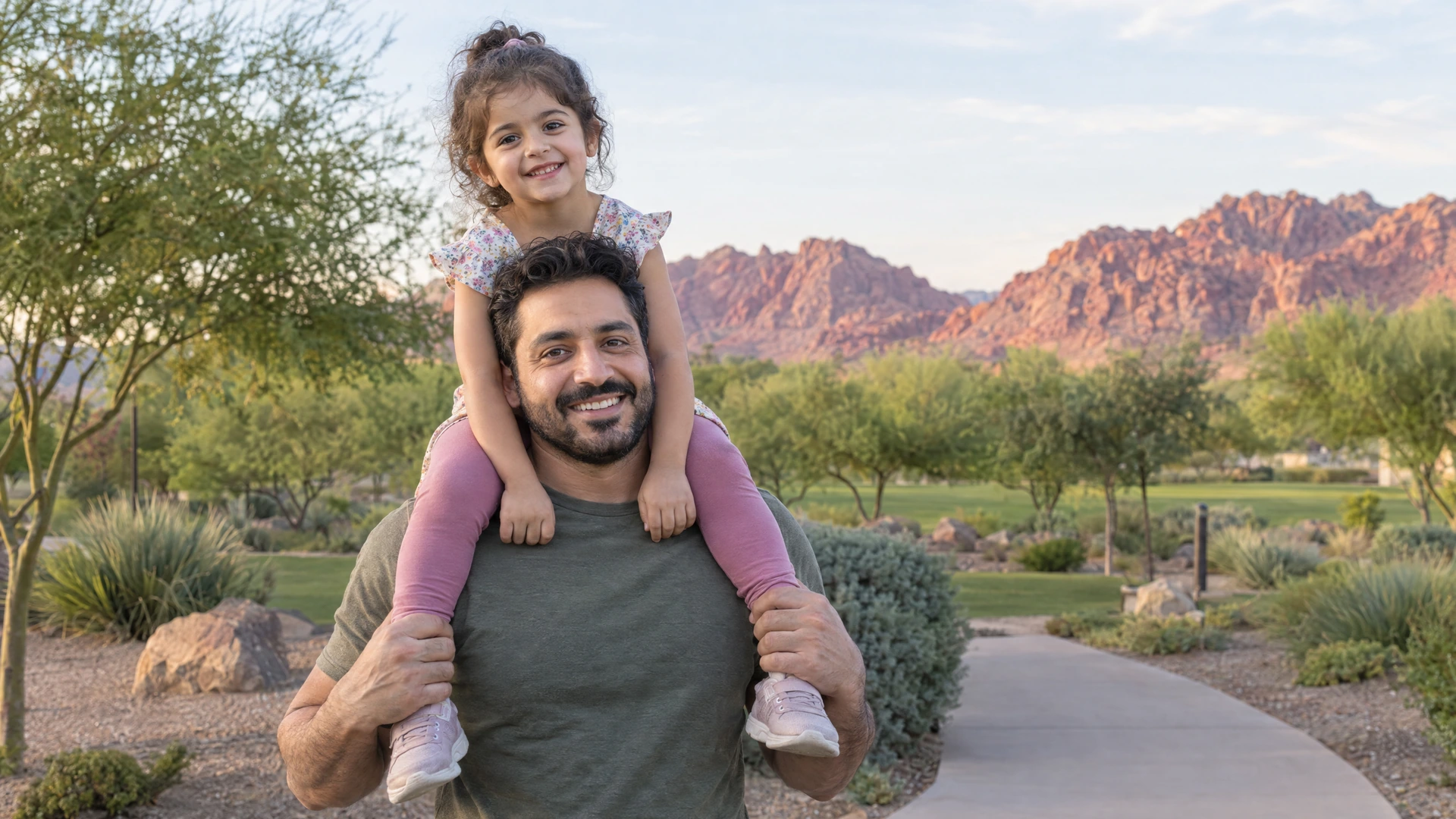
    Father and daughter at a Summerlin park, illustrating crossed eyes in children guidance

    TLDR: An eye turn deserves attention, even when it comes and goes. An examination checks whether your child’s eyes line up, how each eye sees, and which treatment fits the findings.

    Answer: True crossed eyes in children are a form of strabismus, meaning the eyes do not line up. An eye might turn inward, outward, upward or downward. For your family in Las Vegas, the next step is an eye exam to identify the type and assess vision, followed by glasses, patching or a surgical referral when indicated.

    You notice it while scrolling through photos from a Summerlin park. Your toddler smiles toward the camera, but an eye seems to point somewhere else. Then you look up, and both eyes appear straight. You have something worth checking, even when the next picture looks different.

    I reviewed 113 primary sources across five research lenses for this guide, and strabismus and amblyopia are different problems that sometimes occur together. For your child, eye misalignment also carries a risk of amblyopia, as AAPOS explains. I take a parent’s repeated concern about an eye turn seriously. My eye examination service is a place to discuss what you have noticed.

    What Do Crossed Eyes in Children Look Like?

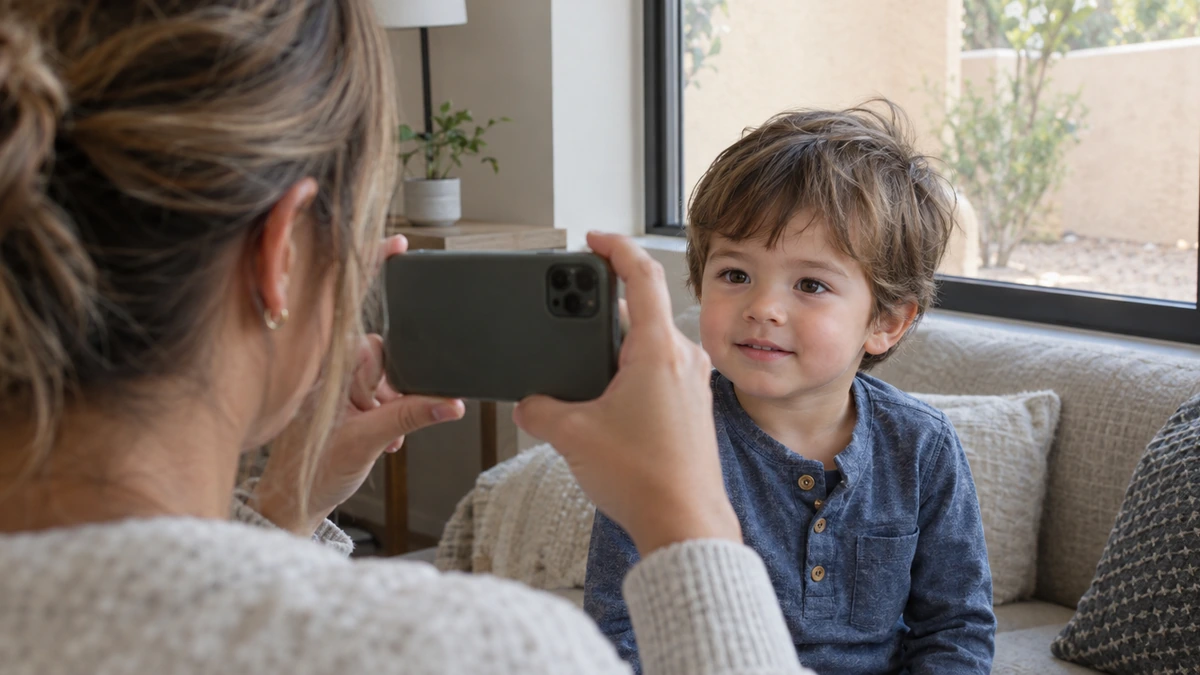
    Mother photographing her toddler by a window for a crossed eyes in children discussion
    A mother takes a casual photo of her toddler in window light at home.

    Tell me which way the eye turns. In or out, up or down, that one detail starts the exam ahead. Esotropia means an inward turn toward the nose, while exotropia means an outward turn toward the ear. For a vertical turn, use plain words when you call, even before you know the medical name.

    TermWhat It DescribesWhat to Record
    EsotropiaAn eye turns inwardWhich eye looks closer to the nose
    ExotropiaAn eye turns outwardWhich eye drifts toward the ear
    IntermittentThe turn comes and goesWhen you notice it and when the eyes look straight
    ConstantThe turn stays presentWhen you first noticed the persistent turn

    An occasional outward drift still matters. Your child’s eyes might look straight for much of the day, then drift when tired or sick, a pattern described by AAPOS. The word intermittent describes timing. It does not tell you to dismiss the concern.

    How to Bring Useful Photos

    Your everyday photos give us a place to begin. A casual picture near a window or a short video of ordinary play gives you something concrete to show me. Save the original files and note what was happening. Collecting pictures should never postpone the examination.

    1. Choose an existing photo that shows your child’s face and both eyes clearly. Include the date with it.
    2. For a new picture, use comfortable natural light and hold the phone near your child’s eye level. Let your child look naturally toward you.
    3. Save the original without filters, red-eye correction or other edits. Save a wider view as well as any close-up.
    4. Write down whether you noticed the turn during play, before a nap or during illness. Include what you saw in person.

    Have your child see an eye doctor right away for a white or gray-white glow in the pupil, in person or in a flash photo, as AAPOS advises. Several conditions cause this reflection, and some are serious. Do not wait for another photo to confirm it.

    When Is Newborn Eye Wandering Normal?

    Brief, on-and-off inward turns are common in babies younger than about 4 to 5 months, says AAPOS. An eye that turns all the time, at any age, needs an eye exam right away. Children do not outgrow true strabismus, the American Optometric Association says, and any child older than 4 months whose eyes are not straight all the time needs an exam. For your baby, describe constant crossing when you call so the need for care is clear.

    Some babies only look cross-eyed. A wide nasal bridge or folds of skin near the inner corners sometimes create that appearance, called pseudostrabismus, which children sometimes outgrow, according to the American Academy of Ophthalmology. An eye exam tells you which one your child has.

    You do not need to settle the diagnosis at home. Describe the direction, the pattern and when you first noticed it, then arrange the recommended evaluation. For the wider infant schedule, read your baby’s first eye exam guide. Address the crossing concern before planning routine checkups.

    How Are Crossed Eyes in Children Evaluated?

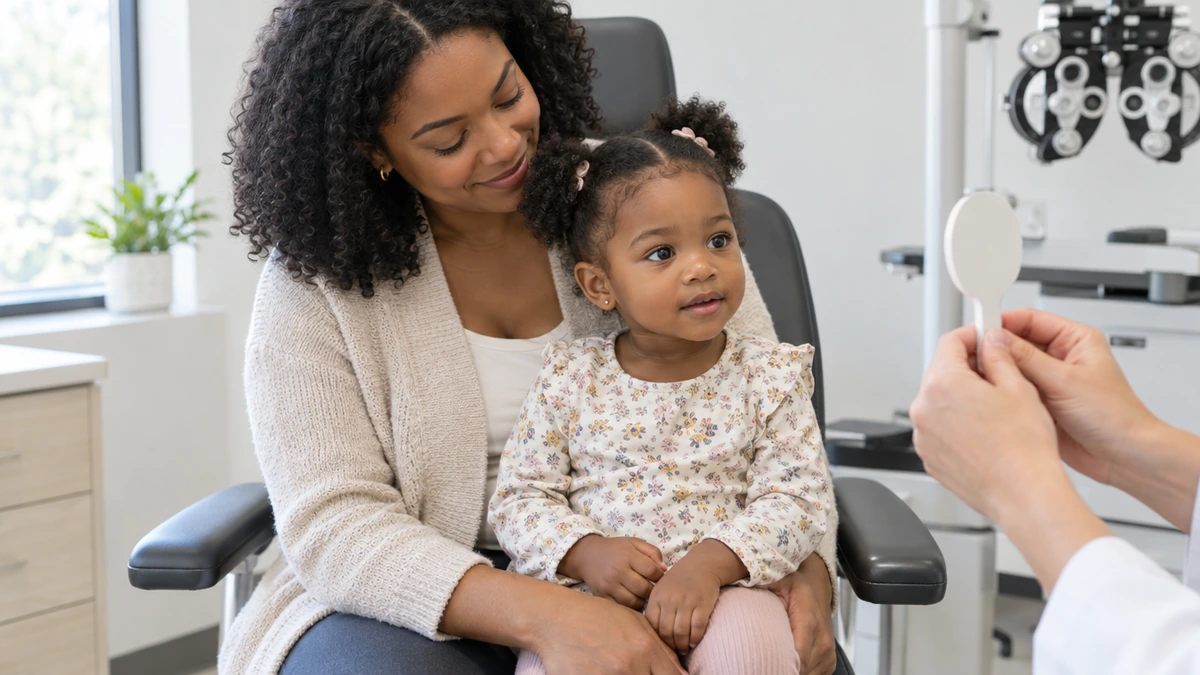
    Toddler on her mother’s lap watching a toy during an exam for crossed eyes in children
    The examination approach adapts to your child’s age and cooperation.

    A comprehensive eye exam looks beyond the photograph. The American Academy of Ophthalmology describes an assessment of your child’s history, visual acuity or fixation, eye movements, alignment, binocular vision, refraction and eye health. Refraction measures the focusing prescription, while binocular testing examines how the eyes work together. The approach adapts to your child’s age and cooperation.

    Your history speeds everything up. Bring past results, any screening note, current glasses and every treatment already prescribed. Note whether relatives have had an eye turn or childhood vision treatment. At a Las Vegas preschool pickup, you might notice the turn while your child looks up from fastening a backpack. That ordinary detail belongs in our conversation, even without a photograph.

    You deserve an explanation in everyday language. Before leaving, request the name of the finding, the next step and the reason for any referral. Use what to expect at a child’s first examination for general visit preparation. Here, keep your questions focused on alignment and vision in each eye.

    How Is Strabismus Related to Lazy Eye?

    Your child’s eye position and vision are separate findings. Strabismus describes misalignment, while amblyopia, often called lazy eye, describes a problem with vision development. Misalignment is one possible cause of amblyopia. That connection is why an eye turn deserves more than a comment about appearance.

    Two words, two jobs. Your child’s plan should say which one each step treats: the turn, the lazy eye, or both. My lazy eye guide explains the vision-development side in more detail. I want you to understand the reason for each step before you leave.

    What Treatments Help Crossed Eyes in Children?

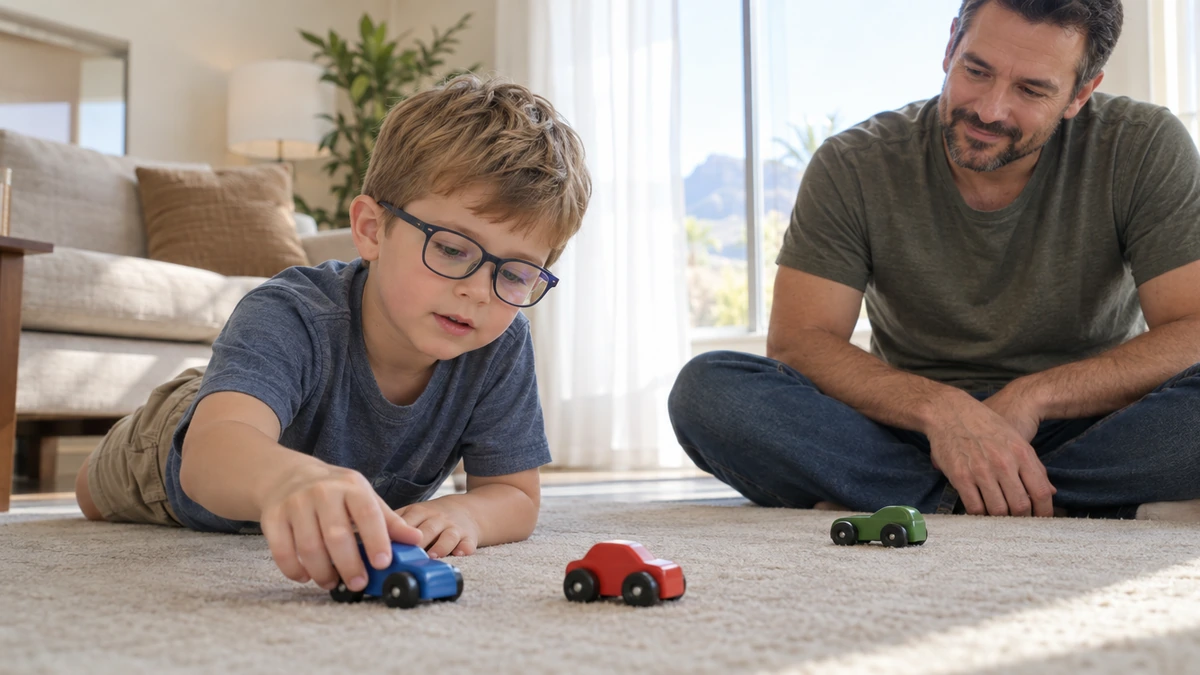
    Boy wearing glasses and playing with toy cars, illustrating care for crossed eyes in children
    A boy in new glasses plays with toy cars while his father watches.

    The treatment follows the type. Prescription glasses help align some children’s eyes, and a pediatric ophthalmologist performs eye muscle surgery when indicated, as the American Academy of Ophthalmology explains. Surgery does not replace glasses or patching when these are also prescribed for your child. When your child needs eye muscle surgery, I refer you to a pediatric ophthalmologist and coordinate the care around it.

    Glasses and Patching Have Different Jobs

    Glasses address the focusing prescription. In some forms of inward crossing, correcting that prescription also improves alignment. Your child’s examination determines whether this approach fits. Get clear instructions about when to wear the glasses and when to return.

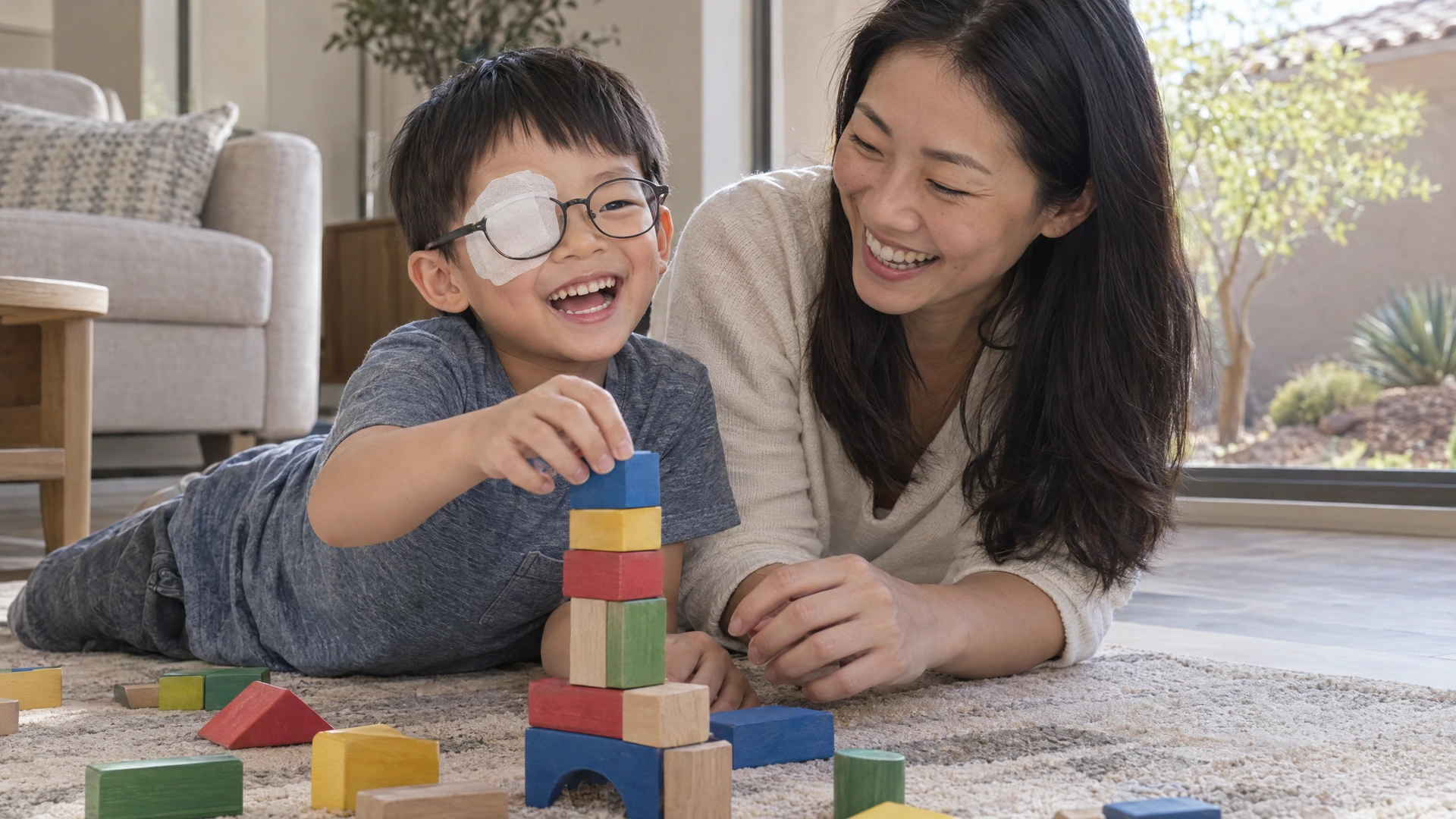
    Patching treats the lazy eye that a turn can cause, and my lazy eye guide covers how it works. Your instructions should make the purpose of patching clear. Discuss resistance or missed sessions at follow-up before changing the prescribed plan.

    Make Shared Care Clear

    Two doctors, one plan. Co-management means your optometrist and your child’s pediatric ophthalmologist share the work, and you always know who handles what. I explain my part in your child’s care and the reason for an ophthalmology referral. Before you leave, we should be clear about who handles glasses, who directs any patching and who reviews surgical decisions.

    How I Approach Your Child’s Eye Turn at Vision by Amel

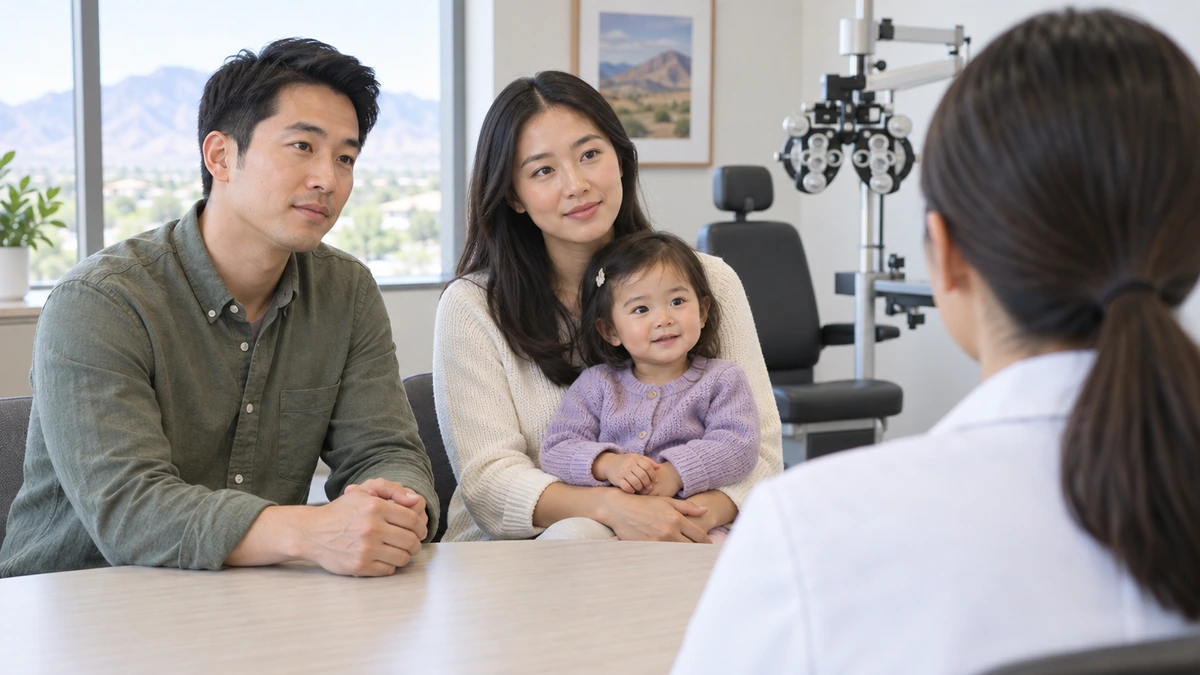
    Parents and toddler talking with an eye doctor about crossed eyes in children
    Parents talk through their toddler's eye exam with an eye doctor.

    Bring me the photo that worried you. I look at the turn you saw, then I check how each eye sees and how both eyes work together. I am Dr. Amel Youssef, your optometrist at Vision by Amel. My pediatric eye exam process includes patient history, digital diagnostics, an evaluation of binocular vision and a plan.

    A Sunday visit at Festival Plaza should leave you with a clear next step. Picture sitting beside your child while we go over the photo saved on your phone, then naming the question you most want answered. Is the eye turning, does each eye see well, or is an ophthalmology referral needed? Those questions guide our discussion.

    My team offers eye care in Downtown Summerlin at 2010 Festival Plaza Dr, Suite 195, Las Vegas, NV 89135. You need no referral to book an eye exam. For questions about insurance, call before the visit so my team has time to verify your benefits by phone. Share any existing ophthalmology appointment when arranging the visit.

    Frequently Asked Questions About Strabismus in Children

    Should I Cancel If My Child’s Eyes Look Straight Today?

    Keep the appointment and explain what changed. Your observations from other days still belong in the history, especially when the original concern was an intermittent turn. Show me both the concerning pictures and a note about the days you saw no turn.

    Will My Child Grow Out of Crossed Eyes?

    No, your child will not outgrow true strabismus. Some babies only look cross-eyed because of the shape of the nose bridge or nearby skin folds, and they sometimes outgrow that appearance, called pseudostrabismus. An exam distinguishes the two. Strabismus usually shows up in babies and young children, most often by age 3, says the AOA.

    What Is the Difference Between Esotropia and Exotropia?

    Esotropia means your child’s eye turns inward, while exotropia means it turns outward. Upward and downward misalignment are called hypertropia and hypotropia. An outward drift that appears when your child is tired or sick fits the intermittent pattern, with straight-looking eyes at other times.

    Can Crossed Eyes Cause Lazy Eye?

    Yes, an eye turn sometimes leads to amblyopia, or lazy eye, as vision develops. With esotropia, your child also risks losing stereopsis, or 3-D vision, and the ability to use both eyes together, according to AAPOS. That is why the assessment looks at vision and how the eyes work together as well as their position.

    Does My Child Need Surgery for Crossed Eyes?

    Not always: some inward crossing improves with glasses, and prisms are another treatment option for certain types of strabismus. Your child’s findings determine whether a pediatric ophthalmologist recommends surgery, which does not replace prescribed glasses or patching. The American Academy of Ophthalmology says most children resume routines in about 2 to 3 days after surgery. Follow your child’s surgical team’s instructions about returning to preschool and play.

    Book My Eye Exam Call (702) 858-4362

    Like this article? Add Vision by Amel as a preferred source, and you are more likely to see our articles in Google’s Top Stories.

    Add as a preferred source on Google

  • Lazy Eye (Amblyopia) in Children: Signs, Causes and Treatment

    Lazy Eye (Amblyopia) in Children: Signs, Causes and Treatment

    Lazy Eye (Amblyopia) in Children: Signs, Causes and Treatment

    Boy with a patch and round glasses stacking blocks with his mother, illustrating lazy eye in children

    TLDR: Lazy eye in children, or amblyopia, affects developing vision and sometimes has no visible signs. Your child’s treatment starts with an eye doctor’s assessment and often includes prescription glasses, with patching when prescribed. An eye that turns all the time, at any age, needs an eye exam right away.

    Answer: Amblyopia means vision has not developed properly in an eye, even when the eyes look straight. Causes include unequal prescriptions, eye misalignment, or an obstruction to clear sight. For your child in Las Vegas, an eye exam identifies the problem so treatment, such as glasses or prescribed patching, addresses the cause and the weaker vision.

    On a shaded bench at a Summerlin park, your child points out tiny pictures in a book. Then a screening note mentions weaker vision in an eye. That mismatch deserves attention. Amblyopia concerns how vision develops, so everyday confidence gives you only part of the picture.

    I reviewed 113 primary sources across five research lenses for this guide, and amblyopia sometimes goes unnoticed until an eye exam. The National Eye Institute reports that up to 3 in 100 children have amblyopia. Your next step is to understand each eye’s vision. My eye examination service explains how I assess vision and help you understand the findings.

    What Signs Suggest Lazy Eye in Children?

    Girl covering one eye while playing with her father, illustrating a discussion of lazy eye in children
    A father and daughter share a playful moment.

    Lazy eye hides well. Squinting, tilting the head or covering one eye are signs to have checked, according to the American Optometric Association. An eye that turns in or out all the time needs an eye exam right away. You do not need to name the problem before seeking care.

    Your observations help me understand the concern. A child covering an eye during a game is different from repeatedly doing it to see. Describe what happened, which eye was involved, and whether you noticed it during reading, play, or looking across the room. The useful detail is what you saw.

    For broader concerns, use my checklist of signs your child needs glasses. Bring your observations to a pediatric eye exam, along with any screening result. I would rather you bring a small concern than wait for a dramatic sign.

    A white or gray-white glow in the pupil, in person or in a flash photo, means your child sees an eye doctor right away, as AAPOS advises.

    What Causes Lazy Eye in Children?

    The cause shapes treatment. AAPOS describes refractive, strabismic, and deprivational amblyopia and warns of permanent vision loss without treatment. Unequal prescriptions and eye alignment problems affect the visual input reaching the developing brain. A blocked view creates a different problem requiring attention to the obstruction. Arrange your child’s assessment early, even when the eyes look normal.

    CauseWhat It MeansWhat to Discuss at Your Visit
    Refractive amblyopiaBlur during development, including when one eye needs a stronger prescription than the other.The prescription in each eye and the glasses plan.
    Strabismic amblyopiaMisaligned eyes interfere with normal vision development.Both eye alignment and vision in each eye.
    Deprivational amblyopiaA cataract, drooping lid, or corneal scar obstructs clear sight.How the obstruction and developing vision will be addressed.

    The diagnosis tells you what needs treatment. Strabismus names the alignment problem. Amblyopia names the problem with developing vision. Your child needs an explanation of which is present and what each part of the treatment plan addresses.

    Leave the visit knowing the cause. Request the diagnosis in plain language, alongside the medical term. For unequal prescriptions, have the difference explained using your child’s own results. For an obstruction, clarify the next assessment and who will provide it.

    How Do Glasses Help With Amblyopia?

    Mother helping her daughter put on glasses at a mirror, illustrating care for lazy eye in children
    A mother helps her daughter put on glasses.

    Glasses often lead the plan. In a PEDIG study of 84 children aged 3 to under 7 with untreated anisometropic amblyopia, glasses alone improved weaker-eye vision by at least 2 chart lines in 77%, with improvement taking up to 30 weeks. That study covered one type of lazy eye and had no untreated group, so read it as a signal, not a forecast for your child.

    For many children, glasses alone are not enough, says AAPOS, and patching follows when your eye doctor prescribes it. The goal is better vision in the weaker eye. Your follow-up measurements show whether glasses alone are doing enough.

    Give the glasses a place in your morning. In your Las Vegas kitchen, the cereal bowl, backpack and glasses case share the counter before school. Set the glasses beside the morning essentials so putting them on becomes part of getting ready. Share the prescribed wearing instructions with anyone helping your child start the day.

    Report problems plainly. Explain whether your child removes the glasses during meals, complains about the frame, or repeatedly loses them between home and school. The glasses belong at the next visit, too. A specific account gives the conversation more value than saying the week went badly.

    Watch the chart, not the calendar. The prescription is the lens. Visual acuity is how well your child’s eye sees, and that number tells you whether treatment is working. New glasses begin a plan whose progress needs review.

    What Does Prescribed Patching Involve?

    Boy with an eye patch drawing beside his grandmother, illustrating prescribed care for lazy eye in children
    A grandmother sits beside her grandson as he draws.

    Patching covers the stronger eye to encourage use of the weaker eye. Your eye doctor prescribes which eye to cover, how long to patch, and when to review progress. Get those instructions in writing. Follow the prescribed schedule rather than borrowing another family’s routine.

    More hours are not automatically better. A PEDIG randomized trial involving 189 children under 7 with moderate amblyopia found the same average improvement with 2 or 6 daily patching hours after 4 months, with at least 1 hour of near activities in both groups. This finding applies to the studied moderate cases. Your child’s prescription still governs the schedule.

    A familiar activity gives patch time a place in your day. Choose a time with room for the prescribed session. Drawing, blocks, or shared reading give you activities to discuss when the patching plan is explained. Match the activity and its timing to the instructions you receive.

    1. Confirm which eye to patch and the prescribed daily duration before starting.
    2. Check how glasses fit into the patching instructions.
    3. Record completed sessions and any practical difficulties.
    4. Call your eye doctor about skin irritation or a child who keeps fighting the patch.
    5. Keep every follow-up visit. Only your eye doctor changes the patching hours.

    A difficult afternoon deserves a useful conversation. Describe what your child found hard, how much of the session was completed, and what you tried. A short note about a difficult session gives you something concrete to discuss at follow-up. I value an honest treatment diary more than a perfect-looking one.

    Why Do Screening Results and Follow-Up Both Matter?

    Boy wearing glasses reading with his mother on a porch swing, illustrating lazy eye in children
    A mother and son read together on a porch swing.

    Your next step needs to be clear. After a vision screening flags a concern, arrange a comprehensive eye exam and take the actual result with you. My guide to school screening and comprehensive eye exams explains the difference. At your visit, I check vision and eye health and explain the findings.

    Follow-up puts the focus on each eye’s progress. Your current glasses, prescribed schedule and account of home treatment belong in that conversation. Request an explanation of each eye’s measured vision and whether the plan changes. Leave with the next review date written down.

    Your afternoon is already full: Summerlin school pickup, dinner, homework. Fit the patch into what you already do, like the drawing table or the bedtime book. Share the treatment instructions with caregivers so everyone follows the same plan. When the routine breaks down, raise the difficulty before making your own changes.

    How I Approach Your Child’s Exam at Vision by Amel

    I am Dr. Amel Youssef, an optometrist and the founder of Vision by Amel. For your visit about possible amblyopia, bring prior prescriptions, screening results, and any existing treatment instructions. My evaluation includes binocular vision and eye disease screening, with digital refraction among our Visionix diagnostics. Your history gives those findings context.

    My practice provides pediatric eye care at 2010 Festival Plaza Dr, Suite 195, Las Vegas, NV 89135. You will find us at Festival Plaza in Downtown Summerlin. No referral is needed for an eye exam. Book online or call with your child’s exam needs.

    Your questions about children’s vision deserve time at the visit. Tell me what worries you most, whether it is the diagnosis, the prescription, or understanding an existing plan. My team verifies insurance benefits by phone before your visit. Have your plan information ready for that conversation.

    Frequently Asked Questions About Lazy Eye in Children

    Is My Child Too Old to Start Treatment?

    Treatment works best when it starts young, and older children and teens can still improve, especially if they were never treated before. The American Academy of Ophthalmology advises offering treatment regardless of age when the visual system is structurally sound, with potential benefit in older children and adolescents, especially those previously untreated. Bring your child’s treatment history so the discussion reflects what has already been tried.

    Will Lazy Eye Hurt My Child’s Grades?

    The American Academy of Ophthalmology finds insufficient evidence that amblyopia in one eye harms school or career performance. Your child’s treatment addresses vision itself. Discuss school concerns on their own terms, without assuming lazy eye explains every difficulty in class.

    How Many Hours a Day Will My Child Wear a Patch?

    The National Eye Institute describes schedules ranging from 2 hours a day to all waking hours. Your eye doctor sets the patching time and adjusts it at follow-up visits. The PEDIG trial above compared schedules for moderate amblyopia, so its results are not a patching prescription for your child.

    Can My Child Have Lazy Eye if Their Eyes Look Straight?

    Yes, your child might have amblyopia even when the eyes look straight, as AAPOS explains. The National Eye Institute notes that many parents learn of the problem only at an eye exam. You do not need to spot an eye turn for the finding to deserve attention.

    What Should I Say to My Child About the Diagnosis?

    Keep your explanation calm and concrete. Describe the glasses or patch using the instructions you received, then invite questions about the daily routine. Choose words about practicing the routine together, and praise the effort your child puts into following it.

    Book My Eye Exam Call (702) 858-4362

    Like this article? Add Vision by Amel as a preferred source, and you are more likely to see our articles in Google’s Top Stories.
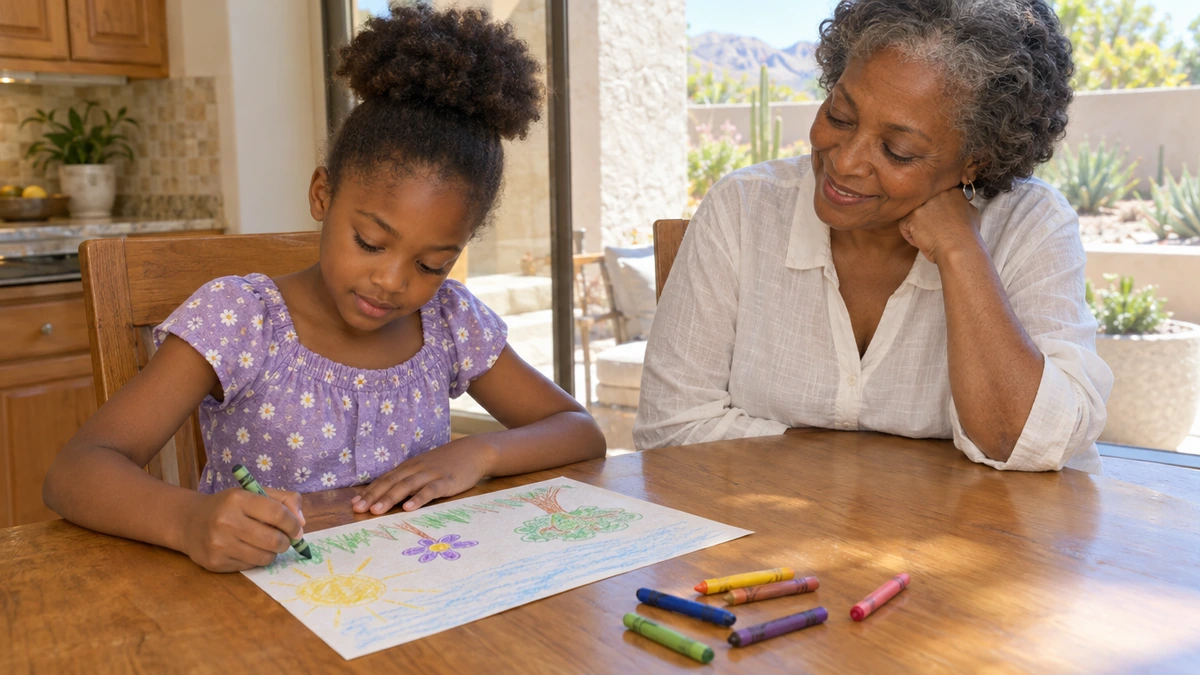
    Add as a preferred source on Google

  • How to Choose a Pediatric Eye Doctor in Las Vegas

    How to Choose a Pediatric Eye Doctor in Las Vegas

    How to Choose a Pediatric Eye Doctor in Las Vegas

    Father and daughter walking toward an optometry boutique, choosing a pediatric eye doctor

    TLDR: Choose a pediatric eye doctor who examines children your child’s age and explains the next step clearly. An optometrist offers exams and treatment within optometry’s scope, while a pediatric ophthalmologist provides specialist medical and surgical care. Match the appointment to your child’s needs.

    Answer: To choose a pediatric eye doctor in Las Vegas, check experience with your child’s age, the purpose of the eye exam, and the approach to referrals. For a failed screening, look for an optometrist or ophthalmologist experienced with children. For surgical needs or complex disease, seek pediatric ophthalmology care.

    Choose the visit that answers your child’s question. At school pickup in Summerlin, your child hands you a vision screening note before climbing into the car, and now you need to know whom to call. Start with the reason for the visit, then choose the professional equipped to address it.

    I reviewed 113 primary sources across five research lenses for this guide, and a failed screening needs follow-up even when you notice no problems. The American Academy of Pediatrics names an ophthalmologist or optometrist experienced with children for that follow-up. For your local appointment options, explore our eye exams in Downtown Summerlin.

    Which Pediatric Eye Doctor Fits Your Child’s Needs?

    Mother beside her coloring son, with laptop lid visible, considering a pediatric eye doctor
    A mother considers an appointment beside her son.

    You searched “pediatric optometrist” or “pediatric specialist” because you want someone great with kids. Good instinct. Those words describe a search, not a license, so check the degree behind the name.

    ProviderRole in Your Child’s CareWhat to Clarify Before Booking
    PediatricianChecks eyes and vision during well-child care, including screening and referral when needed, per the AAP.What did the screening show, and what follow-up was recommended?
    Optometrist, ODExamines, diagnoses, treats and manages eye diseases and disorders, as described by the American Optometric Association.Does this practice examine children your child’s age and handle the reason for this visit?
    Pediatric ophthalmologistA medical doctor with ophthalmology training and pediatric fellowship training who provides exams, glasses and medical or surgical treatment, according to the American Academy of Pediatrics.Does your child need evaluation for a complex condition or possible surgery?

    Experience deserves a direct question. Prevent Blindness notes that some optometrists focus on working with young children. For your family, confirm who will perform the examination and whether the appointment fits your child’s age and concern.

    A title tells you about training. A clear explanation tells you about care. You should understand why this appointment is appropriate before you reserve it. A useful answer names the examination, the concern it addresses and the next step if another professional is needed.

    What Should Your Child’s Eye Exam Include?

    Grandfather beside his grandson in an exam chair, an eye doctor seen from behind
    A grandfather stays beside his grandson in the exam room.

    Know what you are booking. A screening sorts. A comprehensive eye exam diagnoses. Your confirmation should name which one your child gets.

    Your examination has a defined scope: the Nevada Legislature defines a comprehensive examination as an in-person examination including history, eye alignment, visual acuity, pupils and examinations of the front and back of the eyes. When comparing appointments, ask how your child’s visit addresses those areas. Unfamiliar terms deserve plain answers before you agree to the plan.

    The screening note gives you a useful first question: what needs checking? You do not need to translate its abbreviations before calling my team. Our guide to school vision screening and comprehensive exams explains the distinction in more detail.

    Your child’s comfort belongs in the conversation, too. Describe worries about unfamiliar equipment, communication needs or a previous difficult visit. Tell my team what made the earlier visit difficult so we discuss your concerns before you arrive.

    When Does Your Child Need a Pediatric Ophthalmologist?

    Eye muscle surgery belongs to ophthalmology. Nevada law bars optometrists from any procedure that cuts tissue, so when your child’s misaligned eyes need surgery, I refer you to a pediatric ophthalmologist and coordinate your child’s care around it. You should know who handles the surgical assessment and where your follow-up belongs.

    A premature baby or a family history of childhood eye disease changes who should examine your baby first, and my baby eye exam guide lists those histories. Lead with that history when arranging care. A family concern belongs in the first conversation, even when you do not know its medical name.

    An eye that crosses all the time needs an eye exam right away, at any age, and AAPOS sends constant crossing to a pediatric ophthalmologist. Describe whether your child’s eye turns constantly or comes and goes when you call. Use those observations to explain the concern, without trying to name the condition yourself.

    A referral should leave you with clear instructions. My explanation should name the reason, the recommended timing and the service you need to contact. For complex disease, bring any existing diagnosis and treatment plan into that conversation so the next appointment addresses the actual problem.

    What Should You Ask a Pediatric Eye Doctor?

    Mother holding her daughter's hand while asking questions at an optometry front desk
    A mother asks questions while her daughter holds her hand.

    Skip “Do you see kids?” Every office says yes. These questions tell you how your child’s visit will go.

    1. Does this office examine children my child’s age for this concern? Give the age and reason for the visit together.
    2. Who will examine my child, and what is their training and experience with children? Listen for the name and qualification.
    3. Is this a comprehensive examination or a visit for a particular eye concern? Match the answer to your screening note or referral.
    4. How should I explain my child’s communication or sensory needs? Describe what helps your child understand a new situation.
    5. How will I get referral instructions if another service is needed? The answer should cover the reason, timing and next contact.
    6. Which insurance details and previous records do you need? Have the relevant information beside you while you call.

    Listen for a specific answer. “We see children” answers less than a discussion of your child’s age, history and reason for coming. Keep your school report or previous prescription in front of you during the call so the details stay accurate.

    Leave with the result and the next step. Before you leave my exam room, I want you to understand the findings and the follow-up plan. Write down what you need to do, who to contact and when to return.

    How Do You Compare Appointment Options?

    Fit first, then the drive. A Sunday slot after soccer at a Summerlin park means nothing if the visit cannot answer your child’s real question. While your child packs dusty cleats beside the field, settle what the appointment needs to accomplish before checking the route.

    Use the same details for each call. Give your child’s age, the concern and any existing referral, then record the answers together. This keeps a routine examination and a specialist consultation from looking interchangeable because both appear in the same search.

    Consider what happens after the visit. Ask how you would request an explanation of findings or send a question about the plan. For your child who already wears prescription glasses or has an amblyopia treatment plan, bring the current instructions and clarify which earlier records the receiving practice wants.

    Your child also deserves a simple explanation of where you are going. Keep it factual, and let the team explain any unfamiliar examination steps. Our first eye exam guide for Summerlin families covers preparation, so you do not have to work it out during the drive.

    How I Approach Your Child’s Eye Care

    Mexican-American family of four smiling outside an optometry office in desert sunlight
    A family leaves an optometry office together.

    I am Dr. Amel Youssef, OD, founder and optometrist at Vision by Amel. My practice offers pediatric eye care, and I see families from Summerlin every week. At Vision by Amel, you get an optometrist who explains every finding, a team that verifies your benefits by phone before the visit, and a clear plan, including a referral when your child needs one.

    My examination process moves from patient history through digital diagnostics, my evaluation and your plan. Every visit runs on Visionix digital diagnostics, and I review the findings with you myself, in plain language. I check how both eyes work together, test color vision where your child needs it, and screen for eye disease before we set your child’s plan. Your questions about eye health belong in that discussion.

    Saturday at Festival Plaza looks like this: your child beside you, the screening note in your bag, the visit already booked. You will find us at 2010 Festival Plaza Dr, Suite 195, Las Vegas, NV 89135, in Downtown Summerlin at Festival Plaza. We are open Monday to Saturday, 9 am to 6 pm, and Sunday, 11 am to 5 pm. Book online or call (702) 858-4362 to arrange your pediatric eye exam.

    Frequently Asked Questions About Choosing a Pediatric Eye Doctor

    Should My Child See an Optometrist, a Pediatric Ophthalmologist or the Pediatrician?

    Your pediatrician screens for vision problems during well-child care. After a failed screening, the AAP recommends follow-up with an optometrist or ophthalmologist experienced with children, even when you notice no problems. Both examine and diagnose eye conditions, while eye muscle surgery belongs to ophthalmology. Take the screening result to the appointment so the finding that prompted it gets addressed.

    What Is the Difference Between a Pediatric Optometrist and a Pediatric Ophthalmologist?

    Prevent Blindness describes some optometrists as focusing on work with young children. A pediatric ophthalmologist is a medical and surgical eye doctor whose training, according to the AAP, includes at least 4 years of medical school, 1 year of internship, at least 3 years of ophthalmology residency and at least 1 year of pediatric fellowship. For your child, choose by the care needed and the provider’s experience with that age and concern.

    Can an Optometrist Treat My Child’s Eye Infection?

    Yes, treating eye infections falls within Nevada optometry’s scope. Nevada law includes prescribing medication to treat an abnormality of the eye. Your child’s examination determines the diagnosis and appropriate treatment, so describe the symptoms when arranging care.

    Will My Child’s Optometrist Work With a Pediatric Ophthalmologist?

    When your child needs a pediatric ophthalmologist, I refer you and coordinate care around that evaluation. Co-management means I remain your home base for eye care while the ophthalmologist handles the specialty care your child needs. You always know which office books the next visit and which one answers each question.

    What Should I Check About Insurance Before Choosing an Appointment?

    My team verifies your benefits by phone before the visit, and Vision by Amel accepts plans including VSP, EyeMed and Nevada Medicaid. Your own plan determines the coverage available. Have your insurance details ready when you call. You do not need a referral to book an eye exam.

    Book My Eye Exam Call (702) 858-4362

    Like this article? Add Vision by Amel as a preferred source, and you are more likely to see our articles in Google’s Top Stories.
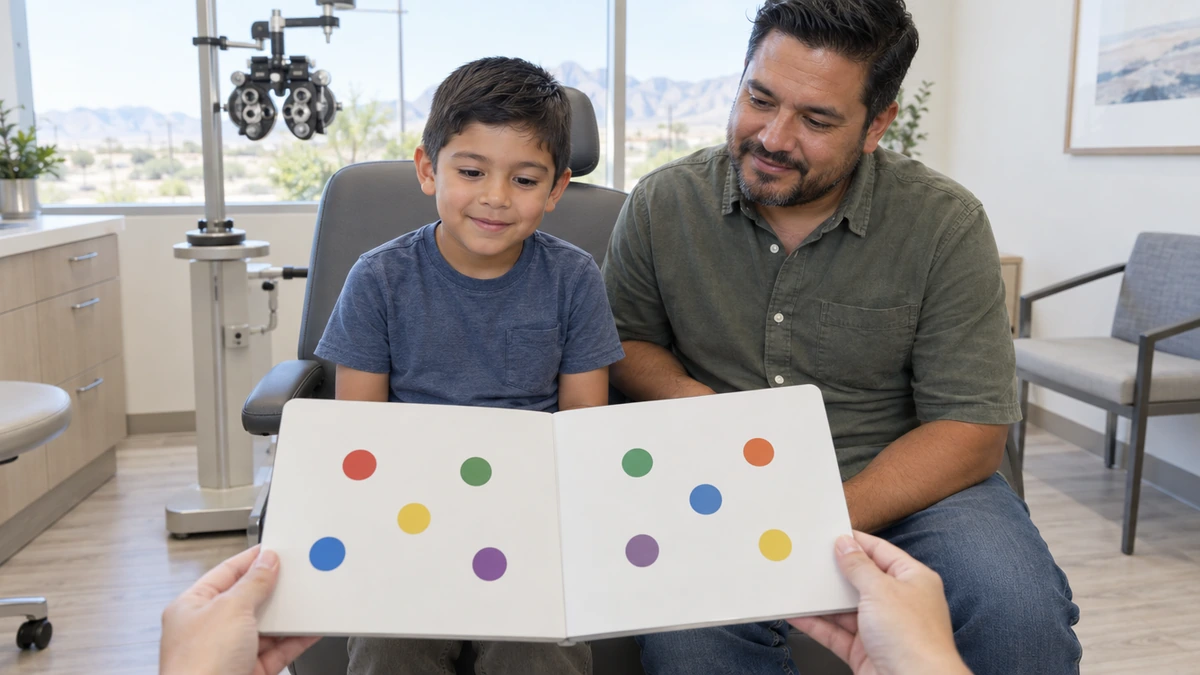
    Add as a preferred source on Google

  • Your Baby’s First Eye Exam in Las Vegas: What Parents Should Know

    Your Baby’s First Eye Exam in Las Vegas: What Parents Should Know

    Your Baby’s First Eye Exam in Las Vegas: What Parents Should Know

    A Black mother cradling her baby girl on a sofa, accompanying a baby eye exam guide.

    TLDR: Your baby’s eye care starts in the first days of life. This baby eye exam guide shows you when the first full exam fits, what it checks, and the warning signs that mean you call an eye doctor right away.

    Answer: The American Optometric Association recommends your baby’s first comprehensive eye exam between 6 and 12 months of age. Your pediatrician checks your baby’s eyes from birth with a red reflex test. In Las Vegas, call an eye doctor right away for a white pupil, an eye that turns all the time, or discharge and puffy red eyelids in a newborn.

    Your baby cannot read an eye chart, and does not need to. You bring the birth history and what you have seen at home, from the stroller walk to the 2 am feed. That is where a great first visit starts. At home in Las Vegas, you settle into a bedroom chair for that feed while a bottle warms nearby. Those quiet moments give you something specific to describe when you call.

    I reviewed 113 primary sources across five research lenses for this guide, and infant eye screening starts at birth. Start the booking conversation with your baby’s age and history. My eye examination page explains our practice’s general exam process, while this guide stays focused on infancy.

    When Should You Plan a Baby Eye Exam?

    A white father holding his infant son and a colorful toy, accompanying baby eye exam guidance.
    A father holds his infant son while moving a colorful toy.

    The American Optometric Association recommends your baby’s first comprehensive eye exam between 6 and 12 months of age, even when nothing looks wrong. Put that recommendation on your list for the next well-child visit. Include any existing screening results in the discussion.

    AAO and AAPOS instead emphasize screening from the newborn nursery, including a red reflex check, and referral for concerning findings or risk factors rather than routine comprehensive exams for every healthy child without symptoms. File your pediatrician’s screening record alongside any eye examination report. Keep both available when discussing follow-up.

    At a newborn red reflex check, a trained clinician looks for the reflection of light from inside your baby’s eyes. An abnormal red reflex needs urgent consultation, so follow the referral right away. Under the same AAO and AAPOS guidance, an ophthalmologist should examine high-risk infants, including those at risk of retinopathy of prematurity or with a family history of childhood cataract, glaucoma or retinoblastoma.

    Born early? Family history of childhood eye disease? Tell your pediatrician first, because those babies need an ophthalmologist’s exam, not a routine date. Mention any existing referral when you call an eye care office. I would rather hear your concern early than have you wait for the perfect appointment age.

    How Do You Prepare Your Baby for the Visit?

    A Vietnamese-American couple seated with their baby in a boutique waiting area before a baby eye exam.
    Parents sit together with their baby in a waiting area.

    Pack for your baby first. A diaper bag, familiar comfort item and feeding supplies belong beside the insurance card. When arranging the visit, describe your baby’s usual nap and feeding pattern and ask how much time to reserve.

    1. Share the basics. Your baby’s age and the reason for the visit help my team pick the right appointment.
    2. Gather the history. Bring birth records you already have, screening results, medication details and any referral instructions.
    3. Describe what you noticed. Note which eye, when the change began and whether it happens constantly or comes and goes.
    4. Plan the trip. Leave room in your schedule for feeding, changing and settling your baby after the drive.
    5. Write your questions. Include who will examine your baby, what the visit covers and how follow-up will be arranged.

    Share the load. On a shaded path at a Summerlin park, you push the stroller while a grandparent leans down to greet your baby. Later, compare what each of you noticed, such as whether your baby watched that familiar face. When you come together for the visit, agree on who will describe the concern and who will hold the bag.

    Skip the rehearsal. Bring your baby as they are, with the information the office requested. For an older sibling accompanying you, my guide to a child’s first visit in Summerlin offers preparation aimed at children old enough to discuss the appointment.

    What Does a Baby Eye Exam Check?

    Gloved hands holding a penlight near a smiling infant on a Latina mother's lap during a baby eye exam.
    A mother holds her infant while a penlight is held nearby.

    The AOA infant vision guide describes checks for nearsightedness, farsightedness, astigmatism, eye movement, alignment and overall eye health during your baby’s exam. Use those areas to organize your questions. Start with the concern you brought from home, then ask what the findings mean.

    Area of the ExamWhat to Ask About Your Baby
    Focusing and refractionDid the check find a focusing issue, and what happens next?
    Eye movementWhat did you observe as my baby’s eyes moved?
    AlignmentDid the eyes appear aligned during the examination?
    Overall eye healthWas anything found that needs further evaluation?
    Follow-up planWho should we see next, and when should we arrange it?

    You deserve plain English. Visual acuity, refraction, amblyopia and strabismus should each come with what it means for your baby, today. Before leaving, repeat the next step aloud so everyone has the same plan.

    Leave space for your questions in a pediatric eye exam. Write down any recommendation for prescription glasses, another examination or an ophthalmology appointment, including who will arrange it. My broader pediatric eye exam guide covers the wider picture of children’s vision as your child grows.

    Which Eye Changes Need Prompt Care?

    Call an eye doctor right away if your baby has a white or gray-white glow in the pupil, in person or in a flash photo, because it has several possible causes and some are serious, as AAPOS explains. Save the photo to show at the examination. Seek care now rather than waiting to collect more pictures.

    Discharge from your baby’s eye or puffy red eyelids means you call a doctor now, says the National Eye Institute. Say it is urgent, and skip the online booking form. Mention when the discharge or swelling began.

    Brief, on-and-off wandering is common in your baby’s first few months. Any crossing after about 4 months needs a check, and constant crossing is worrisome at any age, says AAPOS. An eye that turns all the time, at any age, needs an eye exam right away. Describe whether the eye stays turned or straightens between episodes.

    Have your baby’s tracking checked promptly if they do not follow well after 3 months, the referral threshold in AAPOS screening recommendations. Explain what you see when your baby watches a face or moving toy. That observation is a reason for assessment, not a diagnosis you need to make at home.

    Call an eye doctor right away if your baby turns away from ordinary light or squeezes both eyes shut indoors. The AOA lists extreme light sensitivity among infant warning signs, along with excessive tearing and red or crusted lids. Describe what happens in the room’s usual light when you call.

    How Do You Handle Coverage and the Next Visit?

    A Pacific Islander mother and grandmother walking with a baby in a stroller, accompanying baby eye exam guidance.
    A mother and grandmother walk beside a stroller under shade trees.

    Check benefits before the trip. Vision by Amel accepts Nevada Medicaid, and my school screening guide explains how Healthy Kids handles referrals. Have your child’s member information ready for the benefits check.

    With any plan, get specific. Confirm your baby’s enrollment, the participating provider and which benefit applies to the proposed visit. Request an explanation of your share of the bill and whether further testing needs separate approval.

    Make the next step easy to find. Store your visit summary with the pediatric records, and put any follow-up date in the calendar you share with other caregivers. Back home after a stroller walk, you should have the next appointment and contact details within reach.

    I favor a written next step over a vague instruction to watch and wait. Before leaving, make sure your plan says what to watch, whom to contact and when to return. Keep the contact details beside those instructions.

    How I Approach Your Family’s Visit at Vision by Amel

    I am Dr. Amel Youssef, founder and optometrist at Vision by Amel. Children’s eye care is central to my practice, and Summerlin families visit every week. Tell my team your baby’s age and any note from your pediatrician when you call, and we will tell you the right next step for a baby that age.

    My team verifies your benefits by phone before the visit, and we accept Nevada Medicaid along with several medical and vision plans. Benefits vary with your plan. Have your baby’s insurance details available when you call, and bring the same information to the appointment.

    You will find us at 2010 Festival Plaza Dr, Suite 195, Las Vegas, NV 89135, in Downtown Summerlin at Festival Plaza. Book online or call (702) 858-4362, seven days a week. We open Monday to Saturday, 9 am to 6 pm, and Sunday, 11 am to 5 pm.

    Picture your Sunday at Festival Plaza: the stroller is folded in the trunk, the diaper bag is on your shoulder, and your baby is ready for a feed. Leave room for that pause when you plan a routine visit. My team will give you the appointment details before you make the trip.

    Frequently Asked Questions About Baby Eye Exams

    How Do You Check a Baby’s Eyes if They Can’t Talk or Read?

    No letters are needed for your baby’s eye examination. Focus, eye movement and alignment help assess vision, alongside checks of eye health. Even before speech, the newborn red reflex check looks for reflected light from inside the eyes.

    When Should My Baby Start Following Toys With Their Eyes?

    Around three months, your baby should begin following moving objects with their eyes and reaching for things, according to the AOA. AAPOS recommends having poor tracking checked after 3 months. Note whether you see the same response to a face and a moving toy, and share those observations at the assessment.

    Why Does My Baby’s Eye Water All the Time?

    Excessive tearing can point to a blocked tear duct, according to the AOA. An assessment of your baby’s watering helps identify the cause. Discharge or puffy red eyelids means you call a doctor now, as the National Eye Institute advises.

    Should I Bring a Video of the Eye Movement?

    Bring an existing video or photo and note when you took it. Keep the original available, and tell me what you noticed when you recorded it. Describe what happened before and after the recording so our discussion includes more than a single moment.

    Does Nevada Medicaid Cover My Baby’s Eye Care?

    Vision by Amel accepts Nevada Medicaid, and my team verifies your benefits by phone before the visit. Your plan determines the benefits available for the proposed appointment. For Healthy Kids referral rules, read my guide to school screening and eye exams.

    Book My Eye Exam Call (702) 858-4362

    Like this article? Add Vision by Amel as a preferred source, and you are more likely to see our articles in Google’s Top Stories.
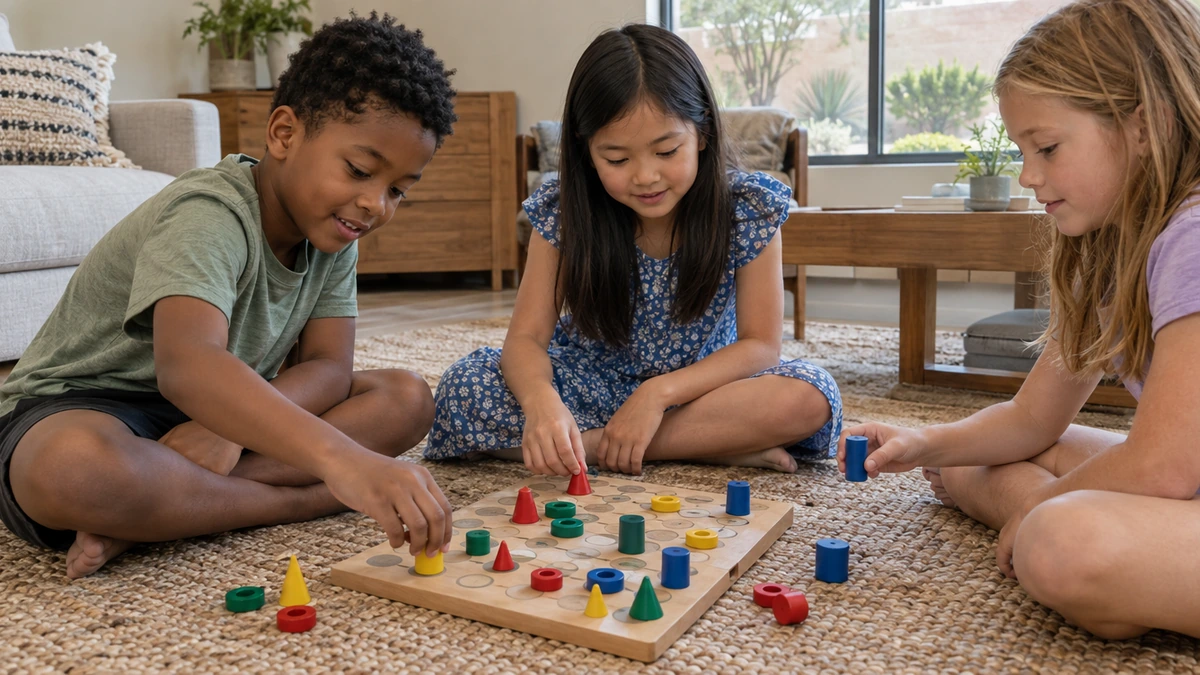
    Add as a preferred source on Google