Author: Dr. Amel Youssef, OD

  • Dry Eye or Eye Allergies? Telling Them Apart in Las Vegas
    Dry Eye or Eye Allergies? Telling Them Apart in Las Vegas

    Dry Eye or Eye Allergies? Telling Them Apart in Las Vegas

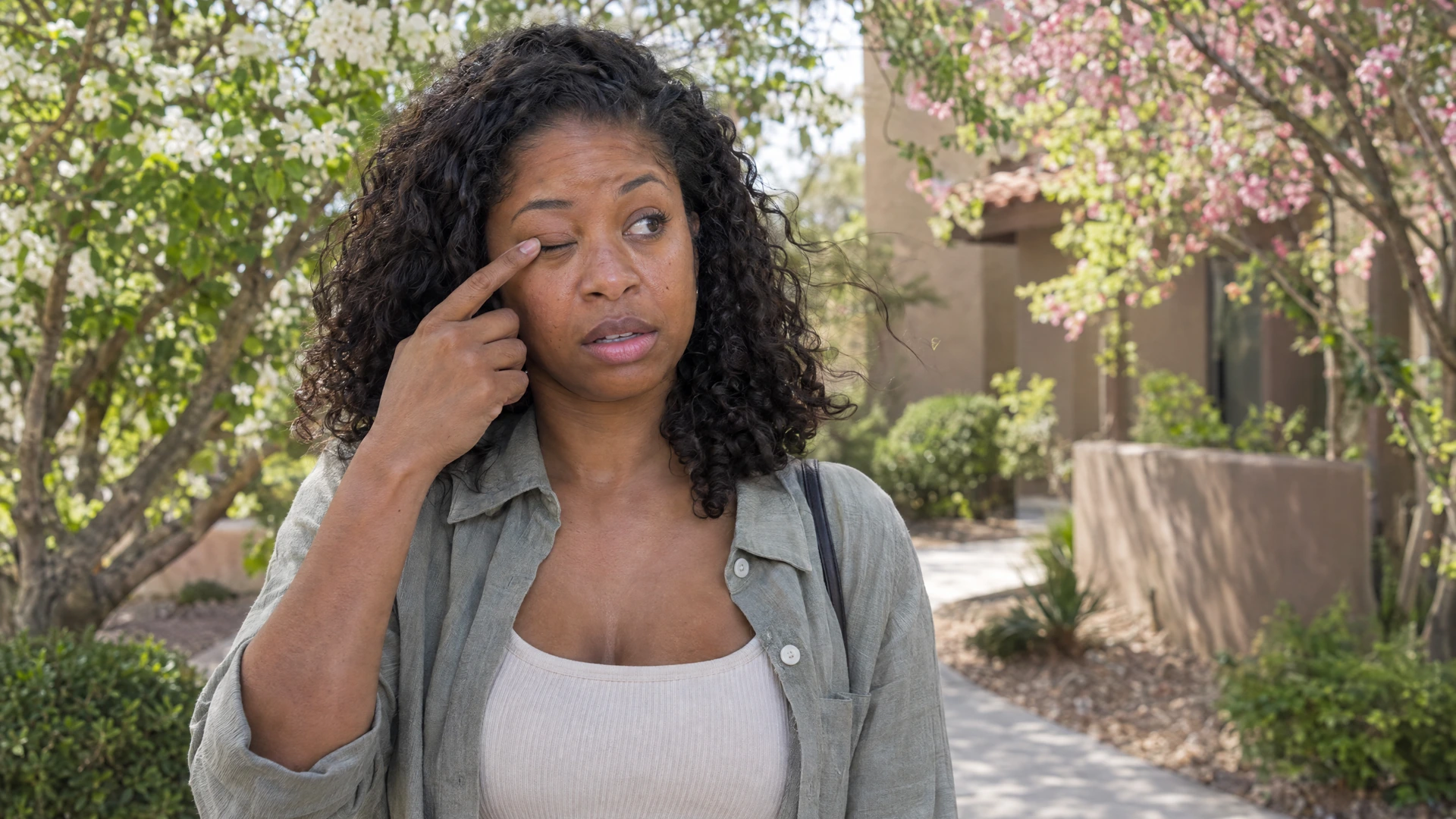
    Black woman rubbing an itchy eye by blooming desert trees, dry eye vs allergies

    TLDR: The useful distinction in dry eye vs allergies is your pattern of symptoms: itching is the strongest allergy clue, while burning points neither way on its own. Symptoms overlap, and both problems sometimes occur together. An eye exam sorts out the cause so your care fits it.

    Answer: Eye allergies usually make your eyes itch, often alongside sneezing, while dry eye often brings burning or a gritty feeling. In Las Vegas, pollen and dusty air complicate the picture. Burning alone does not separate them, and allergy medicine sometimes adds dryness. Your symptom history and an examination help distinguish allergy, dryness and overlapping problems.

    You step onto a Las Vegas patio and start rubbing your eyes. Later, indoors, they feel sandy instead. Before buying another bottle, notice which feeling troubles you most and when it starts. Those details give an optometrist more to work with than the word irritation.

    I reviewed 88 primary sources across five research lenses for this guide, and dry eye and blepharitis share symptoms with eye allergies. The American Optometric Association recommends a comprehensive eye exam to distinguish these causes of your discomfort. My approach to dry eye care starts with understanding what needs treatment. A guess between allergy and dry eye costs you weeks of the wrong drops.

    Dry Eye vs Allergies: What Do Your Symptoms Suggest?

    White man squinting on a dusty Las Vegas sidewalk with palms, dry eye vs allergies
    A dusty-day flare does not establish pollen allergy.

    Start with the itch. AAPOS identifies itching as the main symptom of allergic conjunctivitis, although your eyes also sometimes burn, sting or tear. Allergic conjunctivitis means allergy-related inflammation of the tissue covering the white of the eye and lining the eyelids. Burning does not settle the question.

    Your description matters more than finding the perfect medical word. Say whether you want to rub your eyes, blink away a gritty feeling or wipe away tears. Mention a stuffy nose or sneezing, too. Use the comparison below to organize what you notice before your visit.

    What You NoticeWhat It SuggestsWhat It Does Not Settle
    Itching is the strongest complaintAllergy deserves considerationDry eye and eyelid inflammation also cause itch
    Burning or stingingDryness or allergyThe sensation alone does not identify the cause
    Grittiness or a scratchy feelingDry eye belongs in the evaluationA symptom description does not replace an examination
    Sneezing or an itchy, stuffy nose with eye symptomsAn allergy patternDryness still needs consideration
    Symptoms during a dusty outingIrritation or exposure worth reportingDust exposure does not establish pollen allergy

    Your whole pattern belongs in the appointment. Describe the strongest symptom first, then the others, even when they seem unrelated. Include whether the discomfort starts outdoors, follows a medicine or stays with you indoors. A useful history describes what happened before you decided what to call it.

    Do Allergy Pills or Eye Drops Add Dryness?

    Latina woman using an unbranded eye drop by a sunny kitchen window, dry eye vs allergies
    Include eye drops in your medication review.

    An allergy pill can stop the itch and still dry your eyes. The American Academy of Ophthalmology notes that oral antihistamines sometimes dry your eyes and worsen eye allergy symptoms despite helping itch. Report both changes when they happen together. Less itching does not explain new grittiness.

    Eye drops need review, too. The 2017 TFOS DEWS II report links topical medicines and some preservatives to dry eye through effects on your ocular surface, the exposed surface of the eye. With an antihistamine drop, review the full formulation and your response rather than assuming every drop has the same drying effect. A pill and a drop are different decisions.

    Bring your bottles or a written list. Include allergy pills, eye drops and medicines you buy without a prescription, with a note about when each started. Keep prescription changes with the prescriber, and report new discomfort instead of stopping treatment yourself. My guide to medications linked to dry eye explains that review in more detail.

    Make your notes specific. Record what improved, what persisted and what appeared after a new medicine. Keep the product names on your list even when the packaging calls several bottles allergy relief. At the visit, ask what each medicine is meant to treat and which changes need a call.

    When Does Southern Nevada Pollen Matter?

    East Asian man sneezing into his elbow by a Summerlin flowering shrub, dry eye vs allergies
    Sneezing alongside eye symptoms belongs in your allergy history.

    Spring in the valley is tree pollen season, and your calendar is a clue. A UNLV pollen study observed the main tree season from February to June and higher weed pollen from March to May and August to October across five Las Vegas Valley sites during April 2015 to April 2016. The study covered one year, with differences between sites, so use those months as an observed pattern rather than a fixed calendar for your neighborhood. Report your own timing.

    A dusty afternoon calls for a separate question. The CDC distinguishes allergens such as pollen from irritants such as dust, so your reaction to blowing desert dust does not prove allergy. Describe what was in the air and what your eyes felt. Windblown desert dust irritates your eyes. Irritation is not allergy.

    Think about your usual route through Summerlin. Note whether discomfort starts beside flowering plants in your yard, during a dusty walk or after you return indoors. Include uneventful outings as well as uncomfortable ones. For practical changes involving wind and indoor air, see why Las Vegas air dries out your eyes.

    Dry Eye vs Allergies: What If Both Are Involved?

    You do not have to choose a diagnosis before booking. Dryness and allergy sometimes coexist, and blepharitis adds another source of similar symptoms. Your appointment should address the whole complaint, including symptoms left over after treatment. I want your plan to explain the discomfort you still have.

    Keep a short record before your visit. Use ordinary language and include your current treatment. Follow this sequence to make the discussion useful without turning it into homework.

    1. Name the main feeling: itch, burning, grittiness or watering.
    2. Record when it starts and whether one eye or both feel affected.
    3. Note the setting, such as your backyard, a dusty sidewalk or an indoor workspace.
    4. List the medicines and drops used before and after symptoms began.
    5. Describe what improved and what still interrupts your day.

    Book an evaluation when recurring discomfort leaves you uncertain about what to use. Explain the problem when arranging your visit, especially when a previous allergy label no longer describes it well. Your history matters even if your eyes feel better that morning. For a broader look at visits and follow-up, read when to see an optometrist for dry eye.

    Which Red Eyes Cannot Wait Out Allergy Season?

    Red or painful eyes do not wait out allergy season: contact an eye care provider right away, as MedlinePlus instructs. Its warning signs also include flaking, discharge or a sore on your eye or eyelid, an eye injury, a bulging eye or a drooping lid. Get care right away for those signs rather than waiting for a routine allergy appointment. See a provider for pink eye with eye pain, light sensitivity, intense redness or blurred vision that stays after you wipe away discharge, the CDC advises.

    Describe your symptoms when you call. Say when they began and whether they are getting worse, and identify any drops already used. A familiar pollen season is no reason to postpone evaluation of these warning signs.

    How I Sort Allergy From Dryness at Vision by Amel
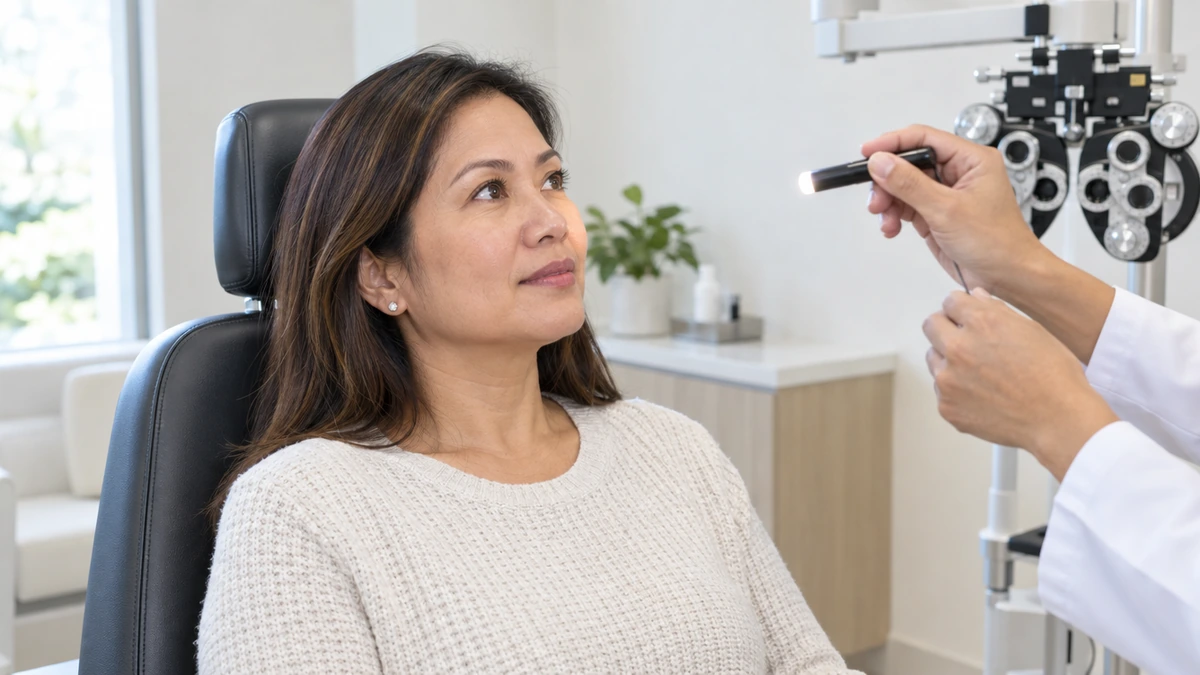
    Filipino woman in an eye exam chair with clinician hands holding a light, dry eye vs allergies
    An examination helps distinguish causes of eye discomfort.

    Your visit should separate allergy from dryness. As Dr. Amel Youssef, OD, I use your symptom history and my evaluation to shape your plan at Vision by Amel. Your symptom notes and medicine list put the details in front of us. Our eye exams include patient history, digital diagnostics, my evaluation and your plan.

    When dryness shows up in your findings, your dry eye treatment depends on your eyes: artificial tears, targeted prescription drops, warm compresses or eyelid hygiene, with care for meibomian gland dysfunction or blepharitis, chosen to sit beside your allergy care. My guide to dry eye treatment in Las Vegas explains those options. Your visit gives those choices a purpose.

    My office sits in Downtown Summerlin at Festival Plaza, 2010 Festival Plaza Dr, Suite 195. No referral is needed for an eye exam. Book online or call with your symptoms and the questions you want answered. Leave knowing which problem you have and what calms it, so your eye health stays protected.

    Frequently Asked Questions About Dry Eye and Eye Allergies

    Will I Need Allergy Testing for Itchy Eyes?

    Allergy testing is rarely needed to diagnose allergic conjunctivitis, according to the AAPOS guidance cited above. Your history and eye examination usually guide the diagnosis. Details about your exposures and symptoms come before arranging testing on your own.

    Are Allergic Eyes Contagious?

    Allergic conjunctivitis is not contagious, and neither is irritation from dust. The CDC distinguishes both from viral and bacterial causes of pink eye. Your red eye still needs a diagnosis before you assume allergy explains it.

    Should I Rub My Eyes When They Itch?

    Avoid rubbing your eyes. Rubbing adds irritation and swelling, even when the urge feels hard to resist. Mention persistent itching during your evaluation so the plan addresses the reason you keep reaching for your eyes.

    Do Artificial Tears Help Eye Allergies?

    Artificial tears temporarily wash allergens from your eyes and relieve dryness. That overlap in uses means relief from a lubricating drop does not identify which condition you have. Record the response and bring it to your visit.

    How Long Should I Use Redness-Relief Drops?

    The American Academy of Ophthalmology advises you not to use decongestant redness-relief drops for more than two to three days because longer use worsens symptoms. Check which kind of drop you have. Bring recurring redness for evaluation instead of repeatedly restarting the bottle.

    Book My Eye Exam Call (702) 858-4362

    Like this article? Add Vision by Amel as a preferred source, and you are more likely to see our articles in Google’s Top Stories.

    Add as a preferred source on Google

  • Pink Eye in Kids: When to See an Eye Doctor in Summerlin

    Pink Eye in Kids: When to See an Eye Doctor in Summerlin

    Pink Eye in Kids: When to See an Eye Doctor in Summerlin

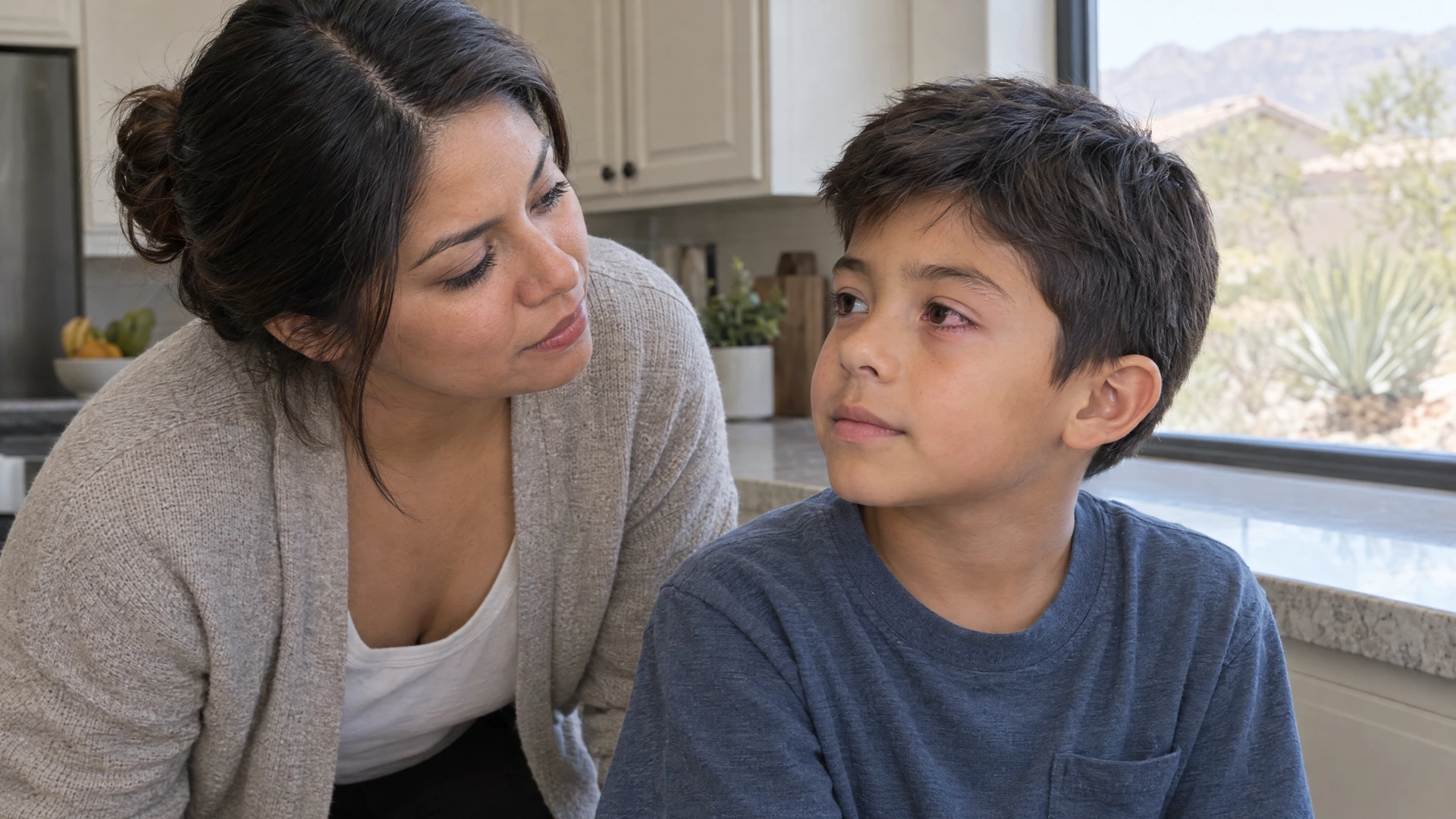
    Latina mother checking her son's slightly red eye at a kitchen counter, illustrating pink eye in kids

    TLDR: With pink eye in kids, your first decisions are whether your child needs prompt care and how to limit spread. Get care right away for the warning signs below, and check the school or daycare policy before sending your child back.

    Answer: Seek an eye doctor right away in Summerlin for your child’s pink eye with pain, light sensitivity or blurred vision that persists after discharge is wiped away. A newborn with pink eye symptoms, or a contact lens wearer with a red, painful eye, needs care right away too. For other concerns, call to arrange an eye exam and discuss school return.

    Your child wakes up with one red, sticky eye. The lunch is packed, the carpool leaves at 7:40, and you have five minutes to decide. Start with how your child feels, then sort out school. At your Summerlin kitchen counter, the car keys sit beside an untouched bowl of cereal.

    I reviewed 113 primary sources across five research lenses for this guide, and the cause of pink eye is sometimes hard to tell from symptoms alone. You do not need to name the infection before calling for help. As an optometrist in Las Vegas, I want your first call to describe what changed and how your child feels. Our eye exam service page explains the broader exam process.

    What Should You Do First for Pink Eye in Kids?

    Black father helping his daughter wash her hands at a bathroom sink, a hygiene step for pink eye in kids
    A father helps his daughter wash her hands with soap at the sink.

    Start at the sink. Wash your hands often with soap and water for at least 20 seconds, as the CDC recommends to limit spread. Help your child follow these hygiene steps while you arrange any needed eye care.

    1. Wash your own hands and help your child wash theirs.
    2. Discourage touching and rubbing the eyes.
    3. Set aside separate towels, washcloths and pillows.
    4. Keep eye drops for the person using them, without sharing bottles.
    5. Wash used linens in hot water, then wash your hands after handling them.

    Make the routine easy to follow. Put your child’s towel where they reach for it, and show siblings which towel belongs to them. Explain the plan to the adult handling pickup or bedtime. A clear handoff keeps everyone following the same steps.

    When Does Pink Eye in Kids Need Care Right Away?

    Eye pain, light sensitivity and blurred vision that does not clear when you wipe away the discharge are on the CDC list of reasons to see a provider. With pink eye, I want your child seen for those right away. The CDC also wants a provider to check intense redness, symptoms that get worse or do not improve, bacterial pink eye that is not better after 24 hours of antibiotics, and any child with a weakened immune system. Say which sign you noticed when you call. Do not wait for a routine appointment slot.

    Have your newborn seen right away for pink eye symptoms, as the CDC directs. Start the call with your baby’s age and symptoms. This call takes priority over planning your routine infant visit.

    Wear contacts? Take them out now. A red, painful eye in a contact lens wearer needs care right away. The CDC warns that bacterial pink eye in lens wearers raises the risk of bacterial keratitis and calls for antibiotics plus a prompt ophthalmologist exam. Mention your child’s contact lenses when calling for care.

    Is Your Child’s Pink Eye Viral, Bacterial or Allergic?

    The cause matters. Viral and bacterial pink eye spread between people, allergic pink eye does not, and overlapping symptoms complicate identifying your child’s cause, according to the CDC. Use this comparison to understand those distinctions before discussing treatment.

    TypeDoes It Spread Between People?What It Means for Your Family
    ViralYesFollow the handwashing and separate towel routine.
    BacterialYesFollow the same hygiene routine and discuss treatment.
    AllergicNoDiscuss allergy care once the cause has been assessed.

    Describe what you see without trying to label it. Note when the redness began, whether an eye is draining and what your child says about discomfort. Include anything already used on the eye. I would rather hear your child’s own words than a guessed diagnosis.

    One red eye, one question. Save the glasses and screening questions for another day, and read my pediatric eye exam guide once the redness clears. Your notes about today’s redness deserve their own space.

    How Do You Keep Pink Eye From Spreading at Home?

    White mother placing fresh towels in a laundry basket as her son watches, home hygiene for pink eye in kids
    A mother sets out fresh towels while her son watches from the hallway.

    One towel per person. That single rule protects your whole household, including whoever does the laundry. Set clean towels within reach and put used ones straight into the laundry basket. Avoid leaving a damp washcloth beside the shared hand towel.

    Your child needs a simple explanation. Try, “This towel is yours while we look after your eye.” Show them where it belongs instead of repeating a warning from across the room. When another caregiver takes over, point out the towels and explain the handwashing routine.

    At a Las Vegas school pickup, your child climbs into the back seat rubbing an eye while another parent waits behind you. Park before calling about the symptoms. Tell the teacher or daycare staff what symptoms you noticed and what guidance you received. Explain whether your child still needs help keeping hands away from the eyes. That detail belongs in the return discussion alongside the attendance policy.

    What Helps Your Child Feel More Comfortable?

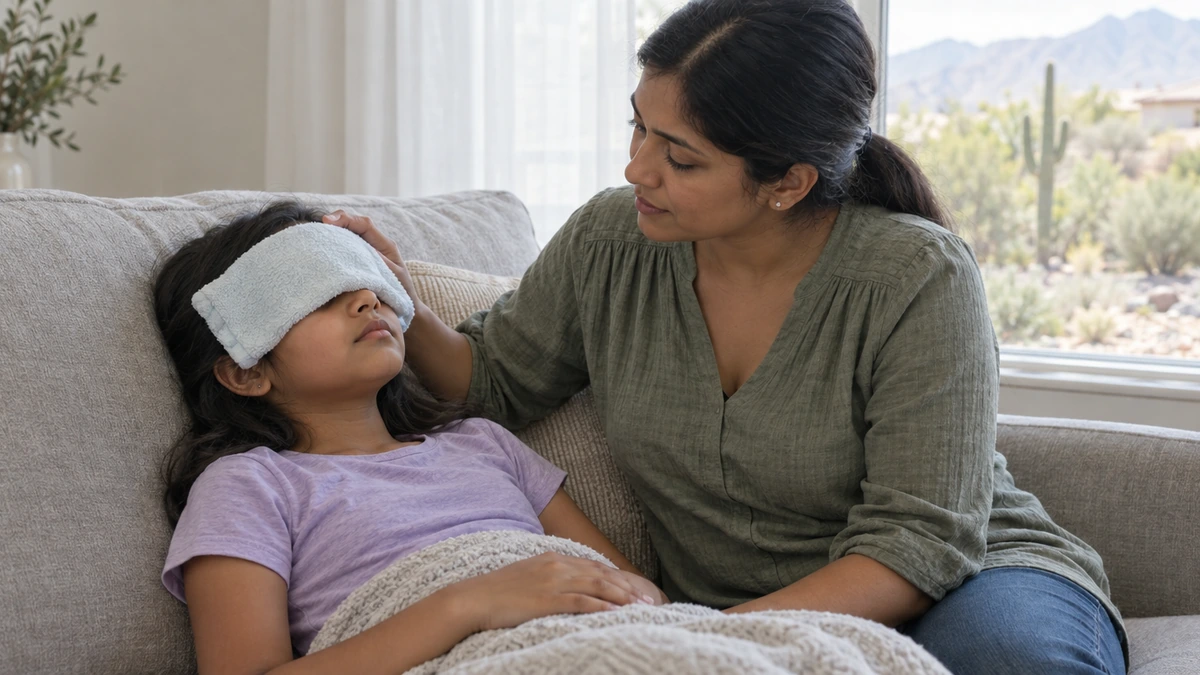
    South Asian girl resting with a cool damp washcloth over closed eyes beside her mother, comfort for pink eye in kids
    A cool compress is a comfort measure for pink eye.

    Match your child’s care to the cause. Antibiotics do nothing for viral pink eye, mild bacterial pink eye often clears without them, and cold compresses with artificial tears ease the irritation, says the CDC. For allergic pink eye, the same guidance points to allergy medicine or antihistamine eye drops. Discuss which drops fit your child’s symptoms before choosing a bottle.

    Your child’s treatment decision belongs with the assessment. Bring the school policy to that discussion, along with the symptoms you have observed. Describe what has changed since the morning, including anything your child says feels worse.

    Make your questions practical. Write down what to use, how to use it and when to check back. Repeat those instructions to anyone helping with care so the plan stays consistent. I want you to leave with instructions you understand and know how to follow.

    When Should Your Child Return to School or Daycare?

    Rules depend on the type of pink eye and on your child’s school or daycare. Nevada’s state health guidance does not require keeping your child home for clear, watery pink eye without fever, eye pain or red eyelids, unless your child cannot keep hands away from the eyes, says the Nevada OSE provider sheet. Thick white or yellow discharge with eye pain means a provider exam and approval before your child goes back.

    The Nevada OSE parent sheet says your child needs to stay home for fever or being too unwell for routine activities, and says antibiotics or a provider note are not required for return. These are health guidance documents. Confirm how your school or daycare handles the differing instructions.

    Ask staff for their written policy. Explain the symptoms, the assessment and any treatment instructions rather than promising a return date before the visit. Save the response with your child’s care notes. I believe a clear return plan is part of caring for the whole family.

    How I Approach Your Child’s Visit at Vision by Amel

    Mother and son walking from a parked car toward a glass-front optometry boutique, a visit for pink eye in kids
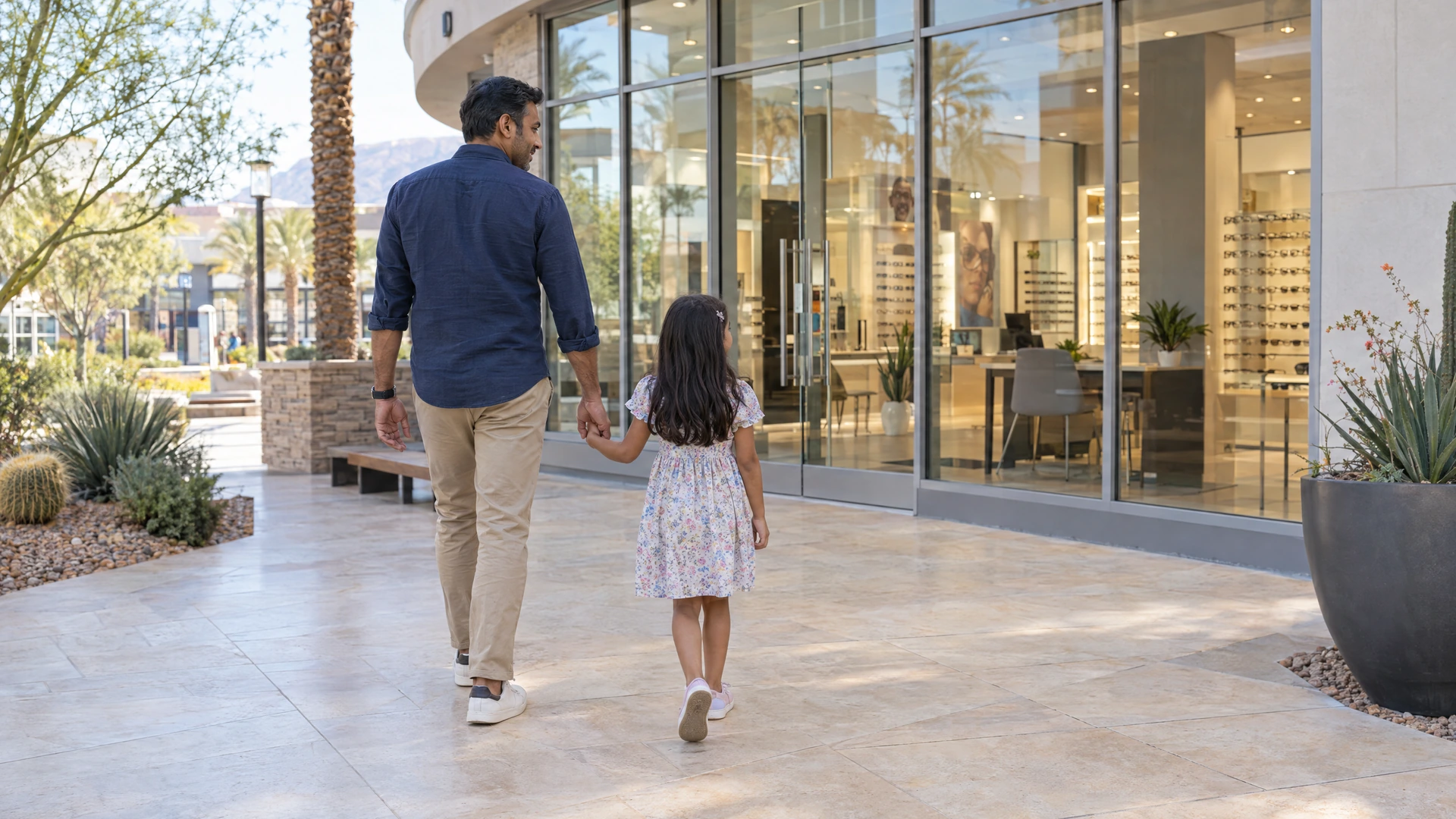
    A mother and son walk toward an optometry boutique on a late Sunday morning.

    Call with the red eye first. Tell my team your child’s age, when the redness started and whether your child wears contacts. Act on the urgent signs above before making a routine booking request. Your child’s eye health comes before finding the most convenient appointment.

    I am Dr. Amel Youssef, OD, founder of Vision by Amel. You are welcome to book a pediatric eye exam without a referral. For visit preparation, our guide to your child’s first eye exam in Summerlin walks through what to expect. List your red eye questions ahead of any broader vision concerns. My medical eye care page explains how my team handles red, irritated eyes.

    You will find our Summerlin office at 2010 Festival Plaza Dr, Suite 195, Las Vegas, NV 89135, in Downtown Summerlin at Festival Plaza. We open seven days, Monday to Saturday 9 am to 6 pm and Sunday 11 am to 5 pm. Book online or call (702) 858-4362. Use the weekend hours to plan a visit, while acting right away on urgent symptoms.

    On a Sunday at Festival Plaza, your child holds your hand as you cross the walkway from the parked car. Before heading over, call with the symptoms and your visit questions. Put the care instructions beside the car keys so whoever takes your child has the same information. The next step should be clear before you leave home.

    Frequently Asked Questions About Pink Eye in Kids

    How Long Is Pink Eye Contagious?

    For infectious pink eye, Nevada’s provider sheet lists the contagious period as the time symptoms are present. It lists symptom onset 1 to 12 days after exposure, usually 1 to 3 days. Your child’s symptom timeline helps you explain when the redness began, but it does not establish who passed the infection along.

    How Long Does Pink Eye Last in Kids?

    Most children improve after 5 or 6 days without antibiotics, according to Nevada’s parent sheet. The CDC says mild bacterial pink eye usually clears in 2 to 5 days, though complete recovery sometimes takes 2 weeks. Your child’s return date still needs its own discussion with the school or daycare.

    Should My Child Stop Wearing Contact Lenses With Pink Eye?

    Yes, stop your child’s contact lenses until symptoms are gone or I say wearing them again is appropriate, following the CDC prevention guidance. Make the restart instruction part of your care notes. A school return date does not settle when to put the lenses back in.

    What Should I Ask My Child’s School About a Return Note?

    Request the exact wording of the policy and find out who handles return decisions. Bring any form your school wants completed to the visit. Keep a copy of the instructions so the adult taking your child back has the same information.

    Why Does My Newborn Have Pink Eye?

    The CDC lists a blocked tear duct, irritation from antimicrobial drops given at birth, and infection passed during birth among the causes. You do not need to identify which one applies before seeking help. Have your newborn seen right away for pink eye symptoms.

    Book My Eye Exam Call (702) 858-4362

    Like this article? Add Vision by Amel as a preferred source, and you are more likely to see our articles in Google’s Top Stories.

    Add as a preferred source on Google

  • Medications That Can Cause Dry Eye, and What to Do About It

    Medications That Can Cause Dry Eye, and What to Do About It

    Medications That Can Cause Dry Eye, and What to Do About It

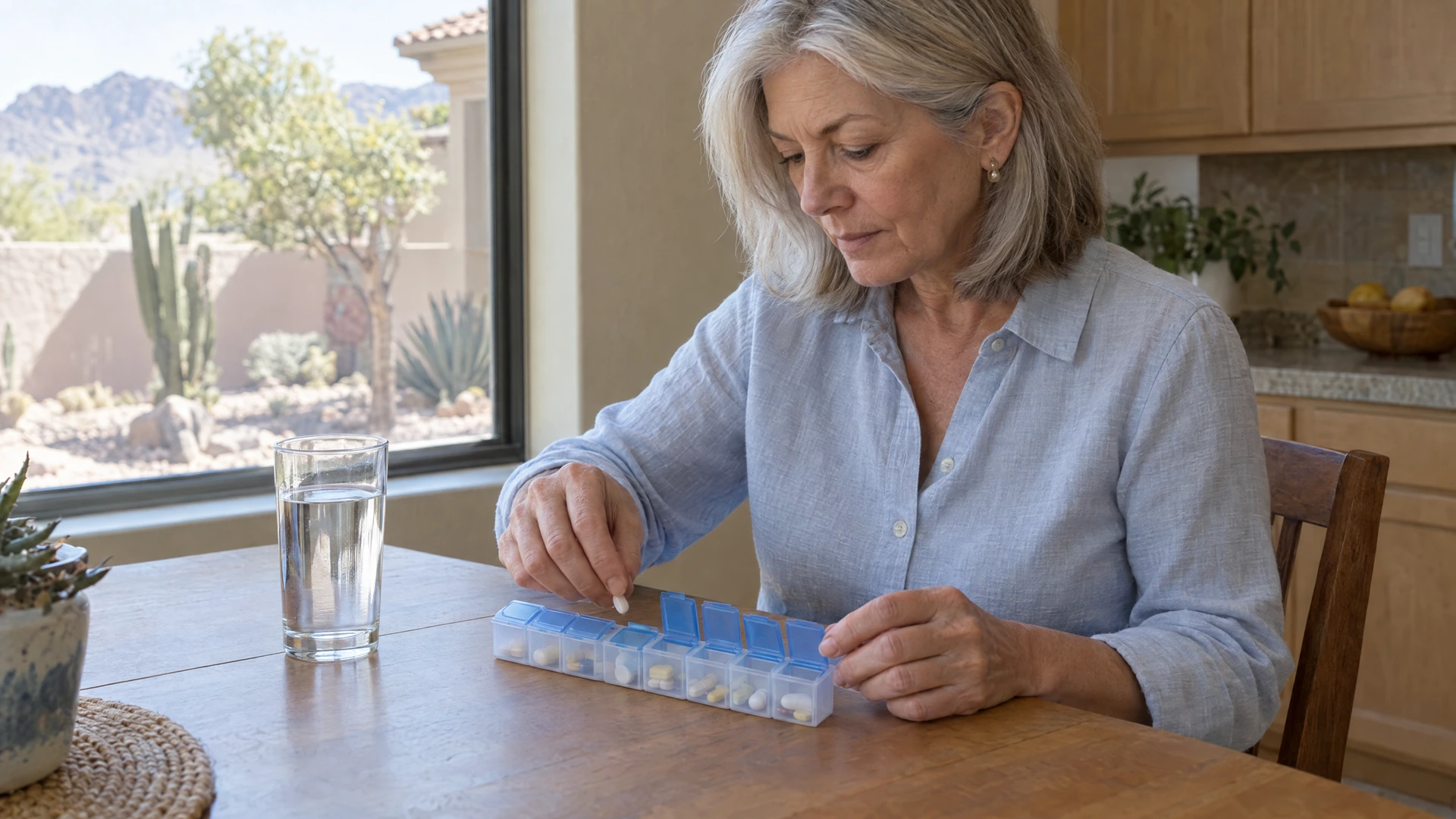
    White woman sorting a pill organizer beside water, for a guide to medications that cause dry eye

    TLDR: Reviewing medications that cause dry eye starts with your full medicine list, including allergy tablets and eye drops. Never stop or change a prescribed medicine without your prescriber, and bring the list to an eye appointment so we address dryness alongside your other health needs.

    Answer: Antihistamines, decongestants, antidepressants, some blood pressure medicines, isotretinoin and hormone therapy are linked to dry eye. Your medicine is a clue, not a diagnosis. In Las Vegas, an eye exam helps identify contributing factors and guide treatment while your prescriber decides whether a prescription needs changing.

    You fill the pill organizer at your Summerlin kitchen table. Then you reach past your breakfast cup for eye drops. When dryness appears after a new prescription, bring that timing to me, your optometrist, along with the medicine name. My priority is an eye care plan you understand, with a clear next step for both your eyes and your prescriptions.

    I reviewed 88 primary sources across five research lenses for this guide, and some medicines for allergies, depression and high blood pressure are linked to dry eye. The National Eye Institute identifies these medicine groups among possible causes of your symptoms. My dry eye treatment approach starts with the whole picture, as outlined on our dry eye care page. Bring your questions, including the ones you have hesitated to ask.

    Which Medications That Cause Dry Eye Belong on Your List?

    Black man reading a medicine container with glasses, for a guide to medications that cause dry eye
    Bring the medicine container when you are unsure of its name.

    Names beat categories. “Blood pressure pill” tells me little. The name on the bottle tells me plenty. The 2017 TFOS DEWS II report links the groups below to dry eye through effects on your tears or eyelid oil glands. These links describe possible contributors, with effects differing by medicine and person.

    Medicine GroupLink to Dry EyeWhat to Bring Up
    AntihistaminesSome have drying effects, and oral use is associated with dry eye.Your allergy tablets, including occasional use.
    DecongestantsIncluded among medicine groups with drying effects.Cold remedies and products with several ingredients.
    Antidepressants and anti-anxiety medicinesUse is associated with dry eye in observational research.The exact prescription and any recent changes.
    Some blood pressure medicinesDiuretics and beta-blockers have links to dry eye.The medicine name, rather than its purpose alone.
    IsotretinoinLinked to changes in eyelid oil glands and tear film stability.Current or past acne treatment and when symptoms began.
    Hormone therapyMenopausal hormone therapy, especially estrogen alone, is associated with dry eye.The type of hormone therapy you use.

    Use this table to prepare. Bring the actual package when you do not know which group a medicine belongs to. Include treatments prescribed elsewhere, even when their purpose seems unrelated to your eyes. I would rather review an extra bottle than have you leave out a medicine because it seemed irrelevant.

    How Does Dry Eye Care Work Around Your Medicines?

    Latina woman using eye drops at a kitchen counter, for a guide to medications that cause dry eye
    Include eye drops when you review your medicines.

    You keep your treatment. We work on your comfort. Depending on your eyes, my plan includes artificial tears, targeted prescription eye drops for inflammation, warm compresses, eyelid hygiene or punctal plugs to conserve tears. Care for meibomian gland dysfunction and blepharitis also belongs in the discussion when those conditions are present. The choice follows your evaluation.

    Your home plan needs clear instructions. Before you leave, ask which drops to use, how to use them and what should prompt a call. My guide to dry eye treatment in Las Vegas explains the treatment options in more detail. A drop schedule needs to fit your day, whether you are heading to a shift off the 215 or caring for a parent at home. Tell me which step feels difficult so we address it before you leave.

    Write down whether your concern is discomfort, difficulty using the drops or uncertainty about the instructions. Keep prescribed medicines on their assigned schedule while you seek advice about changes. I want your eye treatment to fit into a plan you understand, rather than become another bottle you feel unsure about.

    What Should You Bring to Your Eye Appointment?

    Older Asian couple with a medicine pouch at a front desk, for a guide to medications that cause dry eye
    Bring your medicine containers when you need help completing the list.

    A complete list saves you guesswork at the visit. Include daily prescriptions, occasional tablets and everything you put in your eyes. A bottle tucked into a travel bag still belongs on that list, even when you rarely use it. Gather the containers before your drive to Festival Plaza, while the pill organizer and bathroom shelf are still within reach.

    1. Record each medicine’s name, strength and schedule exactly as shown on its container. Add the reason you take it and the prescriber’s name.
    2. Include nonprescription cold and allergy remedies, vitamins, supplements and eye drops. Record how often you actually use each product.
    3. Note when dryness began and any prescription starts or dose changes near that time. Mark uncertain dates as approximate.
    4. Describe a difficult moment in your day, such as reading at the kitchen table or wearing contacts through a shift. Explain what you tried afterward.
    5. Bring the list to both visits. Use the same version with me and your prescriber, then update it after an agreed change.

    Missing a detail is easy. A partner who fills your pill organizer might know the names better than you do. That person or the containers help fill the gaps, along with recently stopped medicines and their stop dates. You do not need to decide which item matters before you arrive.

    Specific timing gives your concern a clear focus. “My eyes started burning after this prescription changed” gives us more to discuss than “my eyes feel bad.” Describe the timing without deciding the cause yourself. Save the main concern at the top of your list so it gets discussed before the visit ends.

    What Should You Ask About Medications That Cause Dry Eye?

    Middle Eastern woman on the phone beside a notepad, for a guide to medications that cause dry eye
    Discuss symptoms with your prescriber before changing a prescription.

    Never stop or change your prescribed medicine without your prescriber. MedlinePlus advises discussing side effects before stopping, with dose adjustments or a different medicine among the options your prescriber considers. Start the conversation with the symptom, the medicine and the timing. Your request is simple: help with the discomfort, with no break in your treatment.

    You do not need to propose a replacement. Ask whether the medicine is a plausible contributor and whether an alternative makes sense for your health needs. Explain any eye treatment already prescribed so the discussion includes both plans. Leave with clear instructions about what to continue and whom to contact with questions.

    Keep your mental health care in that conversation. Finding an antidepressant in the table is a reason to discuss symptoms, not to experiment with missed doses. The same instruction applies to blood pressure treatment and hormone therapy. Your prescriber should direct any change.

    Use a short note during the call. Include the medicine name, when symptoms appeared, what your eyes feel like and what you need clarified. Record the advice in your own words and read it back when anything sounds uncertain. One clear call to your prescriber beats a month of guessing.

    When Should You Get Help Right Away?

    A red or painful eye comes before any medication question: contact an eye care provider right away, as MedlinePlus advises. Do not wait for a routine medication review to report those symptoms. Tell the person taking your call about the eye symptoms first, then the medicine you suspect.

    Your suspected side effect is still a symptom that needs an exam. My guide to when dry eyes need an appointment covers the broader signs and referral discussion.

    How I Approach Your Medication Questions at Vision by Amel

    Your medicine list gives us a clear place to begin your comprehensive eye exam. At Vision by Amel, your visit includes a patient history, digital diagnostics, my evaluation and your plan. Use the history discussion to raise changes in prescriptions and the discomfort you want addressed. The eye exam page explains the visit before you arrive.

    Your eye health plan should make sense at home. Your medicines stay in your prescriber’s hands, and I build your eye plan around them. With your current drop bottles in front of us, we discuss the products you use at the kitchen counter or keep in your work bag. My priority is a workable eye plan with prescription changes directed by the prescriber responsible for that medicine.

    You will find Vision by Amel in Downtown Summerlin at Festival Plaza, 2010 Festival Plaza Dr, Suite 195, Las Vegas, NV 89135. No referral is needed for an eye exam. Book online or call (702) 858-4362, and mention the medication question when arranging your visit. Tuck your medicine list beside your keys before you leave home.

    Frequently Asked Questions About Medications and Dry Eye

    Why Do My Allergy Tablets Help Itching but Leave My Eyes Dry?

    Both effects are possible with oral antihistamines, according to the American Academy of Ophthalmology. Relief from itching does not tell you whether the treatment suits your dryness. Describe each symptom separately when we discuss your allergy medicines.

    Will My Eyes Return to Normal After Isotretinoin?

    A small uncontrolled study in Ophthalmology and Therapy found gland changes judged reversible, but symptoms remained above baseline a month after treatment stopped. That finding does not establish a recovery date for your eyes. Arrange an eye assessment for dryness during treatment or symptoms persisting afterward.

    Do My Glaucoma Drops Belong on the List Too?

    Yes, include their names and schedules because the 2017 TFOS DEWS II report describes irritation of the ocular surface and dry eye linked to topical medicines and their preservatives. Keep using your glaucoma prescription as directed while you raise the concern with its prescriber. Include which drop stings and whether the sensation continues after you use it.

    Does a Medicine Missing From This Table Need Mentioning?

    Yes, the AAO Preferred Practice Pattern includes additional medicines in its history checklist, such as heart rhythm drugs and chemotherapy. Your list should be complete even when this article does not name the treatment. Include the prescribing team’s contact details with an unfamiliar medication.

    What Should I Do When Different Offices Give Me Different Instructions?

    Request clarification before changing your prescription. Write down each instruction and contact the prescriber responsible for the medicine, explaining where the advice differs. At your next eye visit, share the clarified plan so we are discussing the same schedule.

    Book My Eye Exam Call (702) 858-4362

    Like this article? Add Vision by Amel as a preferred source, and you are more likely to see our articles in Google’s Top Stories.

    Add as a preferred source on Google

  • Crossed or Wandering Eyes in Children: What Strabismus Means

    Crossed or Wandering Eyes in Children: What Strabismus Means

    Crossed or Wandering Eyes in Children: What Strabismus Means

    Father and daughter at a Summerlin park, illustrating crossed eyes in children guidance

    TLDR: An eye turn deserves attention, even when it comes and goes. An examination checks whether your child’s eyes line up, how each eye sees, and which treatment fits the findings.

    Answer: True crossed eyes in children are a form of strabismus, meaning the eyes do not line up. An eye might turn inward, outward, upward or downward. For your family in Las Vegas, the next step is an eye exam to identify the type and assess vision, followed by glasses, patching or a surgical referral when indicated.

    You notice it while scrolling through photos from a Summerlin park. Your toddler smiles toward the camera, but an eye seems to point somewhere else. Then you look up, and both eyes appear straight. You have something worth checking, even when the next picture looks different.

    I reviewed 113 primary sources across five research lenses for this guide, and strabismus and amblyopia are different problems that sometimes occur together. For your child, eye misalignment also carries a risk of amblyopia, as AAPOS explains. I take a parent’s repeated concern about an eye turn seriously. My eye examination service is a place to discuss what you have noticed.

    What Do Crossed Eyes in Children Look Like?

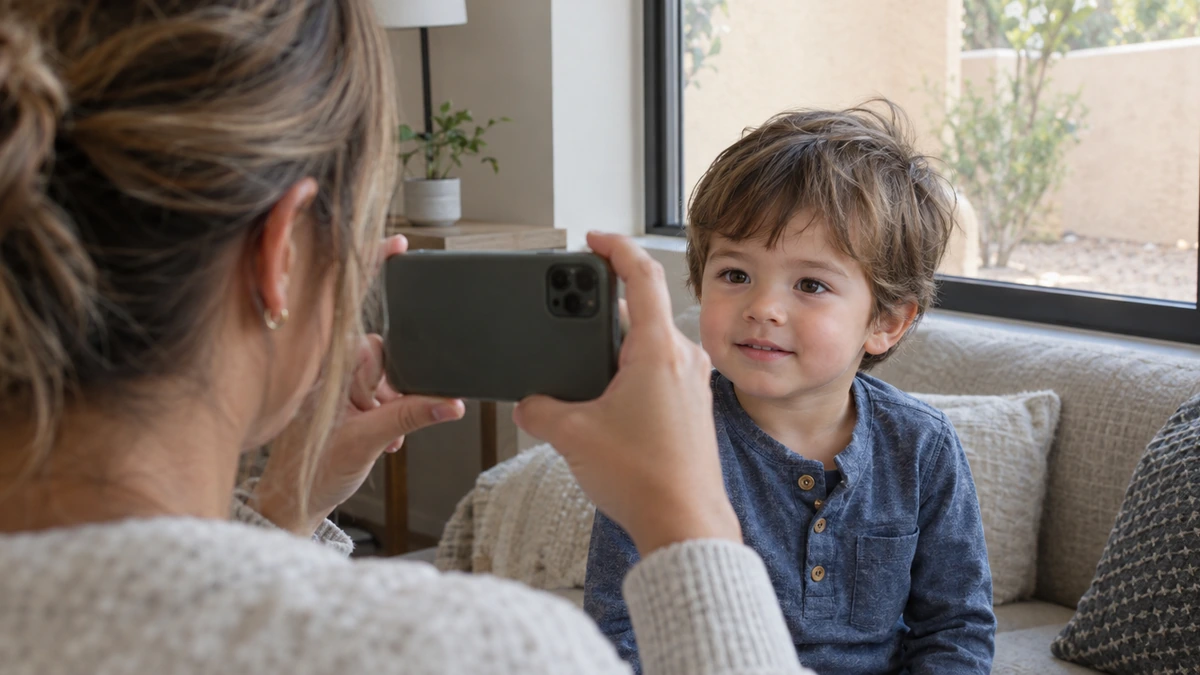
    Mother photographing her toddler by a window for a crossed eyes in children discussion
    A mother takes a casual photo of her toddler in window light at home.

    Tell me which way the eye turns. In or out, up or down, that one detail starts the exam ahead. Esotropia means an inward turn toward the nose, while exotropia means an outward turn toward the ear. For a vertical turn, use plain words when you call, even before you know the medical name.

    TermWhat It DescribesWhat to Record
    EsotropiaAn eye turns inwardWhich eye looks closer to the nose
    ExotropiaAn eye turns outwardWhich eye drifts toward the ear
    IntermittentThe turn comes and goesWhen you notice it and when the eyes look straight
    ConstantThe turn stays presentWhen you first noticed the persistent turn

    An occasional outward drift still matters. Your child’s eyes might look straight for much of the day, then drift when tired or sick, a pattern described by AAPOS. The word intermittent describes timing. It does not tell you to dismiss the concern.

    How to Bring Useful Photos

    Your everyday photos give us a place to begin. A casual picture near a window or a short video of ordinary play gives you something concrete to show me. Save the original files and note what was happening. Collecting pictures should never postpone the examination.

    1. Choose an existing photo that shows your child’s face and both eyes clearly. Include the date with it.
    2. For a new picture, use comfortable natural light and hold the phone near your child’s eye level. Let your child look naturally toward you.
    3. Save the original without filters, red-eye correction or other edits. Save a wider view as well as any close-up.
    4. Write down whether you noticed the turn during play, before a nap or during illness. Include what you saw in person.

    Have your child see an eye doctor right away for a white or gray-white glow in the pupil, in person or in a flash photo, as AAPOS advises. Several conditions cause this reflection, and some are serious. Do not wait for another photo to confirm it.

    When Is Newborn Eye Wandering Normal?

    Brief, on-and-off inward turns are common in babies younger than about 4 to 5 months, says AAPOS. An eye that turns all the time, at any age, needs an eye exam right away. Children do not outgrow true strabismus, the American Optometric Association says, and any child older than 4 months whose eyes are not straight all the time needs an exam. For your baby, describe constant crossing when you call so the need for care is clear.

    Some babies only look cross-eyed. A wide nasal bridge or folds of skin near the inner corners sometimes create that appearance, called pseudostrabismus, which children sometimes outgrow, according to the American Academy of Ophthalmology. An eye exam tells you which one your child has.

    You do not need to settle the diagnosis at home. Describe the direction, the pattern and when you first noticed it, then arrange the recommended evaluation. For the wider infant schedule, read your baby’s first eye exam guide. Address the crossing concern before planning routine checkups.

    How Are Crossed Eyes in Children Evaluated?

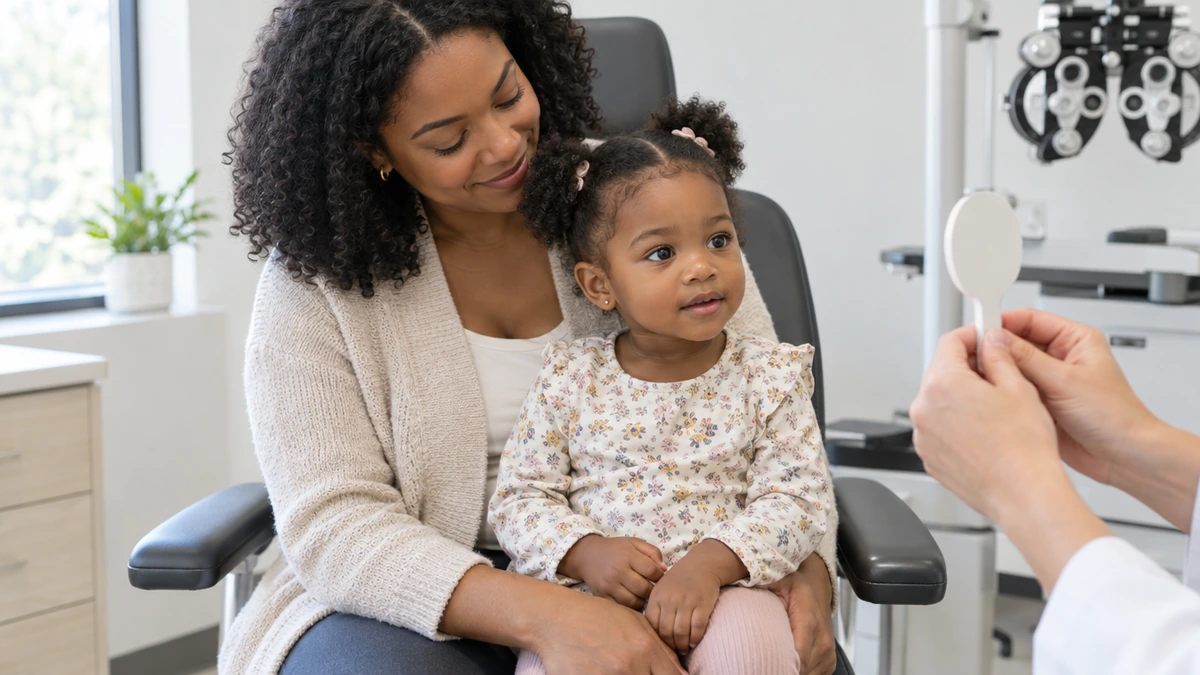
    Toddler on her mother’s lap watching a toy during an exam for crossed eyes in children
    The examination approach adapts to your child’s age and cooperation.

    A comprehensive eye exam looks beyond the photograph. The American Academy of Ophthalmology describes an assessment of your child’s history, visual acuity or fixation, eye movements, alignment, binocular vision, refraction and eye health. Refraction measures the focusing prescription, while binocular testing examines how the eyes work together. The approach adapts to your child’s age and cooperation.

    Your history speeds everything up. Bring past results, any screening note, current glasses and every treatment already prescribed. Note whether relatives have had an eye turn or childhood vision treatment. At a Las Vegas preschool pickup, you might notice the turn while your child looks up from fastening a backpack. That ordinary detail belongs in our conversation, even without a photograph.

    You deserve an explanation in everyday language. Before leaving, request the name of the finding, the next step and the reason for any referral. Use what to expect at a child’s first examination for general visit preparation. Here, keep your questions focused on alignment and vision in each eye.

    How Is Strabismus Related to Lazy Eye?

    Your child’s eye position and vision are separate findings. Strabismus describes misalignment, while amblyopia, often called lazy eye, describes a problem with vision development. Misalignment is one possible cause of amblyopia. That connection is why an eye turn deserves more than a comment about appearance.

    Two words, two jobs. Your child’s plan should say which one each step treats: the turn, the lazy eye, or both. My lazy eye guide explains the vision-development side in more detail. I want you to understand the reason for each step before you leave.

    What Treatments Help Crossed Eyes in Children?

    Boy wearing glasses and playing with toy cars, illustrating care for crossed eyes in children
    A boy in new glasses plays with toy cars while his father watches.

    The treatment follows the type. Prescription glasses help align some children’s eyes, and a pediatric ophthalmologist performs eye muscle surgery when indicated, as the American Academy of Ophthalmology explains. Surgery does not replace glasses or patching when these are also prescribed for your child. When your child needs eye muscle surgery, I refer you to a pediatric ophthalmologist and coordinate the care around it.

    Glasses and Patching Have Different Jobs

    Glasses address the focusing prescription. In some forms of inward crossing, correcting that prescription also improves alignment. Your child’s examination determines whether this approach fits. Get clear instructions about when to wear the glasses and when to return.

    Patching treats the lazy eye that a turn can cause, and my lazy eye guide covers how it works. Your instructions should make the purpose of patching clear. Discuss resistance or missed sessions at follow-up before changing the prescribed plan.

    Make Shared Care Clear

    Two doctors, one plan. Co-management means your optometrist and your child’s pediatric ophthalmologist share the work, and you always know who handles what. I explain my part in your child’s care and the reason for an ophthalmology referral. Before you leave, we should be clear about who handles glasses, who directs any patching and who reviews surgical decisions.

    How I Approach Your Child’s Eye Turn at Vision by Amel

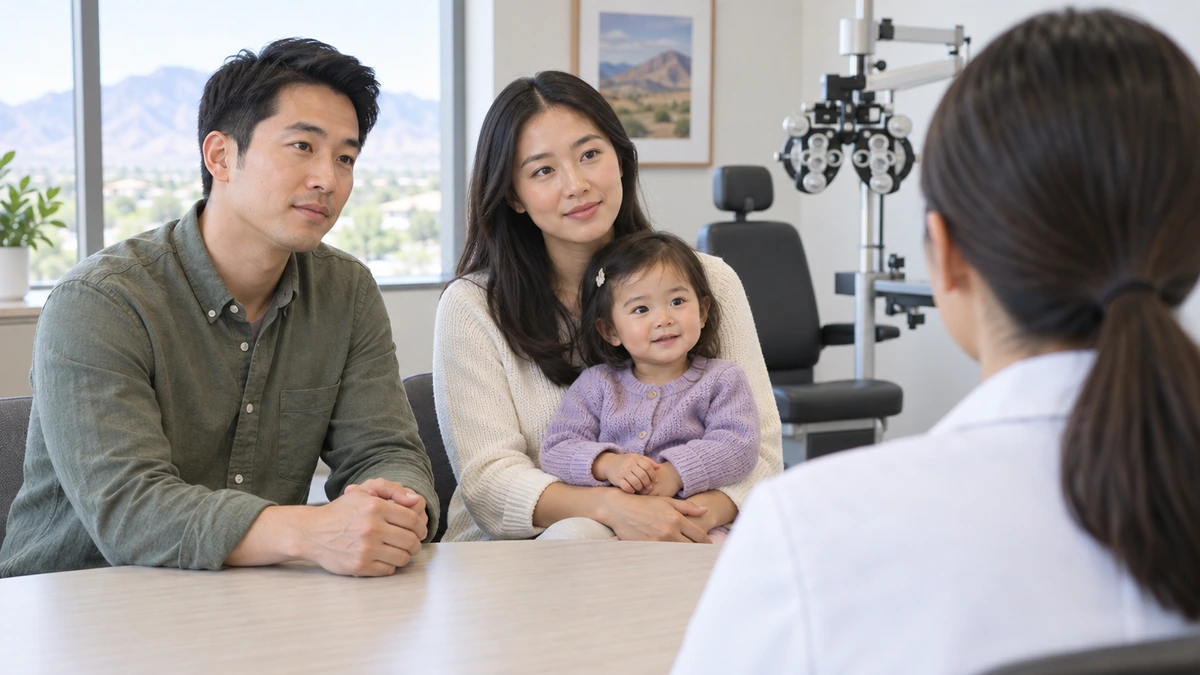
    Parents and toddler talking with an eye doctor about crossed eyes in children
    Parents talk through their toddler's eye exam with an eye doctor.

    Bring me the photo that worried you. I look at the turn you saw, then I check how each eye sees and how both eyes work together. I am Dr. Amel Youssef, your optometrist at Vision by Amel. My pediatric eye exam process includes patient history, digital diagnostics, an evaluation of binocular vision and a plan.

    A Sunday visit at Festival Plaza should leave you with a clear next step. Picture sitting beside your child while we go over the photo saved on your phone, then naming the question you most want answered. Is the eye turning, does each eye see well, or is an ophthalmology referral needed? Those questions guide our discussion.

    My team offers eye care in Downtown Summerlin at 2010 Festival Plaza Dr, Suite 195, Las Vegas, NV 89135. You need no referral to book an eye exam. For questions about insurance, call before the visit so my team has time to verify your benefits by phone. Share any existing ophthalmology appointment when arranging the visit.

    Frequently Asked Questions About Strabismus in Children

    Should I Cancel If My Child’s Eyes Look Straight Today?

    Keep the appointment and explain what changed. Your observations from other days still belong in the history, especially when the original concern was an intermittent turn. Show me both the concerning pictures and a note about the days you saw no turn.

    Will My Child Grow Out of Crossed Eyes?

    No, your child will not outgrow true strabismus. Some babies only look cross-eyed because of the shape of the nose bridge or nearby skin folds, and they sometimes outgrow that appearance, called pseudostrabismus. An exam distinguishes the two. Strabismus usually shows up in babies and young children, most often by age 3, says the AOA.

    What Is the Difference Between Esotropia and Exotropia?

    Esotropia means your child’s eye turns inward, while exotropia means it turns outward. Upward and downward misalignment are called hypertropia and hypotropia. An outward drift that appears when your child is tired or sick fits the intermittent pattern, with straight-looking eyes at other times.

    Can Crossed Eyes Cause Lazy Eye?

    Yes, an eye turn sometimes leads to amblyopia, or lazy eye, as vision develops. With esotropia, your child also risks losing stereopsis, or 3-D vision, and the ability to use both eyes together, according to AAPOS. That is why the assessment looks at vision and how the eyes work together as well as their position.

    Does My Child Need Surgery for Crossed Eyes?

    Not always: some inward crossing improves with glasses, and prisms are another treatment option for certain types of strabismus. Your child’s findings determine whether a pediatric ophthalmologist recommends surgery, which does not replace prescribed glasses or patching. The American Academy of Ophthalmology says most children resume routines in about 2 to 3 days after surgery. Follow your child’s surgical team’s instructions about returning to preschool and play.

    Book My Eye Exam Call (702) 858-4362

    Like this article? Add Vision by Amel as a preferred source, and you are more likely to see our articles in Google’s Top Stories.
    Add as a preferred source on Google

  • Blepharitis: Why Your Eyelids Itch, Crust and Burn

    Blepharitis: Why Your Eyelids Itch, Crust and Burn

    Blepharitis: Why Your Eyelids Itch, Crust and Burn

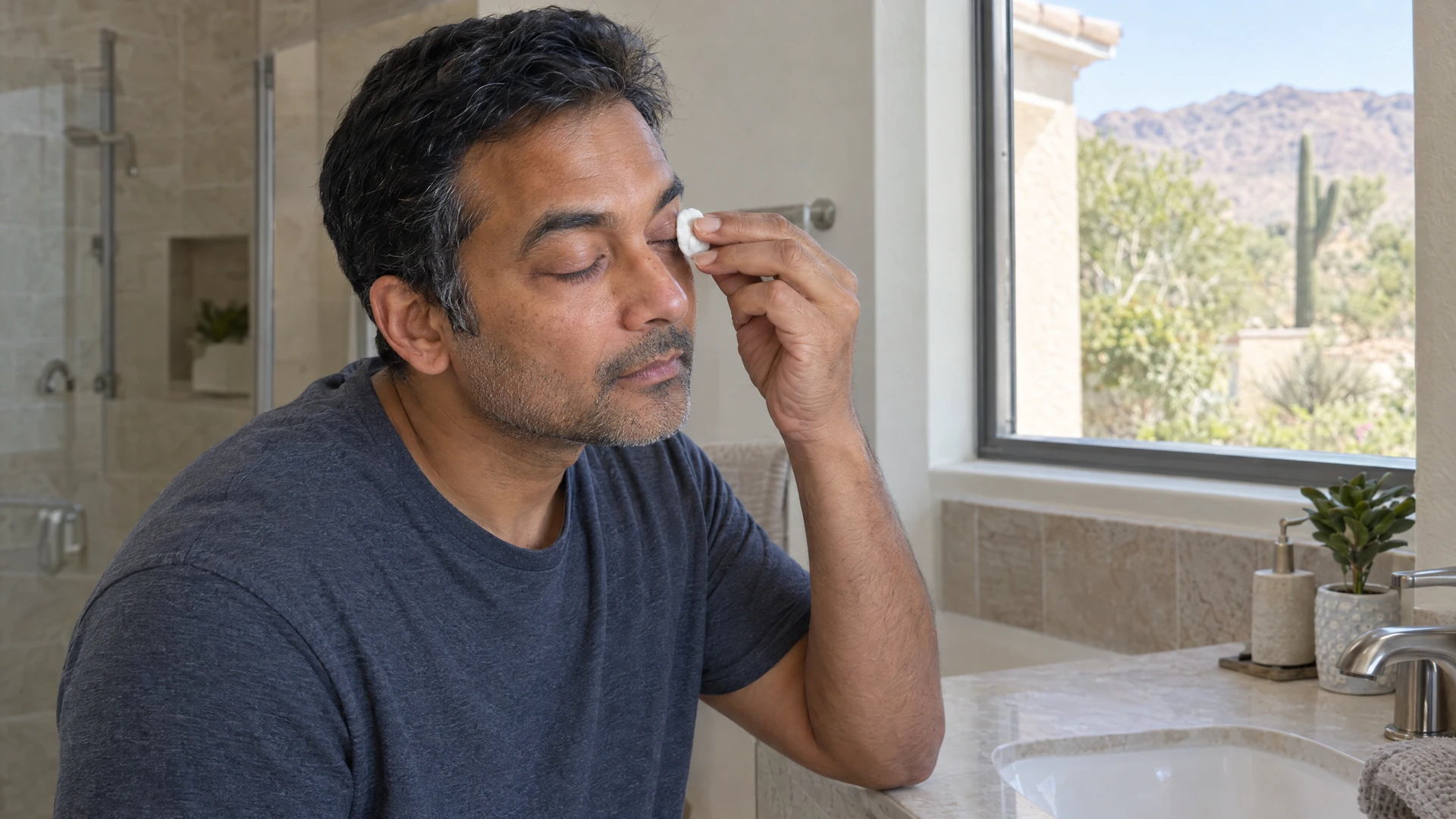
    South Asian man gently cleaning his eyelid with a soft pad for blepharitis care

    TLDR: Blepharitis is eyelid inflammation that leaves your lids itchy, crusty or burning. Gentle daily eyelid hygiene helps control symptoms, while persistent inflammation needs an exam to identify its cause and guide prescription care.

    Answer: Blepharitis affects the lash line, the inner eyelid edge or both, causing crusts and irritation around your eyes. Bacteria, skin conditions, poorly working oil glands and Demodex mites are possible contributors. For adults in Las Vegas, care starts with identifying the type, then choosing a lid-cleaning routine and any prescription treatment your findings require.

    You notice flakes before breakfast. Your eyelids burn while you get ready for work in Summerlin, and washing your face has not settled the problem. As an optometrist, I want you to understand what those changes mean, and book an exam before you buy another bottle of eye drops.

    I reviewed 88 primary sources across five research lenses for this guide, and blepharitis often needs ongoing care to keep symptoms under control. Your lids also matter to dry eye, so I consider them when planning dry eye treatment. My dry eye care page explains the broader options, while this guide focuses on the inflamed eyelid itself.

    Where Does Blepharitis Start?

    White woman looking closely at her eyelids in a lighted bathroom mirror, illustrating blepharitis symptoms
    The location of eyelid inflammation matters.

    Where the crust sits tells me where to start. According to the National Eye Institute, anterior blepharitis affects your lash line, posterior blepharitis affects the inner lid edge, and both types sometimes occur together. Crusts on waking, itching and burning belong to the symptom picture.

    TypeWhere It HappensCommon Contributors
    Anterior blepharitisOuter lid edge where lashes attachSkin bacteria and dandruff from the scalp or eyebrows
    Posterior blepharitisInner lid edge beside the eyeClogged oil glands, with rosacea or scalp dandruff as contributors
    Both types togetherOuter and inner lid edgesOverlapping causes that need attention in the same care plan

    Posterior blepharitis often travels with meibomian gland dysfunction, but the TFOS MGD Workshop says the two terms are not interchangeable, so your exam checks both.

    Your lid symptoms belong in the same conversation as dryness. Blepharitis is associated with dry eye, so mention both the irritated lid edge and how the eye itself feels. For a closer look at gland function and the tear film, read my guide to meibomian gland dysfunction. Include both concerns in your eye exam, even when the flakes seem more obvious than the dryness.

    Why Are Your Lids Inflamed?

    Your scalp and skin hold clues your lids cannot show alone. Your scalp dandruff, facial rosacea, oily skin or allergies affecting the lashes are useful clues to the cause. Mention changes in these areas alongside your eyelid symptoms, including what you already use on your skin.

    Demodex deserves a careful look. A review in Cornea describes sleeve-like debris at the lash base as a clue to Demodex blepharitis, microscopic confirmation of suspected cases, and mites in people with and without symptoms. That means a mite finding alone does not explain your discomfort.

    Persistent symptoms call for another look at the cause. Tell me when your current routine has stopped helping, or when it never made a difference. Bring your treatment history to the visit, including what helped, what stung and what you stopped using.

    I prefer a clear cause over a crowded bathroom shelf. You should know why each part of your routine belongs there. A product chosen for a different eyelid problem adds work without answering why your own lids stay inflamed.

    Does Eyelid Hygiene Help Blepharitis?

    Black man holding a warm washcloth over his closed eyes as part of blepharitis care
    Warm compresses are part of an eyelid hygiene routine.

    Gentle cleaning aims to ease crusting and discomfort. A Cochrane review, with searches ending in February 2012, found possible symptom relief from lid hygiene but no strong evidence of lasting elimination from the treatments studied. For you, that supports a practical goal: manage discomfort and crusting while checking whether the plan fits the cause.

    A clear routine gives you steps to follow. Warm compresses and eyelid cleansing are basic parts of blepharitis care, but more products do not make the instructions easier to follow. My dry eye treatment guide covers the detailed warm-compress and cleaning methods.

    1. Write down your current lid-care routine, including the cleanser, compress and any drops.
    2. Bring the routine to your exam so we match it to the cause of your symptoms.
    3. Follow the agreed method and record whether crusting, itching or burning changes.
    4. At your follow-up, explain which symptoms remain and which steps are hard to follow.

    Make room for the routine in your actual day. After a hospital shift and the drive home on the 215, you need more than a vague instruction to clean your lids. Before you leave the visit, make sure you know what to use, where to use it and which changes warrant a call.

    When Does Blepharitis Need Prescription Care?

    Eye doctor hands holding a small magnifier near a woman’s eyelid during a blepharitis examination
    An exam helps guide care for eyelid inflammation.

    Prescription care depends on the cause. Antibiotic drops, ointments or pills are options for bacterial blepharitis, while steroid drops are sometimes used to control inflammation. Your symptoms alone do not select the medicine, and treatment also needs to address any contributing skin condition.

    A steroid prescription includes follow-up. The American Academy of Ophthalmology recommends a recheck within a few weeks, including eye pressure measurement, when steroid treatment is prescribed. Keep that appointment even when your lids feel better.

    Your skin history helps guide treatment, too. When rosacea or dandruff drives your blepharitis, treating the skin condition helps address that contributor. A plan focused only on the lashes leaves that part of the history unexplored.

    Put your questions beside the prescription. What problem is the medicine treating, how should you use it, and what happens at the recheck? Clear instructions are part of good eye care, especially when the plan includes both lid cleaning and medication.

    Why Does Blepharitis Keep Coming Back?

    East Asian woman calmly washing her face at a sink, illustrating a daily routine alongside blepharitis care
    Ongoing blepharitis care belongs in a manageable daily routine.

    Blepharitis is often chronic. Your symptoms might settle while the tendency toward lid inflammation remains, which is why daily cleaning often becomes an ongoing habit. Judge the plan by symptom control and the findings at follow-up, rather than a promise of permanent disappearance.

    A routine you keep beats a perfect routine you skip. Your plan should fit the morning you have, with instructions you remember when you are tired. Say when a step feels confusing, uncomfortable or hard to fit around work so we have something specific to discuss.

    A calm week is good news, not a finish line. So is a flare after a stretch of calmer lids, especially when you have kept to the agreed routine. Note the change and bring it to the next discussion about your plan.

    Crusts back after a calm stretch? Bring me that detail. Your notes about crusting, burning and the treatments used help keep the conversation focused. Repeating the same purchase without reviewing the cause leaves the most useful question unanswered: what needs to change in your care?

    Which Eyelid Changes Need Care Right Away?

    Contact an eye care provider right away for red or painful eyes, flaking, discharge, or a sore on your eye or eyelid, as MedlinePlus advises. An inflamed eyelid lesion that looks suspicious for cancer needs a specialist, the AAO guideline cited above says, and I refer you to one when your lid needs it. Describe the symptoms when you call so the team knows what has changed.

    Keep your eye health ahead of the label. A previous blepharitis diagnosis does not explain every new eye problem. My guide to when to seek dry eye care explains the broader warning signs and referral decisions.

    How I Approach Your Eyelid Concerns at Vision by Amel

    Your history helps me match eyelid care to the problem. At Vision by Amel, my evaluation and your plan follow the history and digital diagnostic steps in the exam. For eyelid concerns, bring the names of your drops and cleansers, any skin diagnoses and a clear account of how the symptoms have changed.

    Depending on your eyes, my plans include eyelid hygiene, warm compresses, care for blepharitis and meibomian gland dysfunction, or targeted prescription eye drops including anti-inflammatory medication. Each part of your plan needs a clear purpose. You should leave knowing its purpose and the next step.

    My office sits in Downtown Summerlin at Festival Plaza, 2010 Festival Plaza Dr, Suite 195. Book online or call my team at (702) 858-4362, with no referral needed for an eye exam. Visit the eye exams page to prepare for your visit.

    Frequently Asked Questions About Blepharitis

    Is Blepharitis Something I Pass to My Family?

    Blepharitis itself is not contagious. You do not pass the condition to your family through ordinary contact. Its relationship to skin bacteria does not make it a contagious eye infection.

    Are My Repeated Eyelid Bumps Related?

    Styes and chalazia are among the problems associated with blepharitis. Your recurring bumps belong in the history even when the itching is what prompted your visit. Mention where they appear and whether the same area keeps bothering you.

    Should I Use Baby Shampoo on My Eyelids?

    The AAO EyeSmart guide describes baby shampoo diluted in warm water and gentle cleaning at the lash base as one lid-hygiene method. That is a specific diluted method, rather than undiluted shampoo applied to your eyes. Review the cleaning method with me so you understand what belongs in your routine.

    Is Tea Tree Oil a Good Home Treatment?

    Do not start tea tree oil on your eyelids without my advice. A Cochrane tea tree oil review found uncertain short-term effectiveness for Demodex blepharitis and noted the risk of eye irritation. An online recipe does not establish a suitable concentration or method for your eyes.

    Will Blepharitis Damage My Eyes Permanently?

    Blepharitis usually causes no lasting eye damage. In severe cases, blepharitis can damage the cornea, the clear front surface of your eye, so persistent or changing symptoms need evaluation. Keep the distinction in mind: an ongoing condition still needs follow-up when its symptoms change.

    Book My Eye Exam Call (702) 858-4362

    Like this article? Add Vision by Amel as a preferred source, and you are more likely to see our articles in Google’s Top Stories.

    Add as a preferred source on Google

  • Lazy Eye (Amblyopia) in Children: Signs, Causes and Treatment

    Lazy Eye (Amblyopia) in Children: Signs, Causes and Treatment

    Lazy Eye (Amblyopia) in Children: Signs, Causes and Treatment

    Boy with a patch and round glasses stacking blocks with his mother, illustrating lazy eye in children

    TLDR: Lazy eye in children, or amblyopia, affects developing vision and sometimes has no visible signs. Your child’s treatment starts with an eye doctor’s assessment and often includes prescription glasses, with patching when prescribed. An eye that turns all the time, at any age, needs an eye exam right away.

    Answer: Amblyopia means vision has not developed properly in an eye, even when the eyes look straight. Causes include unequal prescriptions, eye misalignment, or an obstruction to clear sight. For your child in Las Vegas, an eye exam identifies the problem so treatment, such as glasses or prescribed patching, addresses the cause and the weaker vision.

    On a shaded bench at a Summerlin park, your child points out tiny pictures in a book. Then a screening note mentions weaker vision in an eye. That mismatch deserves attention. Amblyopia concerns how vision develops, so everyday confidence gives you only part of the picture.

    I reviewed 113 primary sources across five research lenses for this guide, and amblyopia sometimes goes unnoticed until an eye exam. The National Eye Institute reports that up to 3 in 100 children have amblyopia. Your next step is to understand each eye’s vision. My eye examination service explains how I assess vision and help you understand the findings.

    What Signs Suggest Lazy Eye in Children?

    Girl covering one eye while playing with her father, illustrating a discussion of lazy eye in children
    A father and daughter share a playful moment.

    Lazy eye hides well. Squinting, tilting the head or covering one eye are signs to have checked, according to the American Optometric Association. An eye that turns in or out all the time needs an eye exam right away. You do not need to name the problem before seeking care.

    Your observations help me understand the concern. A child covering an eye during a game is different from repeatedly doing it to see. Describe what happened, which eye was involved, and whether you noticed it during reading, play, or looking across the room. The useful detail is what you saw.

    For broader concerns, use my checklist of signs your child needs glasses. Bring your observations to a pediatric eye exam, along with any screening result. I would rather you bring a small concern than wait for a dramatic sign.

    A white or gray-white glow in the pupil, in person or in a flash photo, means your child sees an eye doctor right away, as AAPOS advises.

    What Causes Lazy Eye in Children?

    The cause shapes treatment. AAPOS describes refractive, strabismic, and deprivational amblyopia and warns of permanent vision loss without treatment. Unequal prescriptions and eye alignment problems affect the visual input reaching the developing brain. A blocked view creates a different problem requiring attention to the obstruction. Arrange your child’s assessment early, even when the eyes look normal.

    CauseWhat It MeansWhat to Discuss at Your Visit
    Refractive amblyopiaBlur during development, including when one eye needs a stronger prescription than the other.The prescription in each eye and the glasses plan.
    Strabismic amblyopiaMisaligned eyes interfere with normal vision development.Both eye alignment and vision in each eye.
    Deprivational amblyopiaA cataract, drooping lid, or corneal scar obstructs clear sight.How the obstruction and developing vision will be addressed.

    The diagnosis tells you what needs treatment. Strabismus names the alignment problem. Amblyopia names the problem with developing vision. Your child needs an explanation of which is present and what each part of the treatment plan addresses.

    Leave the visit knowing the cause. Request the diagnosis in plain language, alongside the medical term. For unequal prescriptions, have the difference explained using your child’s own results. For an obstruction, clarify the next assessment and who will provide it.

    How Do Glasses Help With Amblyopia?

    Mother helping her daughter put on glasses at a mirror, illustrating care for lazy eye in children
    A mother helps her daughter put on glasses.

    Glasses often lead the plan. In a PEDIG study of 84 children aged 3 to under 7 with untreated anisometropic amblyopia, glasses alone improved weaker-eye vision by at least 2 chart lines in 77%, with improvement taking up to 30 weeks. That study covered one type of lazy eye and had no untreated group, so read it as a signal, not a forecast for your child.

    For many children, glasses alone are not enough, says AAPOS, and patching follows when your eye doctor prescribes it. The goal is better vision in the weaker eye. Your follow-up measurements show whether glasses alone are doing enough.

    Give the glasses a place in your morning. In your Las Vegas kitchen, the cereal bowl, backpack and glasses case share the counter before school. Set the glasses beside the morning essentials so putting them on becomes part of getting ready. Share the prescribed wearing instructions with anyone helping your child start the day.

    Report problems plainly. Explain whether your child removes the glasses during meals, complains about the frame, or repeatedly loses them between home and school. The glasses belong at the next visit, too. A specific account gives the conversation more value than saying the week went badly.

    Watch the chart, not the calendar. The prescription is the lens. Visual acuity is how well your child’s eye sees, and that number tells you whether treatment is working. New glasses begin a plan whose progress needs review.

    What Does Prescribed Patching Involve?

    Boy with an eye patch drawing beside his grandmother, illustrating prescribed care for lazy eye in children
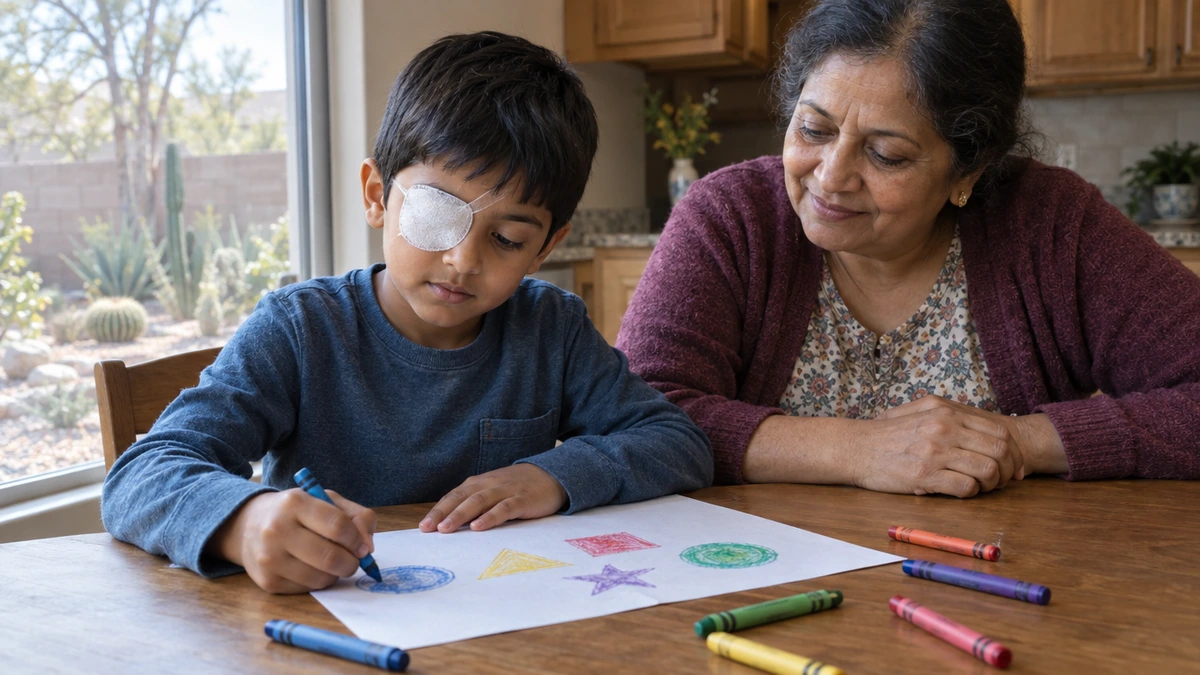
    A grandmother sits beside her grandson as he draws.

    Patching covers the stronger eye to encourage use of the weaker eye. Your eye doctor prescribes which eye to cover, how long to patch, and when to review progress. Get those instructions in writing. Follow the prescribed schedule rather than borrowing another family’s routine.

    More hours are not automatically better. A PEDIG randomized trial involving 189 children under 7 with moderate amblyopia found the same average improvement with 2 or 6 daily patching hours after 4 months, with at least 1 hour of near activities in both groups. This finding applies to the studied moderate cases. Your child’s prescription still governs the schedule.

    A familiar activity gives patch time a place in your day. Choose a time with room for the prescribed session. Drawing, blocks, or shared reading give you activities to discuss when the patching plan is explained. Match the activity and its timing to the instructions you receive.

    1. Confirm which eye to patch and the prescribed daily duration before starting.
    2. Check how glasses fit into the patching instructions.
    3. Record completed sessions and any practical difficulties.
    4. Call your eye doctor about skin irritation or a child who keeps fighting the patch.
    5. Keep every follow-up visit. Only your eye doctor changes the patching hours.

    A difficult afternoon deserves a useful conversation. Describe what your child found hard, how much of the session was completed, and what you tried. A short note about a difficult session gives you something concrete to discuss at follow-up. I value an honest treatment diary more than a perfect-looking one.

    Why Do Screening Results and Follow-Up Both Matter?

    Boy wearing glasses reading with his mother on a porch swing, illustrating lazy eye in children
    A mother and son read together on a porch swing.

    Your next step needs to be clear. After a vision screening flags a concern, arrange a comprehensive eye exam and take the actual result with you. My guide to school screening and comprehensive eye exams explains the difference. At your visit, I check vision and eye health and explain the findings.

    Follow-up puts the focus on each eye’s progress. Your current glasses, prescribed schedule and account of home treatment belong in that conversation. Request an explanation of each eye’s measured vision and whether the plan changes. Leave with the next review date written down.

    Your afternoon is already full: Summerlin school pickup, dinner, homework. Fit the patch into what you already do, like the drawing table or the bedtime book. Share the treatment instructions with caregivers so everyone follows the same plan. When the routine breaks down, raise the difficulty before making your own changes.

    How I Approach Your Child’s Exam at Vision by Amel

    I am Dr. Amel Youssef, an optometrist and the founder of Vision by Amel. For your visit about possible amblyopia, bring prior prescriptions, screening results, and any existing treatment instructions. My evaluation includes binocular vision and eye disease screening, with digital refraction among our Visionix diagnostics. Your history gives those findings context.

    My practice provides pediatric eye care at 2010 Festival Plaza Dr, Suite 195, Las Vegas, NV 89135. You will find us at Festival Plaza in Downtown Summerlin. No referral is needed for an eye exam. Book online or call with your child’s exam needs.

    Your questions about children’s vision deserve time at the visit. Tell me what worries you most, whether it is the diagnosis, the prescription, or understanding an existing plan. My team verifies insurance benefits by phone before your visit. Have your plan information ready for that conversation.

    Frequently Asked Questions About Lazy Eye in Children

    Is My Child Too Old to Start Treatment?

    Treatment works best when it starts young, and older children and teens can still improve, especially if they were never treated before. The American Academy of Ophthalmology advises offering treatment regardless of age when the visual system is structurally sound, with potential benefit in older children and adolescents, especially those previously untreated. Bring your child’s treatment history so the discussion reflects what has already been tried.

    Will Lazy Eye Hurt My Child’s Grades?

    The American Academy of Ophthalmology finds insufficient evidence that amblyopia in one eye harms school or career performance. Your child’s treatment addresses vision itself. Discuss school concerns on their own terms, without assuming lazy eye explains every difficulty in class.

    How Many Hours a Day Will My Child Wear a Patch?

    The National Eye Institute describes schedules ranging from 2 hours a day to all waking hours. Your eye doctor sets the patching time and adjusts it at follow-up visits. The PEDIG trial above compared schedules for moderate amblyopia, so its results are not a patching prescription for your child.

    Can My Child Have Lazy Eye if Their Eyes Look Straight?

    Yes, your child might have amblyopia even when the eyes look straight, as AAPOS explains. The National Eye Institute notes that many parents learn of the problem only at an eye exam. You do not need to spot an eye turn for the finding to deserve attention.

    What Should I Say to My Child About the Diagnosis?

    Keep your explanation calm and concrete. Describe the glasses or patch using the instructions you received, then invite questions about the daily routine. Choose words about practicing the routine together, and praise the effort your child puts into following it.

    Book My Eye Exam Call (702) 858-4362

    Like this article? Add Vision by Amel as a preferred source, and you are more likely to see our articles in Google’s Top Stories.
    Add as a preferred source on Google

  • Meibomian Gland Dysfunction: The Oil Problem Behind Dry Eye

    Meibomian Gland Dysfunction: The Oil Problem Behind Dry Eye

    Meibomian Gland Dysfunction: The Oil Problem Behind Dry Eye

    White woman holding a warm mask over closed eyes for meibomian gland dysfunction care

    TLDR: Meibomian gland dysfunction affects the oil glands in your eyelids and contributes to dry eye by disrupting the tear film. An eye exam helps identify the gland problem, while gentle home care and selected prescription treatment address your symptoms.

    Answer: Meibomian gland dysfunction, or MGD, is a chronic problem involving blocked eyelid oil glands, altered oil, or both. Your tears need this oil to limit evaporation, especially in dry Las Vegas air. Treatment focuses on gland function, eyelid care and inflammation, with an exam guiding which steps fit your eyes.

    You finish a shift under office air conditioning with gritty eyes, then reach for another bottle of drops. The missing question is simple: what is happening at your eyelids? Understanding their oil glands gives you a clearer reason for each step in dry eye treatment, beyond choosing another drop.

    I reviewed 88 primary sources across five research lenses for this guide, and oil-gland dysfunction involves more than blocked openings. The TFOS MGD Workshop defines MGD as a chronic, widespread gland abnormality involving blocked outlets, changed oil quality or amount, or a combination. For you, this explains why my approach to dry eye care starts with identifying the problem.

    What Is Meibomian Gland Dysfunction?

    Gloved hands gently lifting an upper eyelid near a slit lamp during a meibomian gland dysfunction exam
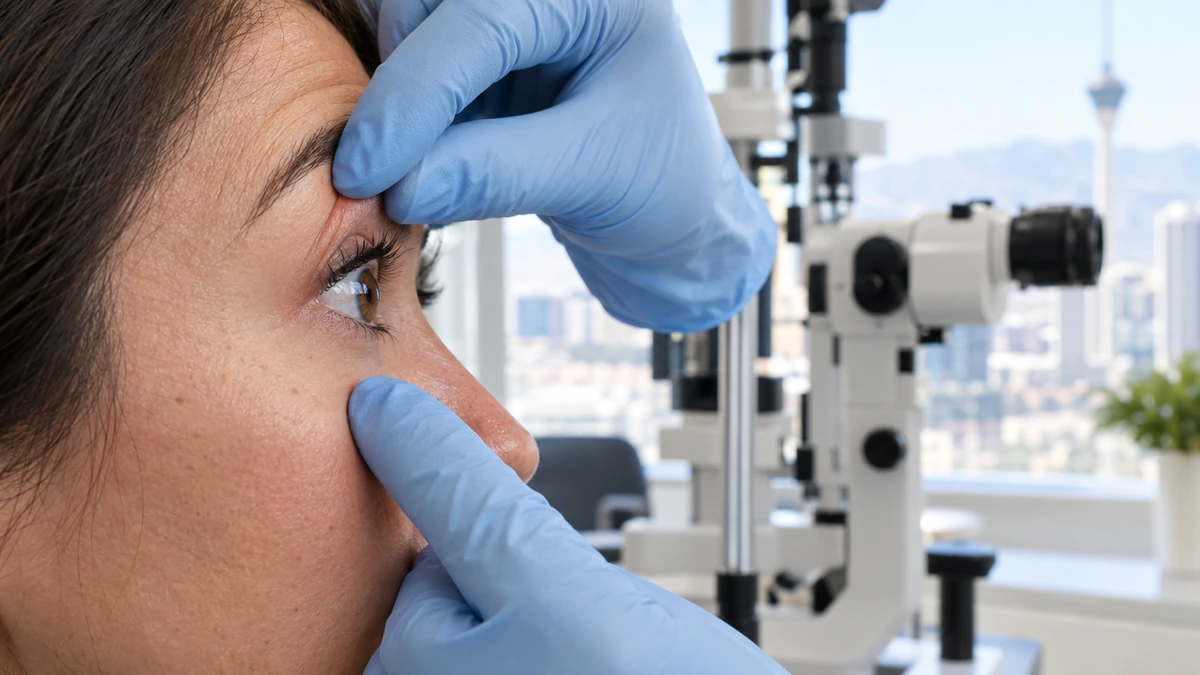
    The eyelid glands are part of an MGD evaluation.

    Your eyelids contain meibomian glands whose oil contributes to the tear film, the coating over the front of your eye. When gland function changes, the tear film loses part of its protection against evaporation. Thin oil, fast evaporation, burning eyes. That is the chain MGD sets off.

    You might notice burning, itching, a sandy feeling, watering or blur that comes and goes, all symptoms listed by AAPOS. Early MGD sometimes produces no noticeable symptoms. The useful detail is whether your discomfort interrupts work or returns after drops. Your description matters even when the problem comes and goes.

    MGD is common, but the numbers need context: the TFOS epidemiology report found published estimates from 3.5% to almost 70%, depending on the population and definition. Those figures do not establish your risk in Summerlin. The useful question is whether your own glands are functioning well.

    You might also hear the term blepharitis during an eyelid evaluation. MGD describes gland dysfunction, while posterior blepharitis describes inflammation along the back edge of the lid. The problems often occur together, but the terms mean different things. That distinction shapes how you read your treatment plan.

    How Is Meibomian Gland Dysfunction Found?

    Your symptoms start the evaluation. An optometrist also needs to assess the lids, gland secretions and tear film to understand what is happening at the ocular surface. For a comprehensive eye exam, bring the names of your drops and describe what changes after you use them. Include what remains uncomfortable.

    The 2017 TFOS diagnostic report explains why oil quantity, quality and ease of expression matter to your evaluation, and why gland imaging alone is insufficient for diagnosis. Gentle pressure helps assess the secretions. A picture adds information, but the findings need to fit together. You should leave understanding what each finding means for your plan.

    Part of the EvaluationWhat It Helps EstablishWhat to Discuss
    Symptom historyYour discomfort and its patternWhich tasks bring symptoms to your notice
    Gland secretion assessmentThe amount, appearance and ease of oil expressionWhether the findings support MGD
    Tear film and surface assessmentTear stability and signs on the eye surfaceHow the findings shape your care
    Gland imaging, when usedStructural information alongside other findingsWhy imaging alone does not settle the diagnosis

    Your exam should explain the next step. You do not need to arrive with a diagnosis selected online. Ask which finding supports MGD and which part of the plan addresses it. A gland problem needs gland care, not a fourth bottle of drops.

    What Does Home Care Do for Your Glands?

    Filipino man gently massaging closed eyelids at a bathroom mirror for meibomian gland dysfunction care
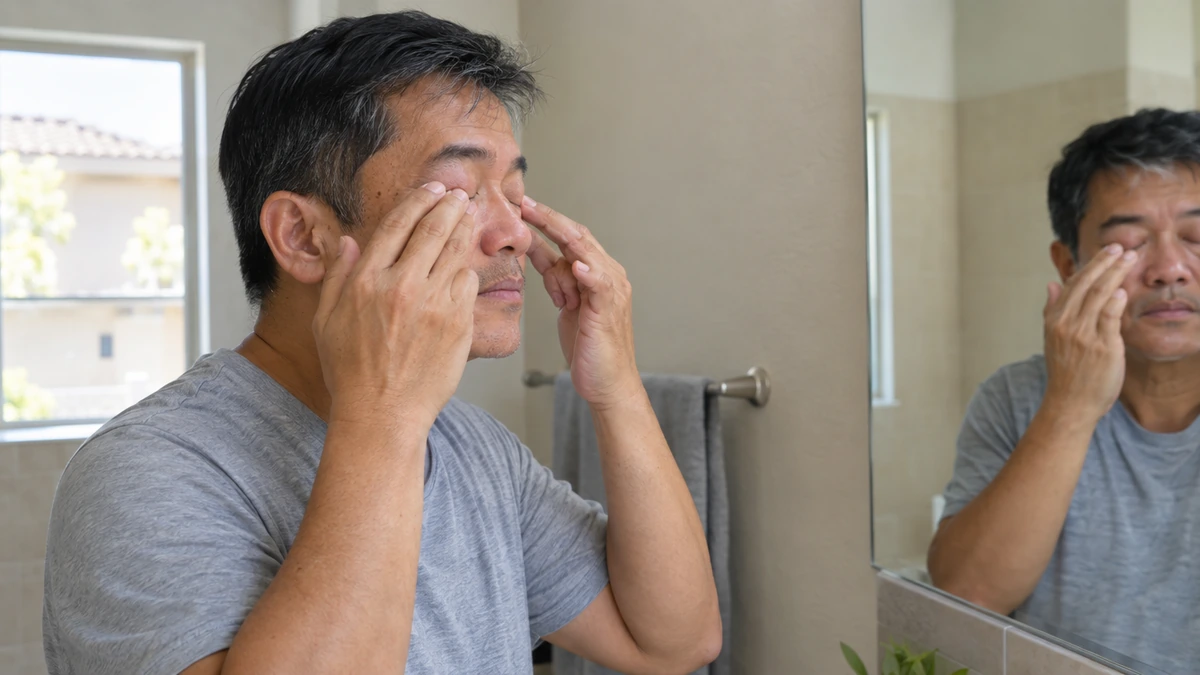
    Keep your eyelid care gentle and follow your plan.

    Warmth softens stubborn gland oil. That is the whole point of a compress. The 2017 TFOS management report includes warm compresses and eyelid hygiene in MGD care, with heat helping soften obstructed secretions in your glands. The best temperature and duration remain unsettled. More heat and harder pressure are poor substitutes for a clear routine.

    1. Review your routine at the exam. Get clear instructions for warmth, duration, cleaning and whether gentle lid massage belongs in your plan.
    2. Use gentle warmth over closed eyes. Follow the instructions for your compress and keep it comfortably warm, never hot.
    3. Keep eyelid cleaning gentle. Follow the method chosen for your lids rather than adding vigorous scrubbing.
    4. Report what happens. Note comfort, irritation and any difficulty keeping up with the routine so your plan stays workable.

    Consistency matters, but expectations matter too. A 2024 Ophthalmology and Therapy review found repeated warm compress use relieved MGD symptoms, describing its role as symptom relief rather than permanent resolution of your gland condition. The studies did not yield a single pooled estimate of benefit. Your response needs follow-up, not a promise.

    Build the routine around your actual day. A quiet stretch after work beats a rushed morning before your commute. Write down any step you find confusing and bring it to your visit. My preference is a simple routine you will follow consistently.

    Why Does Desert Air Matter When Oil Is the Problem?

    Black woman mid-blink at a bright window desk, a workday detail for a meibomian gland dysfunction history
    Your work environment belongs in the symptom history.

    Your eyelid care and your surroundings both matter. Low humidity and moving air increase evaporation and tear instability, as described in the TFOS management report cited above. Picture your desk beside an air vent or the car fan aimed at your face on the 215. Those details belong in your symptom history.

    Make the workday detail specific: gritty eyes at a Summerlin desk beneath the vent, or burning on the drive home. Record where you notice discomfort, then discuss whether the exam points to MGD, another contributor or both. For practical changes around wind and cooling, read why Las Vegas air dries out your eyes. Choose the changes that fit your home, commute and workplace, then note what happens.

    When Does MGD Need Prescription Care?

    Mild MGD and stubborn MGD get different plans. The AAPOS guidance cited above lists artificial tears, warm compresses and selected prescription antibiotic or steroid eye drops, with oral antibiotics among other options. The list describes choices, not a prescription for every person with MGD. Review what each proposed medicine is intended to address in your care.

    Keep the distinction between comfort and gland care clear. When you discuss eye drops, ask whether their role is lubrication or treatment of inflammation, and how they fit with eyelid care. Bring the bottles you already use so the conversation stays specific. Avoid building a plan by collecting products with overlapping purposes.

    You also need a way to review the plan. Record which symptoms remain, what interferes with the routine and what questions arise after you start. The broader Las Vegas dry eye treatment guide explains how treatment options fit together. Use it to prepare questions about your next step.

    When Should You Skip the Compress and Call?

    Skip tonight’s compress and call: red or painful eyes need me or another eye care provider right away, as MedlinePlus directs. Do not wait for the next compress session to decide whether to call. Describe the change when you call so it is clear why you need care.

    Your home routine belongs alongside clear instructions about changes in symptoms. Save my number with your care plan, so you never hunt for it when you are worried. My guide to when to seek dry eye care in Summerlin covers the broader triage questions. Read it before you need it.

    How I Approach Your MGD Care at Vision by Amel

    Latina woman smiling with relaxed eyes on a shaded Summerlin patio, for a meibomian gland dysfunction guide
    Your MGD plan should be clear enough to use at home.

    I am Dr. Amel Youssef, founder of Vision by Amel. My eye care plans include care for MGD and blepharitis, with warm compresses, eyelid hygiene or targeted prescription drops depending on your eyes. Your current routine gives us something concrete to discuss, from the compress you use after work to the drops you reach for before driving home. Your eye health plan should be clear enough to use at home.

    My office sits in Downtown Summerlin at Festival Plaza, 2010 Festival Plaza Dr, Suite 195. Book online or call (702) 858-4362, with no referral needed for an eye exam. My eye exam page explains the visit framework. Your questions about gland function, drops and the steps you struggle to keep up with belong in that visit.

    Frequently Asked Questions About Meibomian Gland Dysfunction

    Can MGD Be Resolved Permanently?

    Plan on long-term care, because the TFOS MGD Workshop defines MGD as a chronic condition. The 2024 review of 20 warm compress studies calls compresses symptom relief, not permanent resolution, so your plan aims at steady control you keep up for the long term.

    How Do I Explain Symptoms That Change During the Day?

    Use a concrete example from your own schedule. Describe what you were doing when discomfort started, whether it interrupted the task and what you tried next. A short account of your morning and evening gives us more to discuss than a label such as mild or severe.

    Is a Hotter Compress Better for MGD?

    No. Hotter is not better: the TFOS management report cited above warns against heating your eyelid skin above 45 °C, because extra heat risks thermal damage. Keep your cloth warm, never hot, and stop if it feels too hot on your skin.

    What If I Struggle to Keep Up With Eyelid Care?

    Tell me what gets in your way, whether it is timing, unclear instructions or an uncomfortable step. Write down which part you complete and which part you skip. That gives us a useful conversation about your routine instead of leaving you with instructions you are not using.

    Why Should I Avoid Rubbing My Eyes After a Compress?

    The TFOS management report warns that rubbing your eye while the cornea is warm risks changing its shape and blurring vision. Gentle eyelid care requires a different approach from rubbing the eye itself. Get the massage instructions clear before adding that step to your routine.

    Book My Eye Exam Call (702) 858-4362

    Like this article? Add Vision by Amel as a preferred source, and you are more likely to see our articles in Google’s Top Stories.
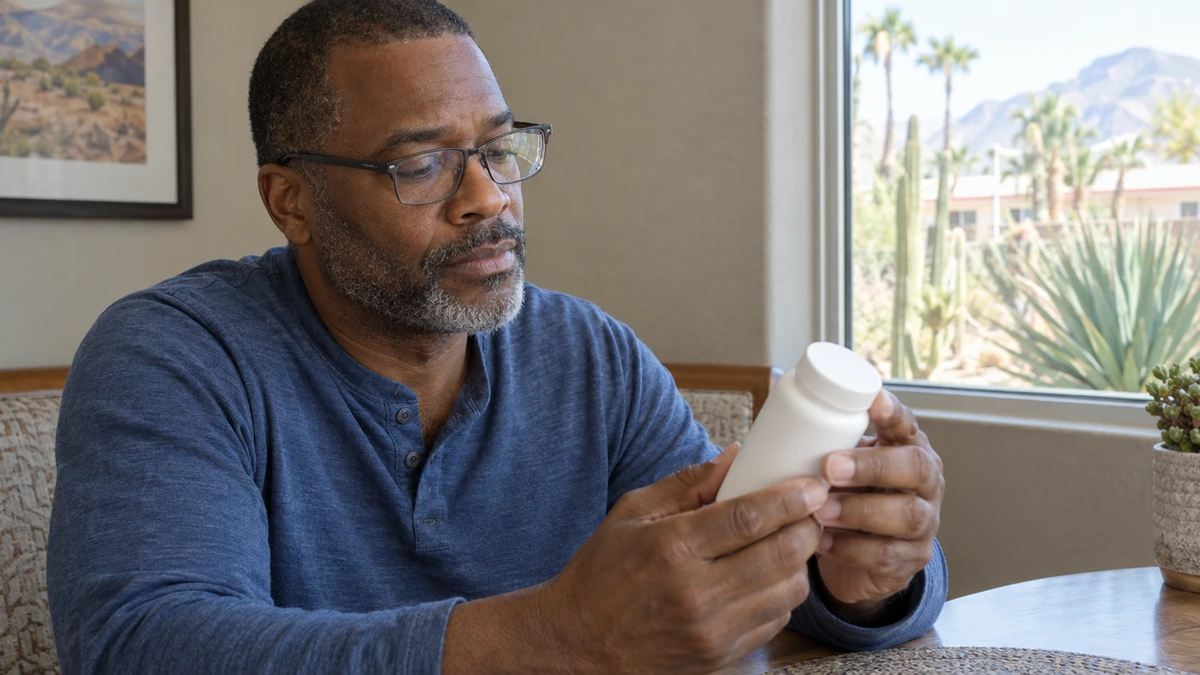
    Add as a preferred source on Google

  • How to Choose a Pediatric Eye Doctor in Las Vegas

    How to Choose a Pediatric Eye Doctor in Las Vegas

    How to Choose a Pediatric Eye Doctor in Las Vegas

    Father and daughter walking toward an optometry boutique, choosing a pediatric eye doctor

    TLDR: Choose a pediatric eye doctor who examines children your child’s age and explains the next step clearly. An optometrist offers exams and treatment within optometry’s scope, while a pediatric ophthalmologist provides specialist medical and surgical care. Match the appointment to your child’s needs.

    Answer: To choose a pediatric eye doctor in Las Vegas, check experience with your child’s age, the purpose of the eye exam, and the approach to referrals. For a failed screening, look for an optometrist or ophthalmologist experienced with children. For surgical needs or complex disease, seek pediatric ophthalmology care.

    Choose the visit that answers your child’s question. At school pickup in Summerlin, your child hands you a vision screening note before climbing into the car, and now you need to know whom to call. Start with the reason for the visit, then choose the professional equipped to address it.

    I reviewed 113 primary sources across five research lenses for this guide, and a failed screening needs follow-up even when you notice no problems. The American Academy of Pediatrics names an ophthalmologist or optometrist experienced with children for that follow-up. For your local appointment options, explore our eye exams in Downtown Summerlin.

    Which Pediatric Eye Doctor Fits Your Child’s Needs?

    Mother beside her coloring son, with laptop lid visible, considering a pediatric eye doctor
    A mother considers an appointment beside her son.

    You searched “pediatric optometrist” or “pediatric specialist” because you want someone great with kids. Good instinct. Those words describe a search, not a license, so check the degree behind the name.

    ProviderRole in Your Child’s CareWhat to Clarify Before Booking
    PediatricianChecks eyes and vision during well-child care, including screening and referral when needed, per the AAP.What did the screening show, and what follow-up was recommended?
    Optometrist, ODExamines, diagnoses, treats and manages eye diseases and disorders, as described by the American Optometric Association.Does this practice examine children your child’s age and handle the reason for this visit?
    Pediatric ophthalmologistA medical doctor with ophthalmology training and pediatric fellowship training who provides exams, glasses and medical or surgical treatment, according to the American Academy of Pediatrics.Does your child need evaluation for a complex condition or possible surgery?

    Experience deserves a direct question. Prevent Blindness notes that some optometrists focus on working with young children. For your family, confirm who will perform the examination and whether the appointment fits your child’s age and concern.

    A title tells you about training. A clear explanation tells you about care. You should understand why this appointment is appropriate before you reserve it. A useful answer names the examination, the concern it addresses and the next step if another professional is needed.

    What Should Your Child’s Eye Exam Include?

    Grandfather beside his grandson in an exam chair, an eye doctor seen from behind
    A grandfather stays beside his grandson in the exam room.

    Know what you are booking. A screening sorts. A comprehensive eye exam diagnoses. Your confirmation should name which one your child gets.

    Your examination has a defined scope: the Nevada Legislature defines a comprehensive examination as an in-person examination including history, eye alignment, visual acuity, pupils and examinations of the front and back of the eyes. When comparing appointments, ask how your child’s visit addresses those areas. Unfamiliar terms deserve plain answers before you agree to the plan.

    The screening note gives you a useful first question: what needs checking? You do not need to translate its abbreviations before calling my team. Our guide to school vision screening and comprehensive exams explains the distinction in more detail.

    Your child’s comfort belongs in the conversation, too. Describe worries about unfamiliar equipment, communication needs or a previous difficult visit. Tell my team what made the earlier visit difficult so we discuss your concerns before you arrive.

    When Does Your Child Need a Pediatric Ophthalmologist?

    Eye muscle surgery belongs to ophthalmology. Nevada law bars optometrists from any procedure that cuts tissue, so when your child’s misaligned eyes need surgery, I refer you to a pediatric ophthalmologist and coordinate your child’s care around it. You should know who handles the surgical assessment and where your follow-up belongs.

    A premature baby or a family history of childhood eye disease changes who should examine your baby first, and my baby eye exam guide lists those histories. Lead with that history when arranging care. A family concern belongs in the first conversation, even when you do not know its medical name.

    An eye that crosses all the time needs an eye exam right away, at any age, and AAPOS sends constant crossing to a pediatric ophthalmologist. Describe whether your child’s eye turns constantly or comes and goes when you call. Use those observations to explain the concern, without trying to name the condition yourself.

    A referral should leave you with clear instructions. My explanation should name the reason, the recommended timing and the service you need to contact. For complex disease, bring any existing diagnosis and treatment plan into that conversation so the next appointment addresses the actual problem.

    What Should You Ask a Pediatric Eye Doctor?

    Mother holding her daughter's hand while asking questions at an optometry front desk
    A mother asks questions while her daughter holds her hand.

    Skip “Do you see kids?” Every office says yes. These questions tell you how your child’s visit will go.

    1. Does this office examine children my child’s age for this concern? Give the age and reason for the visit together.
    2. Who will examine my child, and what is their training and experience with children? Listen for the name and qualification.
    3. Is this a comprehensive examination or a visit for a particular eye concern? Match the answer to your screening note or referral.
    4. How should I explain my child’s communication or sensory needs? Describe what helps your child understand a new situation.
    5. How will I get referral instructions if another service is needed? The answer should cover the reason, timing and next contact.
    6. Which insurance details and previous records do you need? Have the relevant information beside you while you call.

    Listen for a specific answer. “We see children” answers less than a discussion of your child’s age, history and reason for coming. Keep your school report or previous prescription in front of you during the call so the details stay accurate.

    Leave with the result and the next step. Before you leave my exam room, I want you to understand the findings and the follow-up plan. Write down what you need to do, who to contact and when to return.

    How Do You Compare Appointment Options?

    Fit first, then the drive. A Sunday slot after soccer at a Summerlin park means nothing if the visit cannot answer your child’s real question. While your child packs dusty cleats beside the field, settle what the appointment needs to accomplish before checking the route.

    Use the same details for each call. Give your child’s age, the concern and any existing referral, then record the answers together. This keeps a routine examination and a specialist consultation from looking interchangeable because both appear in the same search.

    Consider what happens after the visit. Ask how you would request an explanation of findings or send a question about the plan. For your child who already wears prescription glasses or has an amblyopia treatment plan, bring the current instructions and clarify which earlier records the receiving practice wants.

    Your child also deserves a simple explanation of where you are going. Keep it factual, and let the team explain any unfamiliar examination steps. Our first eye exam guide for Summerlin families covers preparation, so you do not have to work it out during the drive.

    How I Approach Your Child’s Eye Care

    Mexican-American family of four smiling outside an optometry office in desert sunlight
    A family leaves an optometry office together.

    I am Dr. Amel Youssef, OD, founder and optometrist at Vision by Amel. My practice offers pediatric eye care, and I see families from Summerlin every week. At Vision by Amel, you get an optometrist who explains every finding, a team that verifies your benefits by phone before the visit, and a clear plan, including a referral when your child needs one.

    My examination process moves from patient history through digital diagnostics, my evaluation and your plan. Every visit runs on Visionix digital diagnostics, and I review the findings with you myself, in plain language. I check how both eyes work together, test color vision where your child needs it, and screen for eye disease before we set your child’s plan. Your questions about eye health belong in that discussion.

    Saturday at Festival Plaza looks like this: your child beside you, the screening note in your bag, the visit already booked. You will find us at 2010 Festival Plaza Dr, Suite 195, Las Vegas, NV 89135, in Downtown Summerlin at Festival Plaza. We are open Monday to Saturday, 9 am to 6 pm, and Sunday, 11 am to 5 pm. Book online or call (702) 858-4362 to arrange your pediatric eye exam.

    Frequently Asked Questions About Choosing a Pediatric Eye Doctor

    Should My Child See an Optometrist, a Pediatric Ophthalmologist or the Pediatrician?

    Your pediatrician screens for vision problems during well-child care. After a failed screening, the AAP recommends follow-up with an optometrist or ophthalmologist experienced with children, even when you notice no problems. Both examine and diagnose eye conditions, while eye muscle surgery belongs to ophthalmology. Take the screening result to the appointment so the finding that prompted it gets addressed.

    What Is the Difference Between a Pediatric Optometrist and a Pediatric Ophthalmologist?

    Prevent Blindness describes some optometrists as focusing on work with young children. A pediatric ophthalmologist is a medical and surgical eye doctor whose training, according to the AAP, includes at least 4 years of medical school, 1 year of internship, at least 3 years of ophthalmology residency and at least 1 year of pediatric fellowship. For your child, choose by the care needed and the provider’s experience with that age and concern.

    Can an Optometrist Treat My Child’s Eye Infection?

    Yes, treating eye infections falls within Nevada optometry’s scope. Nevada law includes prescribing medication to treat an abnormality of the eye. Your child’s examination determines the diagnosis and appropriate treatment, so describe the symptoms when arranging care.

    Will My Child’s Optometrist Work With a Pediatric Ophthalmologist?

    When your child needs a pediatric ophthalmologist, I refer you and coordinate care around that evaluation. Co-management means I remain your home base for eye care while the ophthalmologist handles the specialty care your child needs. You always know which office books the next visit and which one answers each question.

    What Should I Check About Insurance Before Choosing an Appointment?

    My team verifies your benefits by phone before the visit, and Vision by Amel accepts plans including VSP, EyeMed and Nevada Medicaid. Your own plan determines the coverage available. Have your insurance details ready when you call. You do not need a referral to book an eye exam.

    Book My Eye Exam Call (702) 858-4362

    Like this article? Add Vision by Amel as a preferred source, and you are more likely to see our articles in Google’s Top Stories.
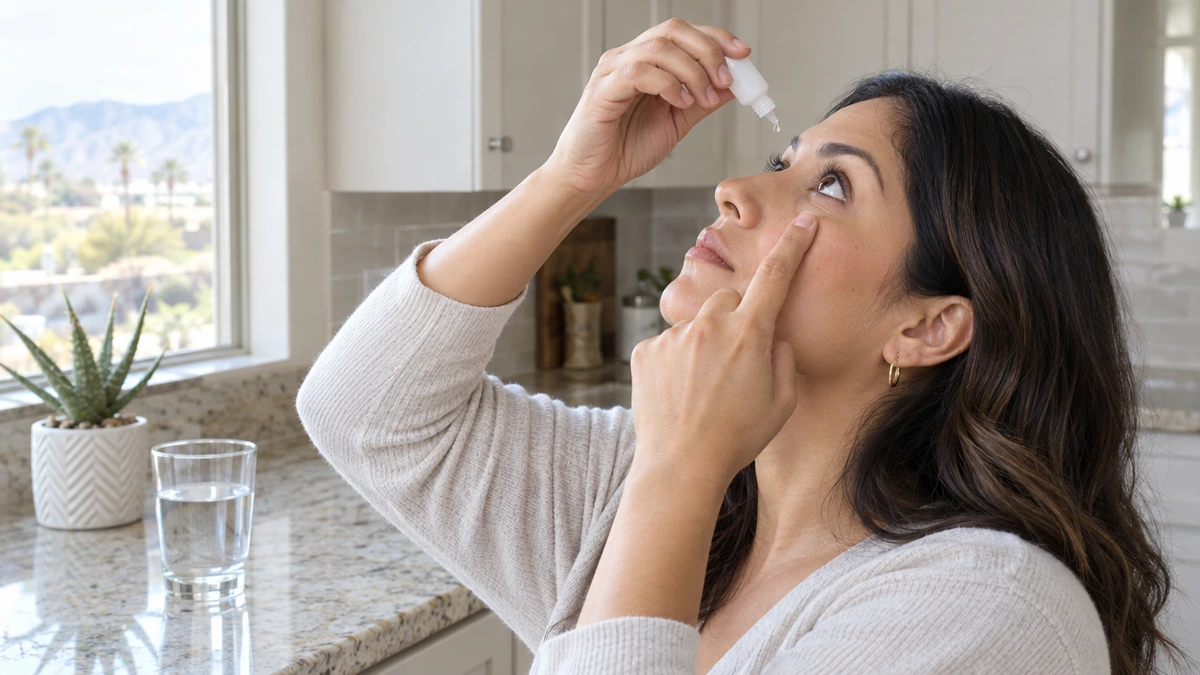
    Add as a preferred source on Google

  • How to Choose a Dry Eye Doctor in Las Vegas

    How to Choose a Dry Eye Doctor in Las Vegas

    How to Choose a Dry Eye Doctor in Las Vegas

    Woman seated across from a dry eye doctor seen from behind in a bright consultation room

    TLDR: Choose a dry eye doctor who explains your findings, treatment choices and next steps. In Las Vegas, compare the evaluation, follow-up plan and referral approach, then check your insurance benefits before booking.

    Answer: To choose a dry eye doctor in Las Vegas, look for an optometrist or ophthalmologist who evaluates your symptoms, eyelids and tears. Request a clear explanation of the findings and a plan for reviewing progress. Check how the office handles ophthalmology referrals and whether your visit will be billed to medical or vision insurance.

    You want an explanation you understand. You have tried three bottles of drops. Your eyes still burn on the drive home along the 215. My approach to treating dry eye starts with understanding what your eyes need, before choosing a product.

    I reviewed 88 primary sources across five research lenses for this guide, and a dry eye diagnosis needs more than an isolated test result. For your evaluation, the American Academy of Ophthalmology says no single test establishes the diagnosis. I value a clear explanation more than a long equipment list.

    How Do You Compare Dry Eye Doctors?

    Man with reading glasses preparing questions in a notebook for a dry eye doctor visit
    Write down what you want answered.

    Start with the care you need. For general eye care, the National Eye Institute considers either an optometrist or ophthalmologist a good option, with ophthalmologists offering additional treatments such as surgery for serious eye problems. Both professions examine eyes and prescribe medicines within their scope of practice.

    You might search for a “dry eye specialist” or “dry eye clinic” when ordinary drops have disappointed you. A search hands you names. The first visit shows you who explains, who listens and who plans ahead. On that call, find out what the evaluation covers, who explains your results and what happens when you need more care.

    One call tells you a lot. Say why you want an eye exam and what you have already tried. Then listen: does the office ask about your symptoms, or only about your insurance?

    Compare explanations as well as availability. Write down what you want answered before you arrive. Afterward, consider whether the explanations made sense, whether you had time for questions and whether you felt rushed. Choose someone you feel able to work with.

    What Should a Dry Eye Doctor Evaluate?

    Woman seated at a slit lamp with a dry eye doctor visible only from behind
    Discuss what the examination shows.

    Your daily symptoms should guide the evaluation. The American Optometric Association describes a workup covering symptoms, general health, medications and environment, along with examination of the lids, blinking, cornea and tear quantity and quality. Bring the names of your medicines and eye drops, plus notes about what you have already tried.

    Make those notes specific. Describe what happens during your afternoon computer work in Summerlin or after a long shift under hospital air conditioning. Include when the problem began and what interrupts your day. A brief account in your own words is more useful than a collection of search results.

    Use this table to prepare your questions. It turns broad examination terms into points to discuss during the visit. The key question is how those findings fit together for you.

    Part of the EvaluationWhat to DiscussA Useful Question
    Symptom and health historyYour symptoms, medicines, general health and environmentWhich details in my history matter here?
    Eyelids and blinkingLid structure and how your eyes blinkWhat did you notice about my lids?
    Magnified examinationThe lids and ocular surface, including the corneaWhat did the close examination show?
    Tear assessmentTear quantity and qualityHow do these findings explain my symptoms?

    A comprehensive eye exam should leave you understanding why a test matters. The 2017 TFOS DEWS II report explains that symptoms plus a positive tear film test support diagnosis without the full test battery, while negative available tests sometimes require referral for further testing. Each proposed test needs a reason tied to your care: what would its result change?

    Which Questions Make the Visit More Useful?

    Leave with a plan you understand. Keep your questions on paper so nothing important gets lost in the conversation. Work through them in this order, beginning with the findings and ending with follow-up.

    1. Start with the explanation: “What did you find, and how does it relate to what I feel?”
    2. Clarify the first step: “Why are you recommending this option for my eyes?”
    3. Discuss practical use: “How do I fit the plan into my workday, and what problems should I report?”
    4. Set the review: “When should we assess progress, and what should I track until then?”
    5. Establish the referral plan: “What findings would mean I need an ophthalmologist?”

    Your questions should include treatment you found online. For example, ask why artificial tears, warm compresses or prescription eye drops belong in your proposed plan. My guide to treating dry eyes in Las Vegas explains the options in more detail. Name the specific option you want to discuss.

    Be candid about what feels manageable. Tell me when a proposed routine conflicts with your work schedule or when an instruction is unclear. Repeat the plan back in your own words and request clarification where needed. I consider a plan unfinished until you understand the next step.

    When Should You Seek Care or an Ophthalmology Referral?

    Stop comparing offices the moment your eyes turn red or painful, and contact an eye care provider right away, as MedlinePlus advises. Put the provider comparison aside while you seek care. My guide to when to seek care for dry eyes covers the broader warning signs.

    I refer you to an ophthalmologist when your eyes need one. The AAO dry eye guideline calls for ophthalmologist evaluation for moderate or severe pain, lack of response to treatment, corneal infiltration or ulceration, progressive conjunctival scarring, or vision loss. Referral belongs in the discussion when choosing ongoing care.

    Before leaving a visit with a referral, establish the next step. Confirm whom you should contact, how soon you should be seen and which records to bring. Before you leave, clarify how to follow your current treatment while waiting. Keep the referral details with your care plan.

    What Should You Check About Insurance Before Booking?

    Couple reviewing a plain folder at a boutique front desk before a dry eye doctor visit
    Keep your appointment questions together.

    Know how your visit will be billed before you arrive. The American Optometric Association tells optometrists to say it up front: care for an eye complaint is billed to your medical plan, not your vision plan. Payment still depends on your plan, deductible, network and medical necessity. Describe your symptoms when booking so the office understands what care you are seeking.

    Keep both insurance cards handy. Ask your insurer whether the provider is in network for the medical visit and which benefits apply. Confirm whether your plan requires a referral or authorization. Write down the answer and the date of your call.

    Your question to the office should be specific. Say, “I am booking for persistent eye discomfort and want to understand how this visit will be billed.” Confirm what the planned evaluation includes and how any separate services are billed. Settle billing on the phone, so your visit stays about your eyes.

    How I Approach Your Visit at Vision by Amel

    Man walking across a Downtown Summerlin plaza toward a boutique for a dry eye doctor visit
    A man walks across an open-air plaza in Downtown Summerlin.

    Your visit here starts with your concerns. I am Dr. Amel Youssef, an optometrist and the founder of Vision by Amel. You will find us at 2010 Festival Plaza Dr, Suite 195, Las Vegas, NV 89135, in Downtown Summerlin at Festival Plaza. Book online or call my team to arrange your visit.

    Your visit runs in four steps: your history, digital diagnostics, my evaluation and your plan. We discuss how the findings relate to the concerns you brought. Our medical eye care page introduces the care available for your eye health.

    Your dry eye treatment plan depends on your eyes. Options include artificial tears, targeted prescription drops, warm compresses and eyelid hygiene, with care for meibomian gland dysfunction and blepharitis. Punctal plugs are another option within a plan. Bring your questions about which steps fit your findings.

    My team verifies your insurance benefits by phone before the visit. Have your plan details ready when you call. You do not need a referral to book an eye exam here. We are open seven days, Monday to Saturday 9 am to 6 pm and Sunday 11 am to 5 pm, so your visit fits your week.

    Frequently Asked Questions About Choosing a Dry Eye Doctor

    Is a Nevada Optometrist Allowed to Prescribe Dry Eye Medicine?

    Yes, with the required state certificate: the Nevada Legislature includes drug treatment within optometric practice and requires a certificate for prescribing treatment drugs beyond diagnostic agents. That certificate covers the treatment drugs your plan might need, beyond the drops used for diagnosis. Ask me what the proposed medicine does and why it belongs in your plan.

    What Should I Bring From a Previous Eye Appointment?

    Request a copy of your previous findings and treatment instructions. Bring the names of products you used and your notes about the experience. Mark anything you stopped using so we discuss what happened.

    Should I See an Optometrist or an Ophthalmologist for Dry Eye?

    Either can be a good choice for your general eye care, the National Eye Institute says, and both prescribe medicines. The difference is surgery. Nevada optometry excludes procedures that cut or burn tissue, so when your eyes need surgery, an ophthalmologist takes that part of your care.

    How Do I Explain What I Want From Treatment?

    Name the activity you want to discuss, such as reading an evening newspaper or wearing your contacts through a workday. Describe what interrupts it and what you have tried. Use that specific concern to begin the discussion about treatment goals.

    How Do I Judge Whether the Visit Was a Good Fit?

    Try explaining the visit to someone at home. You should be able to describe the findings, the proposed plan and the next contact. Write down unanswered questions and request clarification before deciding how to continue care.

    Book My Eye Exam Call (702) 858-4362

    Like this article? Add Vision by Amel as a preferred source, and you are more likely to see our articles in Google’s Top Stories.

    Add as a preferred source on Google

  • Your Baby’s First Eye Exam in Las Vegas: What Parents Should Know

    Your Baby’s First Eye Exam in Las Vegas: What Parents Should Know

    Your Baby’s First Eye Exam in Las Vegas: What Parents Should Know

    A Black mother cradling her baby girl on a sofa, accompanying a baby eye exam guide.

    TLDR: Your baby’s eye care starts in the first days of life. This baby eye exam guide shows you when the first full exam fits, what it checks, and the warning signs that mean you call an eye doctor right away.

    Answer: The American Optometric Association recommends your baby’s first comprehensive eye exam between 6 and 12 months of age. Your pediatrician checks your baby’s eyes from birth with a red reflex test. In Las Vegas, call an eye doctor right away for a white pupil, an eye that turns all the time, or discharge and puffy red eyelids in a newborn.

    Your baby cannot read an eye chart, and does not need to. You bring the birth history and what you have seen at home, from the stroller walk to the 2 am feed. That is where a great first visit starts. At home in Las Vegas, you settle into a bedroom chair for that feed while a bottle warms nearby. Those quiet moments give you something specific to describe when you call.

    I reviewed 113 primary sources across five research lenses for this guide, and infant eye screening starts at birth. Start the booking conversation with your baby’s age and history. My eye examination page explains our practice’s general exam process, while this guide stays focused on infancy.

    When Should You Plan a Baby Eye Exam?

    A white father holding his infant son and a colorful toy, accompanying baby eye exam guidance.
    A father holds his infant son while moving a colorful toy.

    The American Optometric Association recommends your baby’s first comprehensive eye exam between 6 and 12 months of age, even when nothing looks wrong. Put that recommendation on your list for the next well-child visit. Include any existing screening results in the discussion.

    AAO and AAPOS instead emphasize screening from the newborn nursery, including a red reflex check, and referral for concerning findings or risk factors rather than routine comprehensive exams for every healthy child without symptoms. File your pediatrician’s screening record alongside any eye examination report. Keep both available when discussing follow-up.

    At a newborn red reflex check, a trained clinician looks for the reflection of light from inside your baby’s eyes. An abnormal red reflex needs urgent consultation, so follow the referral right away. Under the same AAO and AAPOS guidance, an ophthalmologist should examine high-risk infants, including those at risk of retinopathy of prematurity or with a family history of childhood cataract, glaucoma or retinoblastoma.

    Born early? Family history of childhood eye disease? Tell your pediatrician first, because those babies need an ophthalmologist’s exam, not a routine date. Mention any existing referral when you call an eye care office. I would rather hear your concern early than have you wait for the perfect appointment age.

    How Do You Prepare Your Baby for the Visit?

    A Vietnamese-American couple seated with their baby in a boutique waiting area before a baby eye exam.
    Parents sit together with their baby in a waiting area.

    Pack for your baby first. A diaper bag, familiar comfort item and feeding supplies belong beside the insurance card. When arranging the visit, describe your baby’s usual nap and feeding pattern and ask how much time to reserve.

    1. Share the basics. Your baby’s age and the reason for the visit help my team pick the right appointment.
    2. Gather the history. Bring birth records you already have, screening results, medication details and any referral instructions.
    3. Describe what you noticed. Note which eye, when the change began and whether it happens constantly or comes and goes.
    4. Plan the trip. Leave room in your schedule for feeding, changing and settling your baby after the drive.
    5. Write your questions. Include who will examine your baby, what the visit covers and how follow-up will be arranged.

    Share the load. On a shaded path at a Summerlin park, you push the stroller while a grandparent leans down to greet your baby. Later, compare what each of you noticed, such as whether your baby watched that familiar face. When you come together for the visit, agree on who will describe the concern and who will hold the bag.

    Skip the rehearsal. Bring your baby as they are, with the information the office requested. For an older sibling accompanying you, my guide to a child’s first visit in Summerlin offers preparation aimed at children old enough to discuss the appointment.

    What Does a Baby Eye Exam Check?

    Gloved hands holding a penlight near a smiling infant on a Latina mother's lap during a baby eye exam.
    A mother holds her infant while a penlight is held nearby.

    The AOA infant vision guide describes checks for nearsightedness, farsightedness, astigmatism, eye movement, alignment and overall eye health during your baby’s exam. Use those areas to organize your questions. Start with the concern you brought from home, then ask what the findings mean.

    Area of the ExamWhat to Ask About Your Baby
    Focusing and refractionDid the check find a focusing issue, and what happens next?
    Eye movementWhat did you observe as my baby’s eyes moved?
    AlignmentDid the eyes appear aligned during the examination?
    Overall eye healthWas anything found that needs further evaluation?
    Follow-up planWho should we see next, and when should we arrange it?

    You deserve plain English. Visual acuity, refraction, amblyopia and strabismus should each come with what it means for your baby, today. Before leaving, repeat the next step aloud so everyone has the same plan.

    Leave space for your questions in a pediatric eye exam. Write down any recommendation for prescription glasses, another examination or an ophthalmology appointment, including who will arrange it. My broader pediatric eye exam guide covers the wider picture of children’s vision as your child grows.

    Which Eye Changes Need Prompt Care?

    Call an eye doctor right away if your baby has a white or gray-white glow in the pupil, in person or in a flash photo, because it has several possible causes and some are serious, as AAPOS explains. Save the photo to show at the examination. Seek care now rather than waiting to collect more pictures.

    Discharge from your baby’s eye or puffy red eyelids means you call a doctor now, says the National Eye Institute. Say it is urgent, and skip the online booking form. Mention when the discharge or swelling began.

    Brief, on-and-off wandering is common in your baby’s first few months. Any crossing after about 4 months needs a check, and constant crossing is worrisome at any age, says AAPOS. An eye that turns all the time, at any age, needs an eye exam right away. Describe whether the eye stays turned or straightens between episodes.

    Have your baby’s tracking checked promptly if they do not follow well after 3 months, the referral threshold in AAPOS screening recommendations. Explain what you see when your baby watches a face or moving toy. That observation is a reason for assessment, not a diagnosis you need to make at home.

    Call an eye doctor right away if your baby turns away from ordinary light or squeezes both eyes shut indoors. The AOA lists extreme light sensitivity among infant warning signs, along with excessive tearing and red or crusted lids. Describe what happens in the room’s usual light when you call.

    How Do You Handle Coverage and the Next Visit?

    A Pacific Islander mother and grandmother walking with a baby in a stroller, accompanying baby eye exam guidance.
    A mother and grandmother walk beside a stroller under shade trees.

    Check benefits before the trip. Vision by Amel accepts Nevada Medicaid, and my school screening guide explains how Healthy Kids handles referrals. Have your child’s member information ready for the benefits check.

    With any plan, get specific. Confirm your baby’s enrollment, the participating provider and which benefit applies to the proposed visit. Request an explanation of your share of the bill and whether further testing needs separate approval.

    Make the next step easy to find. Store your visit summary with the pediatric records, and put any follow-up date in the calendar you share with other caregivers. Back home after a stroller walk, you should have the next appointment and contact details within reach.

    I favor a written next step over a vague instruction to watch and wait. Before leaving, make sure your plan says what to watch, whom to contact and when to return. Keep the contact details beside those instructions.

    How I Approach Your Family’s Visit at Vision by Amel

    I am Dr. Amel Youssef, founder and optometrist at Vision by Amel. Children’s eye care is central to my practice, and Summerlin families visit every week. Tell my team your baby’s age and any note from your pediatrician when you call, and we will tell you the right next step for a baby that age.

    My team verifies your benefits by phone before the visit, and we accept Nevada Medicaid along with several medical and vision plans. Benefits vary with your plan. Have your baby’s insurance details available when you call, and bring the same information to the appointment.

    You will find us at 2010 Festival Plaza Dr, Suite 195, Las Vegas, NV 89135, in Downtown Summerlin at Festival Plaza. Book online or call (702) 858-4362, seven days a week. We open Monday to Saturday, 9 am to 6 pm, and Sunday, 11 am to 5 pm.

    Picture your Sunday at Festival Plaza: the stroller is folded in the trunk, the diaper bag is on your shoulder, and your baby is ready for a feed. Leave room for that pause when you plan a routine visit. My team will give you the appointment details before you make the trip.

    Frequently Asked Questions About Baby Eye Exams

    How Do You Check a Baby’s Eyes if They Can’t Talk or Read?

    No letters are needed for your baby’s eye examination. Focus, eye movement and alignment help assess vision, alongside checks of eye health. Even before speech, the newborn red reflex check looks for reflected light from inside the eyes.

    When Should My Baby Start Following Toys With Their Eyes?

    Around three months, your baby should begin following moving objects with their eyes and reaching for things, according to the AOA. AAPOS recommends having poor tracking checked after 3 months. Note whether you see the same response to a face and a moving toy, and share those observations at the assessment.

    Why Does My Baby’s Eye Water All the Time?

    Excessive tearing can point to a blocked tear duct, according to the AOA. An assessment of your baby’s watering helps identify the cause. Discharge or puffy red eyelids means you call a doctor now, as the National Eye Institute advises.

    Should I Bring a Video of the Eye Movement?

    Bring an existing video or photo and note when you took it. Keep the original available, and tell me what you noticed when you recorded it. Describe what happened before and after the recording so our discussion includes more than a single moment.

    Does Nevada Medicaid Cover My Baby’s Eye Care?

    Vision by Amel accepts Nevada Medicaid, and my team verifies your benefits by phone before the visit. Your plan determines the benefits available for the proposed appointment. For Healthy Kids referral rules, read my guide to school screening and eye exams.

    Book My Eye Exam Call (702) 858-4362

    Like this article? Add Vision by Amel as a preferred source, and you are more likely to see our articles in Google’s Top Stories.

    Add as a preferred source on Google